
Finding the Best Mobile Trading Platforms for Options
If a stock moves past your strike, the option can be assigned — meaning you'll have to sell (in a call) or buy (in a put). Knowing the assignment probability ahead of time is key to managing risk.
Posted by
 John Clarke
Related reading
A Step-by-Step Covered Calls Example for Consistent Income
Unlock consistent income with our step-by-step covered calls example. This guide breaks down the strategy, risks, and outcomes to help you trade confidently.
Long Call and Short Put The Ultimate Synthetic Stock Guide
Unlock the power of the long call and short put strategy. This guide explains how synthetic long stock works, its benefits, risks, and how to execute it.
What is a Call Spread? A Clear Guide to Bull and Bear Spreads
What is a call spread? Discover how bull and bear spreads limit risk and sharpen your options trading strategy.
For income-focused options traders, the right tool for the job makes all the difference. You're looking for a specialized app like Strike Price, which puts real-time probability metrics and smart alerts front and center. While traditional brokerages like Robinhood and E*TRADE are great for execution, the best apps turn your phone from a simple order-entry device into a command center for managing risk.
Your Trading Command Center Is Now in Your Pocket
Trading has officially broken free from the desktop. What used to be a nice-to-have feature is now the main way most people invest, turning your smartphone into a seriously powerful, pocket-sized trading desk. This isn't just about convenience—it's about having the power to see, manage, and act on opportunities the second they pop up.
Think of it like a pilot's cockpit. The best mobile trading apps are no longer just for checking your balance or firing off a quick trade. They’ve become sophisticated dashboards, giving you the critical, real-time data you need to navigate the markets safely.
The Mobile-First Revolution in Trading
This shift is a game-changer for options sellers. If you’re running strategies like covered calls and cash-secured puts, you need to stay on top of market moves, assignment risk, and premium opportunities. Being chained to a computer just doesn't cut it anymore. And the data backs this up in a big way.
Mobile platforms aren't an afterthought—they're the main event. Over 130 million people now use mobile apps to trade stocks, a huge jump of more than 150% in less than a decade. It’s pretty clear that smartphones have become the go-to tool for individual traders.
The entire online trading market is on track to hit $16.71 billion by 2032, and mobile app design is one of the key things pushing that growth. For an income trader, this is huge. The top apps now build real-time analytics and smart alerts right into the mobile experience, letting you keep a constant eye on your probabilities and risks. You can see more stats on mobile trading's growth over at etnasoft.com.
What This Means for Your Strategy
This mobile-first world completely changes how you trade. Instead of just reacting to data you pull up every few hours, you get proactive insights that keep you a step ahead. What makes a mobile platform "good" has evolved. It’s no longer about flashy charts—it’s about getting intelligence you can actually act on.
The must-have features now include:
- Data-Driven Insights: You need access to real-time probability metrics that make the risk vs. reward of any trade crystal clear.
- Proactive Alerts: Think smart notifications that warn you when assignment risk is creeping up or flag a juicy premium opportunity you might have missed.
- A Strategic User Experience: The interface should be built for making calculated decisions, not just for encouraging you to click and trade on a whim.
At the end of the day, the best mobile platforms give you the power to run a disciplined, data-backed strategy from anywhere. They turn your phone into your most valuable trading asset.
What Every Options Income Trader Really Needs
When you're hunting for a mobile trading platform, it's easy to get sidetracked by slick designs and promises of zero-commission trades. But for a serious options income trader, that's just the price of entry. Your real needs run much deeper, centered on the tools that directly protect your capital and boost your profitability, day in and day out.
Without the right data, you're flying blind, making trades based on gut feelings instead of a real statistical edge. The goal is to graduate from a basic trading app to a genuine command center in your pocket. This isn't just about convenience; it's about having specialized, actionable intelligence that supports a repeatable, income-focused strategy.
This shows you exactly what that evolution looks like.
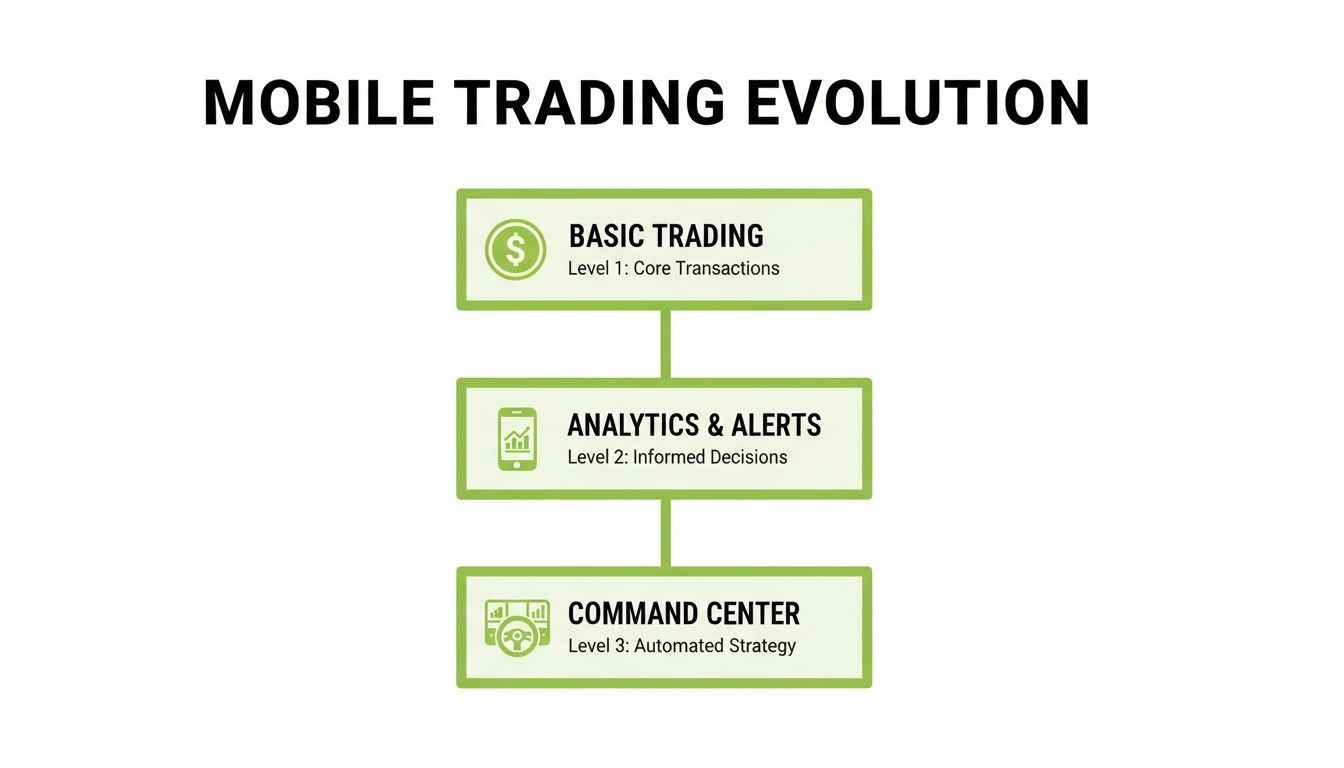
As you can see, the most powerful platforms don't just let you place trades. They arm you with the analytics and alerts you need to make truly strategic decisions.
The Non-Negotiable Feature Checklist
So, what should be on your checklist? It really boils down to three core functions that will completely change how you see and manage your trades. A generic brokerage app might show you the price of an option, but an income-focused platform tells you the story behind that price.
Think of it this way: a standard map shows you the roads, but a GPS with live traffic data tells you the best route to your destination, warning you about accidents and delays up ahead. Your trading platform should do the same for your portfolio.
Let's break down the essential features you should be looking for.
- Real-Time Probability Metrics: This is, without a doubt, the most important tool in your arsenal. You absolutely need to see the exact statistical chance of a strike price expiring worthless, calculated in real time. This metric is the bedrock of every sound income strategy, turning a subjective guess into a data-backed decision.
- Customizable Smart Alerts: Your app should be your second set of eyes. You need alerts that do more than just announce a price change. Look for notifications that warn you when a contract's assignment risk spikes or flag a new opportunity that meets your specific premium and safety criteria.
- A Unified Portfolio Dashboard: You shouldn't have to bounce between multiple screens just to get a clear picture of your positions. An effective dashboard gives you an at-a-glance view of all your open contracts, tracking their performance, decay, and risk levels in one consolidated place.
The Difference Between a Standard App and a Specialized Tool
It's one thing to list features, but it's another to see how they directly impact your trading. The gap between what standard brokerage apps offer and what income-focused sellers truly need is massive.
Here’s a quick comparison to illustrate the point.
| Feature Category | Standard Brokerage App Offers | What Income-Focused Sellers Truly Need |
|---|---|---|
| Data & Analytics | Basic price quotes, volume, and open interest. | Real-time probability of expiring worthless (OTM), helping you quantify risk vs. reward instantly. |
| Alerts & Monitoring | Simple price alerts (e.g., "Stock XYZ hit $50"). | Smart alerts for changes in assignment risk, flagging positions that need immediate attention. |
| Portfolio View | A simple list of open positions and P/L. | A consolidated dashboard tracking theta decay, performance against goals, and overall risk exposure. |
| Trade Execution | A standard options chain with bid/ask spreads. | An interactive options chain integrated with probability metrics, making strike selection faster and safer. |
This table makes it clear: generic tools give you basic information, while specialized platforms give you actionable intelligence.
Why These Features Are a Game Changer
Each of these tools serves a distinct purpose in protecting your capital and maximizing your returns. That early warning from a smart alert, for instance, can be the difference between successfully rolling a position for more premium and waking up to an unwanted stock assignment. It gives you time to react strategically instead of emotionally.
The quality of the mobile experience is no longer a secondary concern—it's the primary battleground where the best platforms compete. Over 72% of traders now prefer mobile apps to desktop platforms, marking a huge shift in how investors interact with the markets.
This trend is reshaping the entire industry. The global online trading platform market is projected to grow by nearly $6 billion between 2025 and 2032, with app-centric interfaces and embedded analytics cited as key drivers. The platforms that consistently rank highest are those that integrate powerful mobile tools like advanced options chains and risk dashboards, specifically for traders managing covered calls and secured puts on the go. You can discover more insights about these marketing trends and what they mean for traders.
Ultimately, choosing the right platform means finding a tool that fits your specific strategy like a glove. Generic features are fine for passive investing, but active income generation requires specialized instruments designed for precision and control. This checklist gives you a tangible way to assess whether a platform truly supports your goals or just offers a stripped-down version of a desktop experience.
Why Probability Is Your Strongest Trading Ally
When you sell options for income, you’re not just guessing which way a stock might go. You're stepping into a world where data and statistics give you a serious edge. The single most important number in this world is probability. It takes the mystery out of risk and turns what feels like a bet into a repeatable, strategic process.
Think of probability like a weather forecast for your trades. Knowing the statistical chance of a strike price finishing in-the-money is like knowing there's an 80% chance of rain. It doesn’t guarantee an outcome, but it lets you prepare and make a smart decision—like grabbing an umbrella—instead of just crossing your fingers.
The very best mobile trading platforms don't just flash prices at you; they crunch the numbers and calculate these probabilities in real time. This is what shifts your focus from simply chasing the biggest premium to intelligently balancing safety and income.
From Guesswork to a Data-Driven Decision
Let's walk through a quick example to see this in action. Say you want to sell a covered call on a stock you own.
A basic mobile app will show you an options chain with different strike prices and their premiums. You might see one strike offering a $50 premium and another offering $75. Without any other information, grabbing the extra money seems like a no-brainer. But this is where probability completely changes the game.
A probability-first platform adds that crucial layer of data.
- The $50 Premium: The app shows this strike has a 95% probability of expiring worthless (out-of-the-money). That’s an extremely high chance you’ll keep both your shares and the premium.
- The $75 Premium: The app reveals this one only has a 70% probability of expiring worthless. The risk of having your shares called away is much, much higher.
That single data point completely reframes the decision. The choice is no longer about just grabbing the highest payout. It's a strategic move based on your own comfort level with risk.
By focusing on probability, you are systematically aligning every trade with your personal risk comfort level. It turns a speculative guess into a calculated business decision, allowing you to build a consistent, repeatable income stream.
This approach is the bedrock of successful options selling. It helps you tune out the noise, avoid emotional decisions, and stick to a numbers-based strategy you can run from anywhere.
Making Probability Actionable on Mobile
This is where the design of a mobile platform is so critical. An app that buries probability data three menus deep is pretty much useless for a trader on the move. The best platforms put this info right where you need it, integrated directly into the options chain.
This lets you see the risk-reward tradeoff for every single trade at a glance. You can instantly filter for trades that meet your safety criteria, like only showing strikes with an 85% or higher chance of expiring worthless. To really dig into how this works, you can explore our guide on calculating the probability of profit for options.
Ultimately, when a platform gives you real-time probability data, it stops being a simple order-entry tool. It becomes your most valuable partner, helping you make smarter, safer, and more profitable decisions right from your phone. This is the one feature that truly separates a good app from a great one.
Putting Mobile Trading Tools Into Action
Knowing about cool features is one thing, but actually using them to make consistent income is what really matters. The best mobile trading platforms close that gap, turning a screen full of data into simple, clear actions you can take right from your phone. Having a solid financial insights dashboard is a huge advantage, helping you make smart calls no matter where you are.
Let’s get practical and see how real traders put these tools to work. We'll walk through two completely different scenarios to show how a good mobile app can support vastly different strategies and comfort levels with risk. The idea is to make these benefits real so you can see how to apply the same thinking to your own trades.
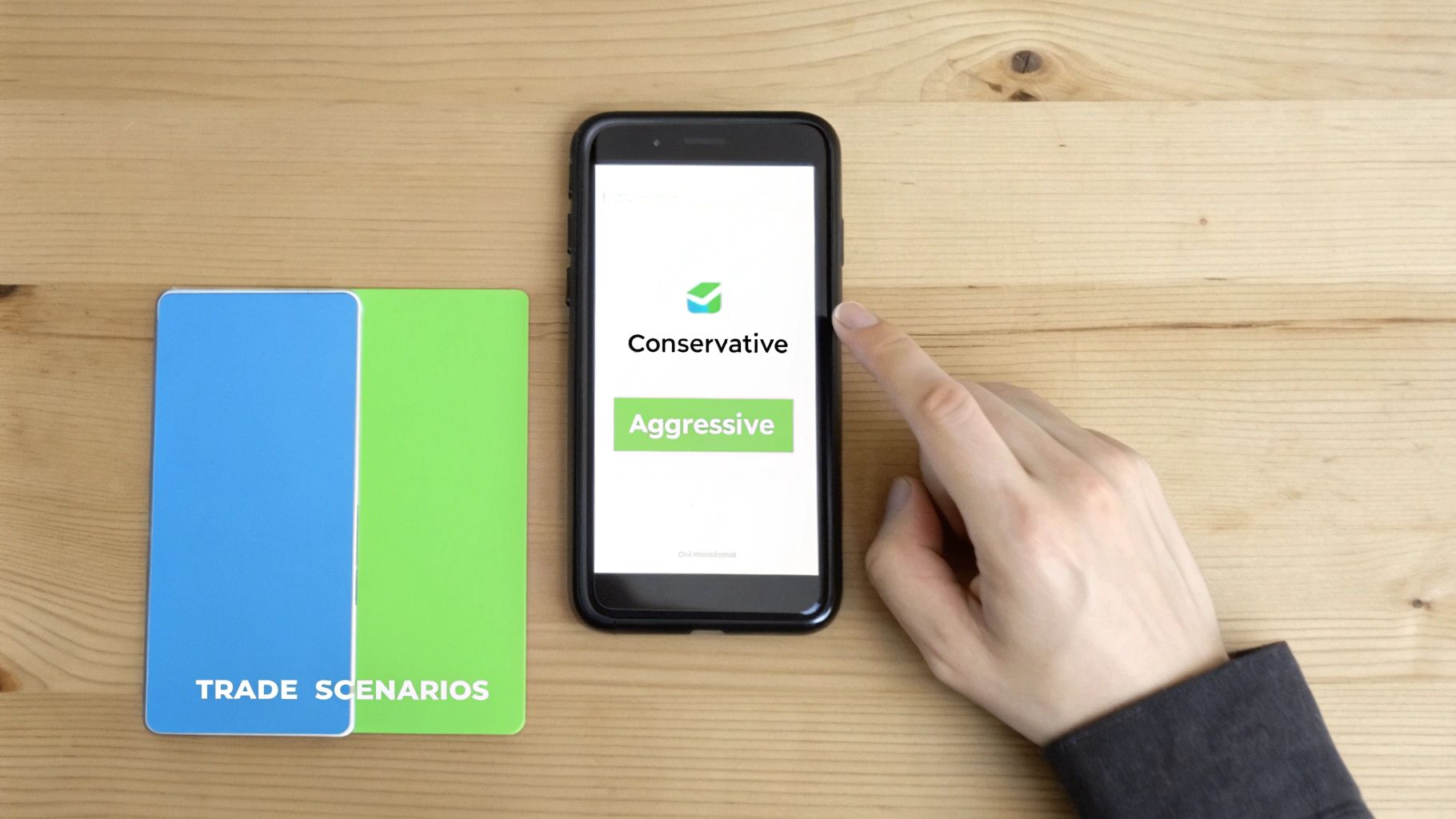
Scenario 1 The Conservative Income Seeker
First up is Alex. Alex’s number one goal is playing it safe. They want to bring in steady weekly income by selling covered calls but hate the idea of taking big risks. The main priority? Avoid having shares called away at all costs. That means finding trades with a super high chance of expiring worthless.
Here’s how Alex’s workflow looks on a specialized mobile app:
- Filter for Safety: The first thing Alex does is open the app and slap a filter on the options chain. The setting? Show only strikes with an 85% or higher probability of expiring out-of-the-money. Boom. All the riskier, lower-probability trades just disappear.
- See the Tradeoff: Now the app shows a clean, curated list of strikes. Alex can instantly see that a strike with a 92% probability of success offers a $45 premium, while an 86% probability strike offers $60. The risk-versus-reward decision is laid out in plain English.
- Set Smart Alerts: After picking the 92% probability trade, Alex sets up a proactive alert. The platform will now send a push notification if the assignment risk on that contract ever jumps above a 25% threshold. This gives Alex plenty of time to manage the position if the market makes a surprise move.
This whole process—from finding a safe trade to setting up a safety net—takes maybe two minutes on a phone. It transforms a potentially overwhelming decision into a simple, repeatable, and data-backed routine.
Scenario 2 The Aggressive Premium Maximizer
Now meet Jordan, a trader who is much more comfortable with risk. Jordan’s goal is to squeeze out as much premium income as possible and is happy to take bigger chances selling cash-secured puts to get it. This calls for a different set of tools—ones built for spotting and grabbing high-yield opportunities fast.
Here’s Jordan’s game plan using an advanced mobile platform:
- Opportunity Alerts: Jordan has alerts set up to flag stocks offering unusually high premiums compared to their normal volatility. A push notification pops up: a stock is offering a 35% annualized yield on a weekly cash-secured put.
- Target-Setting Features: Instead of just scanning the options chain, Jordan uses the app’s "Target Mode" to plug in a specific income goal for the week. The app crunches the numbers and recommends the best strike to hit that goal while balancing it with an acceptable probability of success.
- Managing the Downside: Since this is a riskier play, Jordan keeps a close eye on the app’s risk numbers. When placing the trade, it's smart to think about hidden costs. For example, knowing what slippage is in trading helps Jordan factor in the potential difference between the expected price and the fill price, which is a big deal in fast-moving markets.
The app's interface lets Jordan make a quick, informed decision based on personalized data, not just a wall of market quotes.
These two scenarios drive home a simple truth: the "best" platform is the one that molds to your trading style. It should give you the exact tools you need to play your game with confidence, whether you're focused on protecting your capital or going for aggressive growth.
Both Alex and Jordan are using the same underlying tech—real-time data and smart alerts—but they’re applying it in ways that perfectly match their personal goals. That’s the sign of a truly great mobile trading platform. It gives you the power to trade your plan, wherever you happen to be.
How AI Is Transforming Mobile Trading
Artificial intelligence is quickly turning mobile trading apps from simple data viewers into something more like an intelligent partner. When we talk about AI in this world, it’s not about letting a robot trade for you. It's about using powerful algorithms to chew through mountains of market data faster than any human ever could.
This allows the best mobile platforms to deliver personalized, actionable insights right to your phone. Think of it like a co-pilot who’s constantly watching your portfolio and the markets, only tapping you on the shoulder when something actually needs your attention. For a mobile-first trader who can’t be glued to a screen all day, this is a massive advantage.
From Passive Data to Proactive Insights
Here’s a practical example for an options seller. Say you sold a covered call that you felt was perfectly safe. Out of nowhere, an unexpected market event sends volatility through the roof. An AI-powered platform can instantly analyze this shift against historical data and see that your contract's assignment probability just jumped into a danger zone.
Instead of you having to spot this manually, the platform sends an immediate push alert. This early warning gives you the crucial time you need to take action—like rolling the position to a safer strike—long before it becomes a real problem.
This shift from passive data streams to active intelligence is where AI really shines. It turns your mobile app from a tool you have to babysit into a partner that proactively protects your interests and flags opportunities.
The growth here is undeniable. The global AI trading platform market, valued at around $11.23 billion in 2024, is on track to hit $33.45 billion by 2030. And app-based interfaces are already leading the way, showing a huge appetite for mobile, AI-enhanced tools. This trend isn't happening in a vacuum; it mirrors how SaaS companies are leveraging AI to improve their products across the board.
Your AI-Powered Trading Co-Pilot
So, what does this AI integration actually look like in a top-tier app? It's not one single feature, but a whole suite of smart tools working together. These capabilities are quickly becoming the new baseline for what defines the best mobile trading platforms.
Here are a few key AI-driven features to look for:
- Predictive Risk Alerts: The platform learns your trading style and typical risk tolerance, then notifies you when a position starts acting outside your normal safety zone.
- Opportunity Scanning: Instead of you hunting through option chains, AI algorithms can scan thousands of contracts in real-time to find the ones that meet your specific criteria for premium and probability of success.
- Personalized Insights: Forget generic market news. The app delivers insights that are actually relevant to the specific stocks and options you hold.
This level of intelligent help is taking the kind of algorithmic power once reserved for big institutions and putting it in the hands of regular traders. Some forecasts even suggest that AI-driven strategies could make up as much as 89% of global trading volume by 2025. This marriage of AI and mobile fits perfectly with the rise of app-based investing, where real-time insights aren't just a nice-to-have, they're the main event.
At the end of the day, AI makes mobile trading a more strategic and less stressful way to manage your income strategy with confidence, wherever you happen to be.
Choosing the Right Mobile Platform for You
Picking the right mobile trading platform is a big deal. It directly impacts your ability to generate consistent income, and it’s less about flashy features and more about finding a specialized tool for a specific job.
For those of us selling options, this means looking past generic brokerage apps. We need a command center built on a foundation of data-driven strategy, not guesswork. The right platform becomes your analytical partner, not just a button-pusher for placing trades.
Your Final Evaluation Checklist
When you're looking at your current app or exploring new ones, it really boils down to three core things. These are what separate the genuinely useful platforms from all the noise.
- A Deep Focus on Probability: Does the platform put real-time probability metrics front and center? You need to see the statistical chance of a strike price expiring worthless, baked right into the options chain. Every trade should be a calculated one.
- Customizable Real-Time Alerts: Does it act like a vigilant co-pilot? A great platform will send you a heads-up when assignment risk spikes or when a high-yield opportunity that fits your exact criteria pops up. This lets you manage your positions from anywhere, without being glued to your screen.
- A User Experience Built for Strategy: Is the interface designed for strategic thinking, or does it encourage impulsive clicking? The best apps give you a clean, consolidated view of your portfolio, making it simple to track your performance and manage risk at a glance.
The "best" platform for an income trader isn’t the one with the lowest fees or the slickest design. It’s the one that provides the most powerful, data-driven tools to systematically manage risk and maximize income.
Ultimately, you're looking for a tool that turns your phone into your most valuable trading asset. For a detailed comparison, you might find our breakdown of the 12 best options trading software picks for 2025 helpful, as it digs into various tools that really nail these key areas.
If your current platform makes you hunt for critical data or leaves you guessing about the true risk of a trade, it’s holding you back. By measuring your tools against this checklist—and considering how a specialized platform like Strike Price could change your results—you’re taking a big step toward more consistent, confident, and profitable trading.
Mobile Trading FAQs
Jumping into mobile trading, especially if you're an options seller focused on income, naturally brings up a few questions. Let's run through some of the most common ones I hear.
Can a Mobile App Really Replace My Desktop Setup?
For most income-focused options sellers, the answer is now a firm "yes." The best mobile trading apps aren't just scaled-down versions anymore; they pack serious power with features like real-time probability analysis, solid charting tools, and even multi-leg order entry—stuff that used to be chained to a desktop.
Sure, some traders will always prefer a big monitor for deep-dive research, and that's fine. But for the day-to-day grind of monitoring positions, managing your risk, and placing trades on the fly, a well-built mobile app is more than capable of being your primary platform.
Are Mobile Trading Apps Secure Enough for a Sizable Account?
Absolutely. Security is table stakes for any brokerage worth its salt. The top-tier mobile apps are built with multiple layers of protection to keep your money and data locked down.
You'll typically find security measures like:
- Two-Factor Authentication (2FA) to make sure it's really you logging in.
- Biometric Logins like your fingerprint or Face ID.
- Heavy-Duty Data Encryption to scramble your information and keep it private.
On top of that, accounts with US brokerages are usually covered by SIPC insurance, which adds another significant layer of protection for your capital. The key is to stick with established, regulated brokerages—they have to meet the highest security standards.
What's the Single Most Important Feature for a Covered Call Seller?
Plenty of features are nice to have, but if I had to pick just one, it’s real-time probability of expiring worthless (or probability of profit). Hands down. This one number instantly tells you the risk-reward story of a trade.
It shifts your decision from a gut feeling about where a stock might go to a clear-eyed statistical choice. You stop hoping a trade works out and start knowing the odds are stacked in your favor from the get-go.
A platform that bakes this metric right into the options chain is a game-changer. It's the core of a repeatable, successful covered call strategy, letting you systematically balance income and safety with every single trade—all from the palm of your hand.
Ready to trade smarter, not harder? See how Strike Price can transform your options income strategy with real-time probability data and proactive alerts. Start your journey to more consistent returns today.