
A Guide to the Covered Call Options Strategy for Income
If a stock moves past your strike, the option can be assigned — meaning you'll have to sell (in a call) or buy (in a put). Knowing the assignment probability ahead of time is key to managing risk.
Posted by
 John Clarke
Related reading
A Step-by-Step Covered Calls Example for Consistent Income
Unlock consistent income with our step-by-step covered calls example. This guide breaks down the strategy, risks, and outcomes to help you trade confidently.
Long Call and Short Put The Ultimate Synthetic Stock Guide
Unlock the power of the long call and short put strategy. This guide explains how synthetic long stock works, its benefits, risks, and how to execute it.
What is a Call Spread? A Clear Guide to Bull and Bear Spreads
What is a call spread? Discover how bull and bear spreads limit risk and sharpen your options trading strategy.
The covered call is one of the most reliable ways to generate steady income from stocks you already own. Think of it like being a landlord for your shares: you collect “rent” (the premium) by selling someone the right to buy your stock at a set price, within a certain timeframe. It’s a go-to strategy for investors who want to create consistent cash flow and add a small buffer against minor dips in their portfolio.
What Is a Covered Call and How Does It Generate Income?
Let's use a real-world analogy. Imagine you own a house (your stock). You can just live in it and hope it goes up in value—that's the classic buy-and-hold strategy. Or, you could rent it out. A tenant pays you rent (the option premium) for the right to use your house for a while, but you still own the property. A covered call works the exact same way with your stocks.
To get started, you need to own at least 100 shares of a stock. From there, you sell (or "write") one call option contract against those shares. This contract gives another investor the right—but not the obligation—to buy your 100 shares at a specific price, called the strike price, before a set expiration date.
The moment you sell that contract, you get paid cash, known as the premium. That money is yours to keep, no matter what happens next.
To help visualize this, here’s a quick breakdown of the moving parts.
Covered Call Strategy at a Glance
This table breaks down each component of the strategy, using our landlord analogy to make it stick.
| Component | Analogy | Role in the Strategy |
|---|---|---|
| 100 Shares of Stock | Your Rental Property | The asset you own and are "renting out." You must own the shares to "cover" the call. |
| Call Option | The Lease Agreement | The contract you sell, giving the buyer rights to your asset under specific terms. |
| Strike Price | The Agreed Sale Price | The price at which the option buyer can purchase your shares if they choose to. |
| Expiration Date | End of the Lease Term | The date the contract expires. If the option isn't used by then, it's void. |
| Premium | The Rent Check | The cash income you receive upfront for selling the call option. It's yours to keep. |
Thinking of it this way simplifies the whole process. You're just putting an asset you already own to work, turning it from a passive holding into an active source of income.
The Two Primary Goals of a Covered Call
Investors typically turn to covered calls for two big reasons. Knowing these will help you decide if the strategy is a good fit for you.
- Consistent Income Generation: This is the main draw. The premium you collect from selling calls acts like an extra dividend, paid directly into your account. It's a fantastic way to create a regular income stream from your portfolio.
- Downside Protection: While it won't save you from a market crash, the premium provides a small cushion against losses. If the stock price drops, the cash you already collected helps offset some of that decline, effectively lowering your break-even point.
A covered call strategy transforms a passive asset into an active income-producing machine. It shifts the focus from solely relying on capital appreciation to creating a steady, predictable cash flow from your portfolio.
This strategy works best when you’re neutral to slightly bullish on a stock. You’re essentially betting that the price will stay relatively flat, rise a little, or maybe even dip slightly. You're trading away the potential for lottery-ticket-style gains in exchange for a more predictable return right now.
Why It's a Popular Strategy for Retail Investors
The beautiful balance of income generation and risk management makes covered calls incredibly popular. And it's not just a hunch; the data backs it up.
In fact, one detailed academic study found that over the long term, a covered call strategy produced slightly lower monthly returns than the S&P 500 (1.106% vs. 1.187%), but it did so with significantly less volatility—about two-thirds the risk of just holding the index.
This means it delivered better performance for the amount of risk taken, which is why it has a higher Sharpe ratio. You can review the complete academic study on covered call performance to see the numbers for yourself. For investors who prefer a smoother ride over chasing explosive growth, that trade-off is more than worth it.
A Practical Walkthrough of a Covered Call Trade
Theory is great, but let's make this real. We're going to walk through a simple, practical example of a covered call trade to see how all the pieces fit together from start to finish.
Imagine you're an investor named Alex. You own 100 shares of a fictional company called "TechCorp" (ticker: TCORP), which you bought at $45 a share. That's a $4,500 investment. You’re feeling neutral to slightly bullish on TCORP for the next month—you don't see a huge rally coming, but you don't want to sell either. So, you decide to write a covered call to earn a little extra income on the shares you already own.
The Trade, Step by Step
Placing the trade is straightforward in most brokerage accounts. You’ll look for a single order type, often called "Covered Call" or "Sell to Open - Covered," that links the call you're selling to the shares you hold.
- Own at Least 100 Shares: Alex has this part covered. His 100 shares of TCORP are the "cover" for the call option he's about to sell. Without them, this would be a much riskier "naked call."
- Pick a Strike Price and Expiration: Alex pulls up the options chain for TCORP. The stock is trading at $48 a share right now. He chooses a call option with a $50 strike price that expires in 30 days. Because the strike is above the current market price, this is considered an "out-of-the-money" call.
- Sell to Open the Call: Alex places the trade to "sell to open" one TCORP $50 call contract. The going rate for this specific option is $1.50 per share.
- Collect the Cash Instantly: Since one option contract represents 100 shares, Alex immediately gets a $150 premium ($1.50 x 100 shares). That cash hits his brokerage account right away.
The whole process is pretty simple, as this image shows.
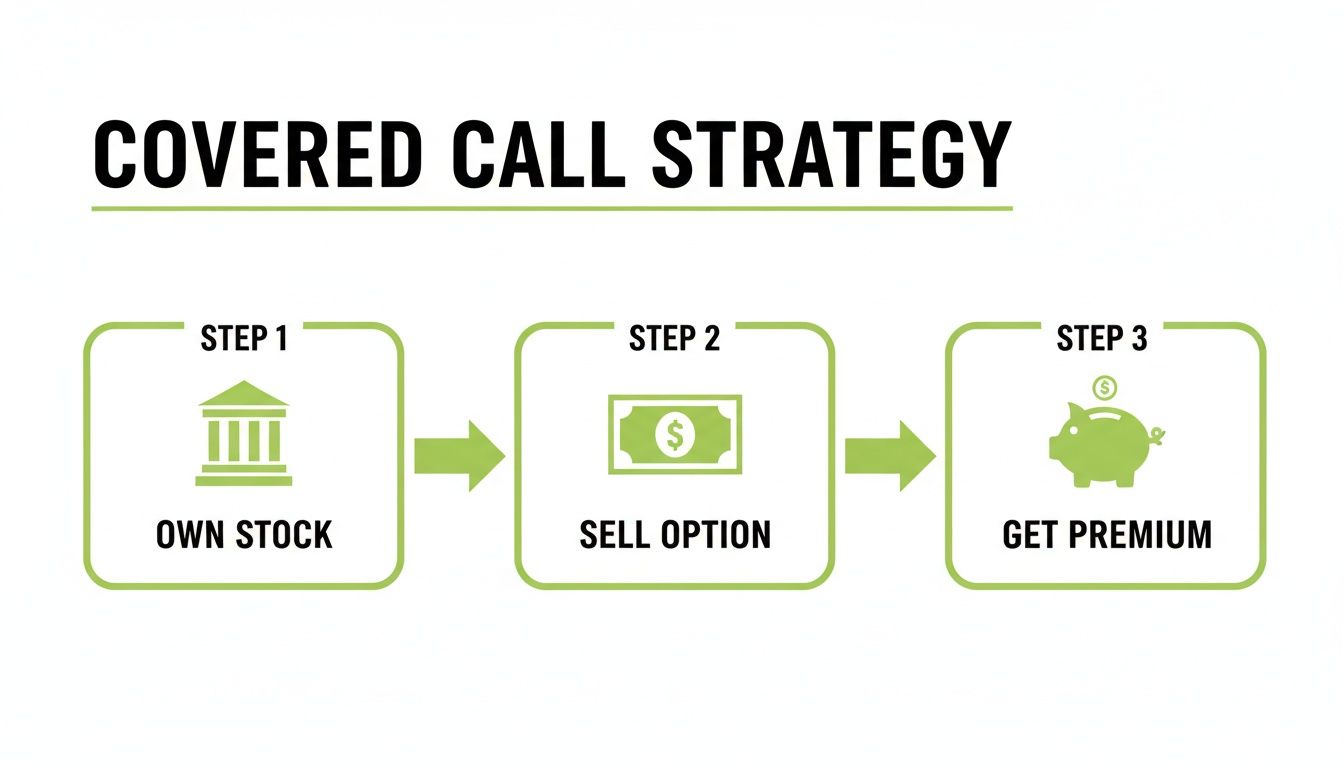
You just use the shares you already hold to sell a contract and get paid for it on the spot.
The Three Ways This Can End
Now, we fast-forward 30 days. When the option contract expires, one of three things will happen. This is where the trade plays out.
The beauty of the covered call lies in its defined outcomes. By choosing your strike price, you pre-determine your potential selling price and maximum profit, turning market uncertainty into a structured income plan.
Outcome 1: The Stock Finishes Below the Strike Price
- Scenario: TCORP closes at $49 per share on expiration day.
- Result: The call option expires worthless. The buyer has no reason to buy shares for $50 when they're cheaper on the open market.
- What Alex Does: He keeps his 100 shares of TCORP, and he also keeps the $150 premium. For an income-focused investor, this is the perfect scenario. He's now free to sell another covered call for the next month.
Outcome 2: The Stock Rises Above the Strike Price
- Scenario: TCORP has a great month and closes at $52 per share.
- Result: The option is now "in-the-money," and the buyer exercises their right to buy Alex's shares at the agreed-upon $50 price. This is called assignment.
- What Alex Does: His 100 shares are automatically sold for $50 each, bringing in $5,000. He also keeps the initial $150 premium. His total profit is $650 ($500 from the stock sale + $150 premium). The only trade-off is that he missed out on the extra gains between $50 and $52.
Outcome 3: The Stock Price Falls
- Scenario: TCORP has a rough month and drops to $46 per share.
- Result: The option expires worthless.
- What Alex Does: He keeps his 100 shares and the $150 premium. While his stock position has an unrealized loss of $200 (from $48 down to $46), that premium he collected helps cushion the blow, reducing his paper loss to just $50. The income acted as a small buffer against the drop.
Choosing the Right Strike Price and Expiration
This is where the real art and science of covered calls come together. Picking the right strike and expiration isn’t just a technical step—it’s how you dial in the trade to match your exact goals. Your decision directly controls the balance between the income you pocket and the odds of keeping your shares.
Think of it like setting the rent on an investment property. You could charge a high rent, which brings in more cash now but might make your tenant (the option buyer) eager to buy the place. Or, you could set a lower rent for a tenant who’s less likely to buy, ensuring you keep your asset while still collecting a steady check. This is the core trade-off you’ll make every single time.
The key is to know your primary objective before you even glance at an options chain. Are you trying to squeeze every last dollar of income from your shares, even if it means selling them? Or is your main goal to hang on to that stock for the long haul, while earning a little extra on the side?
Strike Price: The Income vs. Risk Dial
The strike price is the single most powerful lever you have to adjust the risk and reward of your covered call. It determines both the premium you collect and the probability of your shares being called away.
There are three main flavors of strike prices, each with its own personality.
- At-the-Money (ATM): The strike price is right around the current stock price. This is where you'll find the highest premium because there's roughly a 50/50 shot the stock will end up above it. It's the most aggressive play for pure income.
- Out-of-the-Money (OTM): The strike price is higher than where the stock is trading now. This is the more conservative path. You'll get a lower premium, but your shares have some room to climb before they're at risk of being sold.
- In-the-Money (ITM): The strike price is below the current stock price. This option pays a high premium but comes with a very high chance of assignment. Traders usually use this when they fully intend to sell their shares and just want to maximize the cash they get for doing it.
For most people focused on generating income with covered calls, the sweet spot is usually with OTM strikes. You get meaningful income while still leaving yourself a buffer for the stock to appreciate.
Using Delta as Your Probability Guide
So how do you move from just guessing to making a data-driven choice? The answer is a simple options metric called Delta. While it has a more technical definition, for a covered call seller, you can think of Delta as a simple probability shortcut.
Delta is a number between 0 and 1.0 that gives you a rough, real-time estimate of the probability that an option will expire in-the-money. A call option with a 0.30 Delta, for instance, has an approximate 30% chance of finishing above its strike price at expiration.
This one number is incredibly powerful. It lets you stop guessing and start quantifying your risk.
- Want to be conservative with a low chance of selling your shares? Look for a strike with a Delta around 0.20 (a 20% chance of assignment).
- Willing to be a bit more aggressive for a higher premium? You might choose a strike with a 0.40 Delta (a 40% chance of assignment).
Platforms like Strike Price are built around this very concept, showing you clear probability metrics for every available strike. This lets you make an informed decision based on your personal comfort zone, not just a hunch.
Selecting the Right Expiration Date
Just as critical as the strike price is the expiration date. The timeframe you select affects the premium you get and how often you get to collect it.
Shorter-term options, like weeklies, benefit from rapid time decay (also known as theta). That means they lose value faster, which is great news for you as the seller. The trade-off is that they offer smaller upfront premiums compared to monthly options. For a deeper look, check out our guide on the strategic differences between weekly vs monthly options.
On the other hand, selling an option that expires in 30 or 45 days will land you a bigger chunk of cash upfront. The downside is that your shares are tied up for longer, giving you less flexibility to react if the market makes a big move. The recent explosion of 0-DTE (zero days to expiration) options has introduced an even faster rhythm, allowing traders to reset their positions daily to capture income from short-term moves.
Ultimately, your choice here comes down to style. Active traders might prefer the faster pace and higher frequency of weeklys. Investors looking for a more hands-off approach will likely gravitate toward monthlies. The goal is to match the expiration cycle to your desired level of involvement and your income targets.
Understanding the Risk and Reward Trade-Off
Let's get one thing straight: there's no such thing as a free lunch in investing. The covered call is no exception. At its core, the strategy is a simple trade-off: you give up the chance for huge, unlimited gains in exchange for a steady stream of income right now.
Getting your head around this bargain is the most important part of using covered calls. It helps you set realistic goals and decide if this is actually the right tool for the job.
The reward is immediate and easy to understand. The moment you sell that call option, cash hits your account. This premium acts like an extra dividend, boosting your returns and effectively lowering what you paid for the stock in the first place. It’s a small, consistent win that you can repeat over and over again.
But what do you give up? The main risk is opportunity cost. By agreeing to sell your shares at a set strike price, you’re putting a hard ceiling on your potential profits. If the stock suddenly takes off and soars way past your strike, you'll be watching from the sidelines. You're locked in to sell at that lower price, no matter how high the stock goes.
A Neutral to Slightly Bullish Strategy
This unique risk-reward profile makes the covered call a great strategy for when you're feeling neutral to slightly bullish on a stock. It really shines when you expect a stock to stay flat, climb a little, or even dip slightly.
In those situations, you just sit back and collect the premium while the stock does very little. That's a fantastic outcome.
This is not a strategy for when you think a stock is about to go to the moon. If you're convinced a stock is primed for a major breakout, selling a covered call is like capping your own success before it even starts. You'd be far better off just holding the shares and capturing all the upside.
The core of the covered call is accepting a defined, limited profit in exchange for receiving immediate income. You're trading the possibility of a home run for the certainty of getting on base.
For a deeper dive into the specific risks involved, you might be interested in our detailed breakdown of covered call risks.
Performance in Different Market Conditions
How well this strategy works depends entirely on the market environment. In a raging bull market, the data is pretty clear: the capped upside from selling calls usually means you'll underperform a simple buy-and-hold strategy.
But the script flips in flat or down markets. That’s where covered calls really prove their worth. One analysis looking at 27 years of data showed that in every year the S&P 500 gained 6% or more, buy-and-hold was the winner.
However, in a down year like 2022, when the S&P 500 tumbled 17%, a similar covered call index only dropped 11%. That income from the premiums provided a much-needed cushion against the fall.
Here’s a simple table to see how it all plays out.
Covered Calls vs. Buy-and-Hold in Different Markets
| Market Condition | Covered Call Performance | Buy-and-Hold Performance |
|---|---|---|
| Strong Bull Market | Tends to underperform due to the capped upside. | Captures all gains, resulting in superior performance. |
| Flat or Sideways Market | Often outperforms by generating consistent premium income. | Minimal to zero gains, relying solely on dividends. |
| Slightly Down Market | The premium income provides a cushion, reducing overall losses. | Experiences the full brunt of the stock's price decline. |
Ultimately, using covered calls is all about matching your expectations to the market. The strategy is fantastic for generating cash flow and adding a bit of a buffer during uncertain times. You just have to be okay with steady, modest gains instead of chasing those explosive home runs.
Advanced Tactics for Managing Your Covered Calls

A great covered call strategy doesn’t just end after you sell the option. The real art is in managing the trade as the market moves and expiration gets closer. This is where you shift from just placing a trade to actively steering your position toward your goal.
Your most powerful tool for this is rolling the position. You can think of it like refinancing a loan. In one single transaction, you’re closing out your current option and opening a new one with a different strike price, a later expiration date, or both.
This is how you stay in control. It lets you react to a sudden rally in the stock, a dip in the price, or just the natural decay of time value, keeping your strategy aligned with your original plan.
Understanding When and Why to Roll Your Position
Rolling isn't something you do on a whim; it's a specific move you make in response to what the stock is doing. Once you learn to spot these scenarios, you can dramatically improve your results.
There are three main reasons you’d choose to roll a covered call.
- Rolling Up and Out for More Upside: The stock took off and is now pushing past your strike price. You still think it’s got room to climb and you’d rather not sell your shares yet. By rolling, you can move to a higher strike price (rolling up) and a later expiration date (rolling out). This lets you capture more of the stock's gains while collecting a brand new premium.
- Rolling Down and Out for More Premium: The stock has dropped since you sold the call, and your original option is now far out-of-the-money and practically worthless. You can roll to a lower strike price (rolling down) and a further expiration to collect a more meaningful premium and set a more realistic target.
- Rolling Out for More Time and Income: The stock price hasn't really moved, and your option is about to expire with very little value left. You can simply roll the same strike price to a later expiration date, closing the old trade and pocketing a fresh premium for the new one.
Rolling a covered call is about staying in the driver's seat. It transforms a passive "set it and forget it" trade into a dynamic strategy that can be adjusted to maximize income, protect shares, or react to changing market sentiment.
For a deeper dive into the mechanics, our guide on how to roll over options contracts breaks it down with clear examples.
Letting Go: When Your Shares Get Called Away
Sometimes, the smartest move is to do nothing at all. If your main goal was to sell the stock at a certain price, then having your shares called away is a win. You hit your target selling price, and you got to keep the option premium as a nice bonus.
It's also a win if the option expires worthless because the stock stayed below the strike. You keep your shares, you keep the full premium, and you're free to sell another call for the next cycle. Knowing when to make a move and when to let the trade run its course is the mark of a disciplined trader.
The options world is also evolving, creating new ways to generate income. For example, strategies built around daily covered call options are changing the game. The S&P 500 Daily Covered Call Index delivered an annualized yield of 11.90% from its start through March 2024, blowing past many traditional monthly strategies. By resetting daily, these approaches can capture more upside while collecting premiums far more frequently—a major shift in the covered call landscape.
Common Mistakes to Avoid with Covered Calls
Getting a covered call strategy right is more than just picking a stock and selling an option against it. Like any skill worth learning, there are a few common pitfalls that can easily trip up traders, new and old. Knowing what they are from the start helps you build a more disciplined, repeatable process for generating income.
Avoiding these blunders is a huge part of long-term success. While we'll focus on mistakes specific to covered calls here, it never hurts to brush up on the bigger picture of common mistakes that destroy portfolios.
Writing Calls on the Wrong Stocks
This is easily the biggest mistake I see. People write calls on stocks they wouldn't be caught dead owning for the long haul. If you wouldn't buy the stock today on its own merits, you have no business selling a covered call on it. The entire strategy is built on a foundation of owning quality shares you believe in.
A close cousin to this error is chasing the highest premiums. Sure, volatile stocks offer some juicy-looking payouts, but that fat premium is there for a reason—it’s compensation for taking on a ton of risk. Those stocks can drop like a rock, and the little bit of premium you collected won't do much to soften the blow of a major capital loss.
The cardinal rule of covered calls is simple: only write calls on stocks you would be comfortable holding in your portfolio even if the option trade didn't exist. The premium is a bonus, not the primary reason for ownership.
Neglecting Your Exit Plan
Jumping into a trade without a clear exit plan is like setting off on a road trip with no map and half a tank of gas. You have to know what you’ll do before you sell the call. What's your game plan if the stock blows past your strike price? What if it tanks?
Your plan should map out your decisions ahead of time:
- When to Roll: What conditions will trigger you to roll the option up, down, or out in time?
- When to Let Go: What's your target profit for letting the shares get called away?
- When to Take Profits: Will you buy back the call to lock in a gain if it loses most of its value early?
Having this plan in place takes emotion out of the equation when things get hectic.
Ignoring Dividends and Volatility
Two critical details many investors gloss over are dividends and implied volatility. First, if your stock pays a dividend, a savvy option buyer might exercise their call early to capture that payout, especially if the option is deep in-the-money. Suddenly, your shares are gone when you weren't expecting it.
Second, selling calls when implied volatility (IV) is in the gutter means you're collecting pennies in premium. The best time to be a seller is when IV is high, because that’s what inflates option prices. Selling into low volatility is like working for minimum wage—you’re taking on all the risk of capped upside for barely any reward.
Always check a stock’s IV rank or percentile before you place a trade. It’s the only way to know if you're getting paid fairly for the risk you're taking on.
A Few Common Questions About Covered Calls
As you get comfortable with the idea of covered calls, some practical questions are bound to pop up. Let's walk through a few of the most common ones to help you build confidence before placing your first trade.
What Kind of Stock Is Best for Covered Calls?
The best stocks for covered calls are the ones you’d be happy to own for the long haul, even if you weren't collecting a premium. Think stable, blue-chip companies with plenty of trading volume—that liquidity is key when you need to manage your position.
It can be tempting to chase the huge premiums on volatile stocks, but resist the urge. That high premium is just your compensation for taking on a massive risk. If the stock tanks, that small bit of income won't come close to covering your losses on the shares. Remember, the goal here is steady income, not a lottery ticket.
Can I Lose Money with This Strategy?
Yes, you can absolutely lose money. It's a common misconception that this is a "no-lose" strategy. The premium you collect acts as a small cushion, but it doesn't make you bulletproof if the stock's price falls off a cliff.
If the stock drops hard, your losses on the shares can easily wipe out the income you made from the call. This is why the first rule of covered calls is critical: only run this play on stocks you believe in for the long term.
A covered call doesn't eliminate the risk of owning a stock. It just trades away some of your potential upside for immediate income. Your primary risk shifts from a market drop to missing out on a massive rally.
What Happens If My Shares Are Called Away?
If the stock price closes above your strike price when the option expires, your shares are automatically sold at that strike price. This is called assignment. The cash from selling the shares, plus the original premium you collected, simply lands in your account.
Getting assigned isn't always a bad thing! If your plan was to sell the stock at a certain price anyway, a covered call just helped you hit your target and get paid a little extra for your patience. It's a win-win.
How Is the Income from Covered Calls Taxed?
Tax rules can get complicated and vary depending on where you live, so it’s always a good idea to talk to a tax professional. But generally speaking, the premium you collect is treated as a short-term capital gain.
If your shares get called away, the profit or loss on the stock itself is figured out based on what you originally paid for it versus the strike price you sold it for.
Getting these key points straight helps bridge the gap between theory and real-world trading. It ensures you’re going in with a clear view of both the rewards and the risks.
Ready to stop guessing and start making data-driven decisions with your covered call strategy? Strike Price gives you the real-time probability metrics and smart alerts you need to maximize your income while managing risk. Join thousands of investors who are turning uncertainty into a predictable income stream. Start your free trial at strikeprice.app today!