
A Trader's Guide to the Poor Man Covered Call
If a stock moves past your strike, the option can be assigned — meaning you'll have to sell (in a call) or buy (in a put). Knowing the assignment probability ahead of time is key to managing risk.
Posted by
 John Clarke
Related reading
A Step-by-Step Covered Calls Example for Consistent Income
Unlock consistent income with our step-by-step covered calls example. This guide breaks down the strategy, risks, and outcomes to help you trade confidently.
Long Call and Short Put The Ultimate Synthetic Stock Guide
Unlock the power of the long call and short put strategy. This guide explains how synthetic long stock works, its benefits, risks, and how to execute it.
What is a Call Spread? A Clear Guide to Bull and Bear Spreads
What is a call spread? Discover how bull and bear spreads limit risk and sharpen your options trading strategy.
A Poor Man's Covered Call (PMCC) is a clever options strategy that lets you act like you own 100 shares of a stock—and collect income on it—for a tiny fraction of the cost.
Think of it this way: instead of buying the stock outright, you buy a long-term, deep in-the-money call option, often called a LEAPS. This LEAPS acts as your stand-in for the shares. Then, you turn around and sell shorter-term call options against it, week after week or month after month, to generate a steady stream of cash.
The result is a strategy with a risk and reward profile that looks a lot like a traditional covered call, but without the massive capital commitment.
Unlocking Income with Less Capital

Here's an analogy. Imagine you want to earn rental income from a house, but you can't afford the down payment. The PMCC is like getting a long-term lease on that house (your LEAPS option), which gives you control over the property. Then, you sublet a room to a tenant on a month-to-month basis (selling the short-term call) to collect rent.
This strategy, also known as a figure-eight or long-call diagonal debit spread, is perfect for traders who are bullish on a stock for the long haul but want to generate consistent cash flow while they wait. The main draw is its powerful leverage.
Why Choose a PMCC?
The advantages of running a PMCC over a standard covered call are pretty clear:
- Less Capital Needed: You get exposure to an expensive stock for a fraction of what it would cost to buy 100 shares. This frees up your cash for other trades.
- Higher Return on Capital (ROC): Because your initial investment is so much smaller, the percentage return you can make is often significantly higher than with a traditional covered call.
- Defined Risk: Your maximum loss is capped at the net amount you paid to open the trade. You can't lose more than what you put in, which isn't true when you own the stock itself.
But let's be realistic—this isn't a magic bullet for guaranteed profits. The PMCC behaves a lot like a standard covered call, and historical data on those strategies is mixed. For example, one analysis comparing Invesco’s covered call ETF (PBP) to the S&P 500 ETF (SPY) showed PBP underperformed SPY by almost six percentage points annually over a 17-year period.
In flat or rising markets, these strategies cap your upside, which can cause you to lag the market over time. You can learn more about how covered call strategies perform in different market conditions.
The PMCC is an active strategy that requires more hands-on management than just buying shares and selling calls. Before you dive in, it’s critical to have a solid grasp of how a standard covered call works. Check out our detailed guide on the definition of a covered call to build that foundation. It'll help you understand the nuances of using a LEAPS as a stock substitute and get you ready to manage the trade like a pro.
How to Build Your First PMCC Position
Ready to move from theory to practice? Building your first poor man’s covered call is a logical, three-step process that turns an idea into a real trade. We'll walk through each piece, from picking the right stock to setting up the options for the best chance of success.
Think of it like building a custom car. You need a solid, reliable chassis (the stock), a powerful engine built for the long haul (the LEAPS option), and a way to generate cash flow along the journey (the short call). Every part has to be chosen carefully to make sure the whole thing runs smoothly.
Step 1: Select a High-Quality Underlying Stock
The foundation of any good PMCC is the stock itself. Since you’re making a long-term bullish bet, you need to pick a company you’d be happy to "own" for a while. Trying this with volatile, speculative stocks is a recipe for stress, as your LEAPS value could swing wildly.
Instead, look for stocks with these traits:
- Stability and a Positive Trend: Find established companies with a history of steady growth or a clear upward trend. You're betting on the stock to either climb or hold its ground over the life of your LEAPS.
- High Liquidity: Stick to stocks with high daily trading volume and liquid options. This means tight bid-ask spreads, so you won’t lose money just trying to get in and out of the trade. Bad liquidity can kill an otherwise profitable position.
A poor man’s covered call won't turn a bad stock into a good one. It's a way to generate income from a quality stock you're already bullish on—but with way less capital.
Step 2: Buy the Long LEAPS Call
With your stock picked out, it's time to get your stock substitute. This is the Long-Term Equity AnticiPation Security (LEAPS)—a call option with an expiration date way out in the future. This is the "engine" of your PMCC, designed to act like you own 100 shares.
Here’s what to look for when buying your LEAPS:
- Long Expiration Date: Choose an expiration at least nine months away, but over a year is even better. This drastically reduces the impact of time decay (theta) on your long position, giving your trade plenty of time to work.
- High Delta: Aim for a LEAPS with a delta of 0.80 or higher. A delta of 0.80 means your option's price will move about $0.80 for every $1 the stock moves, making it behave like you own 80 shares. This high delta is what makes it a true stock replacement.
This deep in-the-money call gives you the bullish exposure you want without the huge cash drain of buying the shares outright.
Step 3: Sell the Short-Term Call
Now for the fun part: generating income. You’ll sell a shorter-dated, out-of-the-money call option against the LEAPS you just bought. The cash you collect from selling this call immediately lowers your total cost for the trade.
Here's what to consider for your short call:
- Expiration Date: You’ll typically sell calls with 30 to 45 days left until expiration. This is the sweet spot where time decay really kicks in, causing the option's value to melt away—which is exactly what you want as a seller.
- Strike Price: Pick a strike price above where the stock is currently trading. Many traders look for a delta around 0.30. This usually offers a good balance between collecting a decent premium and keeping the probability of assignment low. Getting comfortable with these metrics is key, and our guide on how to read option chains is a great place to start.
Once you’ve placed both trades, you can calculate your net debit. It’s just the cost of your LEAPS call minus the premium you received from the short call. That number is your total investment and your absolute maximum loss, making the PMCC a defined-risk strategy right from the start.
Walking Through a Real-World PMCC Trade
Theory is great, but seeing a Poor Man's Covered Call in action is where the concepts really click. Let's walk through a complete, hypothetical trade on a stock we all know: Microsoft (MSFT). I'll use real numbers to show you the entire process, from setting up the trade to seeing how it plays out.
Imagine MSFT is trading at $420 a share. You're bullish on the company long-term but want to generate some income while you wait for the stock to climb. A traditional covered call would mean buying 100 shares, which would tie up a whopping $42,000. Instead, let's use a PMCC to get a similar result with way less cash.
This flowchart lays out the basic game plan.
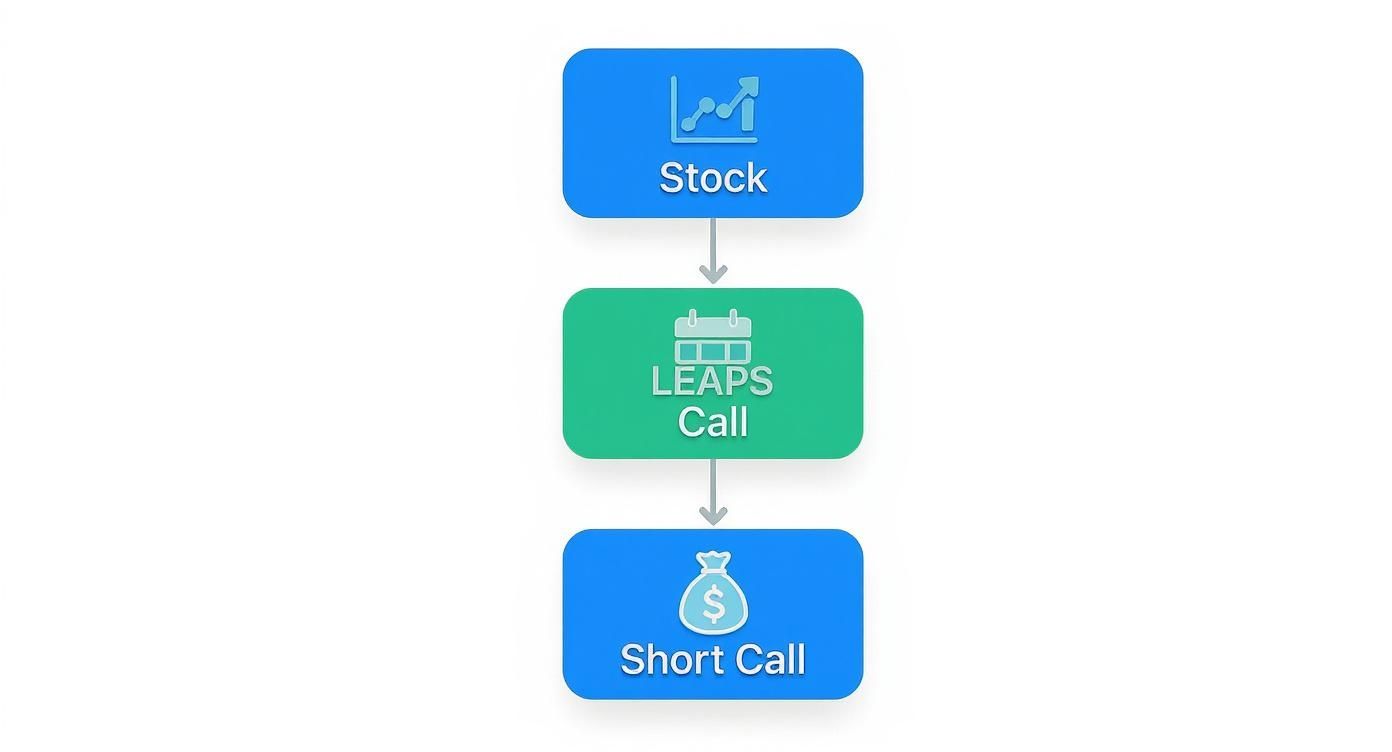
As you can see, it comes down to three core steps: pick a solid stock, buy a long-term LEAPS call to act as your "shares," and then sell a short-term call against it to bring in cash.
Setting Up the PMCC Trade on MSFT
First, we need our stock substitute—the long LEAPS call. We’re looking for one with more than a year until it expires and a high Delta, so it moves a lot like the stock itself.
- Step 1: Buy the LEAPS Call. We'll buy the MSFT $350 strike call that expires in January 2026 (well over a year from now).
- Cost: This option costs $85.00 per share, for a total of $8,500.
- Delta: The Delta is 0.85, meaning for every dollar MSFT moves, our option will move about 85 cents. It's like owning 85 shares.
Next, we sell a short-term call to generate immediate income and lower our initial cost. A good rule of thumb is to look about 30 to 45 days out.
- Step 2: Sell the Short Call. We sell the MSFT $440 strike call that expires in 45 days.
- Premium Collected: We pocket a $5.00 per share premium, which comes out to $500 in cash.
Now, let's figure out our total investment, which is called the net debit.
Net Debit Calculation:
Cost of LEAPS Call ($8,500) - Premium from Short Call ($500) = $8,000 Net Debit
Our maximum potential loss on this trade is locked in at the $8,000 we paid to open the position. That’s a massive capital savings compared to the $42,000 needed for a traditional covered call.
Exploring Potential Scenarios
So, what could happen in 45 days when our short call expires? Let's look at a few possibilities.
Scenario 1: MSFT Rises to $445
The stock rallies right past our short strike. What happens now?
- Short Call: Our $440 short call is now in-the-money. It’s worth at least $5.00 ($445 - $440), so we’d likely buy it back to close the position before assignment. The premium we collected cancels this out.
- LEAPS Call: This is where we win. Our $350 LEAPS call has shot up in value because of the stock's run. It might now be worth around $109.00 ($10,900), a gain of $2,400.
- Result: The $2,400 gain on our LEAPS more than makes up for the short call. We can now sell another short call for the next month and keep the income train rolling.
Scenario 2: MSFT Stays Flat at $420
The stock price doesn't move. Honestly, this is often the perfect outcome for a PMCC.
- Short Call: The $440 short call expires worthless since MSFT is below the strike. We keep the entire $500 premium, no strings attached.
- LEAPS Call: The LEAPS might lose a tiny bit to time decay, maybe dipping to $84.50 ($8,450). That’s a small, unrealized paper loss of $50.
- Result: Our net profit for the 45-day period is $450 ($500 premium - $50 LEAPS loss). That’s a 5.6% return on our $8,000 investment in just 45 days. Not bad at all.
Scenario 3: MSFT Falls to $400
The stock takes a dip.
- Short Call: The $440 short call expires worthless, and we keep the $500 premium. That income acts as a cushion against the stock's drop.
- LEAPS Call: Our $350 LEAPS has lost value along with the stock. It might now be worth around $68.00 ($6,800), an unrealized loss of $1,700.
- Result: Our net loss is $1,200 ($1,700 LEAPS loss - $500 premium). While nobody likes a loss, it’s still better than the $2,000 we would have lost by simply owning 100 shares.
The defensive nature of income strategies like this is backed by long-term data. Research on covered call strategies between 1996 and 2022 shows that while they might lag in roaring bull markets, they provide real downside protection. For example, in 2022, the S&P 500 fell 17%, but a buy-write strategy only dropped by about 11%. For a deeper look at similar trade setups, you might want to check out these other covered call examples.
How to Actively Manage Your PMCC Trade
Unlike buying and holding a stock, the Poor Man's Covered Call isn't a "set it and forget it" play. Think of it less like stashing away a bond and more like managing a rental property. You have to actively maintain the position to keep the income flowing and protect your initial investment.
This active management is what separates consistently profitable PMCC traders from those who get burned when the market gets choppy. Your primary tool for this is a technique called rolling. This simply means buying back your current short call and selling a new one at the same time.
The Art of Rolling Your Short Call
Rolling is how you adapt. It lets you adjust either the strike price, the expiration date, or both, in response to what the stock is doing. The goal, almost every single time, is to collect a net credit. In other words, the cash you get for the new option should be more than what you paid to close the old one.
This process—closing one "rental agreement" to open another—is the engine of the PMCC. It’s how you generate income month after month against your long LEAPS call.
You'll generally run into three main situations that call for a specific action.
Scenario 1: The Stock Rallies (Rolling Up and Out)
This is a good problem to have. The stock price has popped and is now getting close to—or has already blown past—your short call's strike. Your LEAPS call is making you money, but your short call is now at risk of being assigned.
Your move here is to roll up and out.
- Buy to Close your current short call.
- Sell to Open a new short call with a higher strike price and a later expiration date (usually the next monthly cycle).
This adjustment does two things: it locks in a bit of the profit from the stock's run-up and gives you more breathing room before the new strike is threatened. Most importantly, you should be able to do this for a net credit, adding even more cash to your position.
By rolling up and out, you’re basically saying, "The stock did what I hoped it would. I'll take a small win now and reset the trade at a higher price to keep the income train rolling."
Scenario 2: The Stock Price Stays Flat
What if the stock just drifts sideways? If your short call is losing value just like you planned, you often don’t need to do a thing until expiration week. Let time decay (theta) do its job and eat away at the option's value.
Once that short call has lost 80-90% of its value or is down to its last week, it's time to roll. You can usually roll to the same strike price for the next month, collecting another premium payment and restarting the income cycle. Easy money.
Scenario 3: The Stock Price Falls
When the stock takes a dive, your LEAPS call is going to lose value. The premium you collected from your short call acts as a buffer, but you still need to manage the position. Your short call is probably far out-of-the-money now and worth next to nothing.
In this case, you can consider rolling down and out.
- Action: Buy back your nearly worthless short call for pennies and sell a new one at a lower strike price (closer to where the stock is trading now) for a future date.
- Goal: This lets you collect a much bigger premium, which helps offset some of the unrealized loss on your long LEAPS call.
A word of caution, though: don't get too aggressive with rolling down. You want to avoid rolling your short strike below your total cost basis for the entire PMCC position, as that can lock in a loss. Sometimes, during a sharp sell-off, the best move is to simply do nothing. Wait for the stock to find its footing and recover before you sell the next call.
Understanding the Risks and Rewards of a PMCC

Every trade is a balancing act between what you stand to gain and what you stand to lose. The poor man’s covered call is no exception. While it offers a fantastic way to trade with less capital, you absolutely have to walk in with your eyes wide open to both sides of the coin. The rewards are tempting, but the risks are very real.
On the upside, the PMCC packs a powerful one-two punch for generating returns. First, you get the consistent income from selling those short-term calls against your long LEAPS option. On top of that, if the stock moves up like you planned, your LEAPS option itself gains value, giving you a nice chunk of capital appreciation.
This dual-engine approach can create a much higher return on capital (ROC) than a traditional covered call, simply because you've put so much less cash on the table to begin with.
The Major Risks You Must Manage
So, what's the catch? The single biggest danger with a PMCC is a sharp, nasty drop in the stock price. When the stock tanks, your long LEAPS call gets hammered because of its delta exposure. That little bit of premium you collected from the short call provides a small cushion, but it won’t save you from a serious downturn.
If the stock falls far enough, your LEAPS can lose value faster than you can sell calls against it, digging you into a hole. Your maximum loss is technically capped at the net debit you paid to open the trade, but losing 100% of your investment is a very real—and very painful—possibility.
It's not just about the stock's direction, either. A few other forces are always at play:
- Time Decay (Theta): Theta is a double-edged sword here. It’s your best friend on the short call, as its value decays each day. But it's your enemy on the long LEAPS, slowly eating away at its value. A well-built PMCC makes sure the short call decays faster than the long one, but it’s a constant tug-of-war.
- Volatility Risk (Vega): A sudden drop in implied volatility (IV), often called a "vega crush," can hurt your position. Your long LEAPS option is much more sensitive to IV changes than your short call. If IV collapses, your LEAPS will lose value faster than your short call does, which can create a loss even if the stock price doesn't move an inch.
A poor man's covered call is not a set-it-and-forget-it strategy. It’s an active trade. You have to watch the stock's movement, keep an eye on time decay, and be aware of shifts in volatility to protect your capital.
A Realistic Look at Performance
While the PMCC setup looks great on paper, it's critical to have realistic expectations. Research on similar covered call strategies from 2011 to 2023 shows that chasing huge yields often backfires. For example, some strategies that aimed for a 6% annual premium actually ended up with an average annualized loss of 3.1% during that time.
While these income-focused funds did a good job of lowering volatility, their risk-adjusted returns were often way lower than just owning the stock outright.
Of course, smart trading goes beyond just the mechanics of the trade. You also have to think about taxes. Learning how to improve your tax position as a share trading business can make a huge difference in your bottom line. The PMCC gives you leverage and income, but it demands your full attention and a clear understanding of its unique challenges.
Common PMCC Questions Answered
Once you get the hang of how a poor man’s covered call works, a few practical questions always seem to pop up. This isn't like just owning stock—you've got different rules to think about when it comes to taxes, retirement accounts, and the classic rookie errors. Let's tackle the big ones right now.
Getting these answers straight from the start can save you from some expensive headaches down the road. Think of this as your pre-flight checklist, making sure you know the rules of the road before you put any real money on the line.
What Are the Tax Implications of a PMCC?
Taxes on a PMCC are a bit more complicated than a simple stock trade because you're juggling two different options contracts, each with its own timeline. Nailing this down is key to figuring out your actual, take-home profit.
The two legs of the trade get taxed differently:
- The Short Call: Any money you make from selling that short-term call is almost always taxed as a short-term capital gain. That’s because you’re usually holding these contracts for just 30-45 days.
- The Long LEAPS Call: Here’s where it gets interesting. Since a LEAPS option is, by definition, a contract that expires in more than a year, it can potentially qualify for the much friendlier long-term capital gains tax rate. If you hold that LEAPS for over a year before you close it out, your profit gets taxed at the lower rate.
This creates a pretty unique tax picture. The cash you collect every month gets hit with higher taxes, but the growth of your main asset—the LEAPS—could get taxed at a much lower rate.
Key Takeaway: The PMCC is a mixed bag for taxes. Your monthly income from short calls is taxed as short-term gains, while your LEAPS call could qualify for long-term gains if held for over a year. This gives it a potential tax edge over strategies that only produce short-term profits.
It's also worth pointing out that if you run a PMCC on index options like SPX, you can get special tax treatment. Under IRS Section 1256, gains on these options are taxed using a 60/40 rule—60% long-term and 40% short-term, no matter how long you held the position.
Can You Trade a PMCC in an IRA?
Yes, you absolutely can trade a poor man’s covered call in a retirement account like an IRA. But—and this is a big but—it all comes down to your broker and the options trading level they’ve approved you for. Since a PMCC is technically a diagonal debit spread, you'll need a higher approval level than you would for basic covered calls.
Here’s what that usually looks like:
- Level 1 Approval: Just lets you buy basic calls and puts.
- Level 2 Approval: Usually adds selling covered calls and cash-secured puts.
- Level 3 Approval: This is where spreads typically come in. You'll almost certainly need at least Level 3 approval to trade a PMCC.
- Level 4 & 5 Approval: For more advanced stuff like selling naked options, which isn't what we're doing here.
Why the higher bar? Because the PMCC has two moving parts. Even though it's a defined-risk trade, brokers want to be sure you understand how to manage a spread before letting you loose, especially inside a retirement account.
What Is the Biggest Mistake Beginners Make?
The single biggest—and most expensive—mistake beginners make with the PMCC is picking the wrong LEAPS option. They either cheap out and buy one with too little time left or a delta that’s way too low.
A good PMCC works because the long LEAPS call acts like a stand-in for the actual stock. When a trader tries to cut corners on this foundation, the whole strategy just crumbles.
Here’s why it’s so destructive:
- Low Delta (Below 0.80): If your LEAPS has a low delta, it won't keep up with the stock's price movements. When the stock climbs, your LEAPS won’t gain enough value to cover the risk on your short call. This completely defeats the entire purpose of the trade.
- Not Enough Time (Less Than 9 Months): Buying a LEAPS with too little time left means time decay (theta) is working against you from day one. Your long call will bleed value so quickly that you'll find yourself fighting a losing battle, where the decay on your LEAPS eats up more than you can collect from your short calls.
This mistake almost always comes from trying to make the trade cheaper upfront. The PMCC is a capital-efficient strategy, but trying to skimp on its most critical component is a false economy. It's like building a house on a shaky foundation—it’s only a matter of time before things start to fall apart. Always prioritize a high delta and a long expiration for your LEAPS, even if it costs a bit more.
Ready to trade the Poor Man's Covered Call with confidence? Strike Price eliminates the guesswork by providing real-time probability data for every strike price, helping you find the perfect balance between income and safety. Get smart alerts on high-probability trades and manage your positions with ease. Start making data-driven decisions today at strikeprice.app.