
A Guide to the Poor Man's Covered Call
If a stock moves past your strike, the option can be assigned — meaning you'll have to sell (in a call) or buy (in a put). Knowing the assignment probability ahead of time is key to managing risk.
Posted by
 John Clarke
Related reading
A Step-by-Step Covered Calls Example for Consistent Income
Unlock consistent income with our step-by-step covered calls example. This guide breaks down the strategy, risks, and outcomes to help you trade confidently.
Long Call and Short Put The Ultimate Synthetic Stock Guide
Unlock the power of the long call and short put strategy. This guide explains how synthetic long stock works, its benefits, risks, and how to execute it.
What is a Call Spread? A Clear Guide to Bull and Bear Spreads
What is a call spread? Discover how bull and bear spreads limit risk and sharpen your options trading strategy.
If you’ve ever looked into generating income with options, you’ve probably come across the classic covered call. It’s a solid strategy, but it has one big hurdle: you need to own 100 shares of a stock for every contract you sell. That can tie up a serious amount of capital.
This is where the Poor Man's Covered Call (PMCC) comes in. Think of it as a capital-efficient workaround that delivers a similar income-generating punch without the hefty price tag.
What Is a Poor Man's Covered Call?
Let's use a real estate analogy. A traditional covered call is like buying a house outright just to rent out a single room. Sure, you collect rent, but you had to buy the entire property first. That’s a massive upfront investment.
The Poor Man's Covered Call is a much savvier approach.
Instead of buying the whole house, you secure a long-term lease on it. This is your LEAPS call option—a long-term, deep in-the-money call that gives you control over the property for a fraction of the cost. Then, you turn around and "sublet" a room month-to-month by selling short-term call options against your lease.
The "rent" you collect from selling those short-term calls is your income, which you can use to chip away at the cost of your long-term lease.
The Core Mechanics
It might sound complex, but the strategy really just has two moving parts:
The Long LEAPS Call: This is your stock substitute. You buy a deep in-the-money call option that expires far out in the future (think 9+ months). Because it's deep in-the-money, its high Delta makes it move almost like the real stock.
The Short Call: This is your cash flow engine. You sell a call option with a much closer expiration date (usually 30-45 days out) against your LEAPS. The premium you pocket from this sale is your income for the month.
The goal is simple: keep selling those short-term calls month after month. Each premium payment you collect lowers the net cost of your LEAPS, boosting your overall return on investment.
To give you a clearer picture, let's break down how the PMCC stacks up against its traditional counterpart.
Traditional vs Poor Man's Covered Call At a Glance
This table offers a side-by-side look at the two strategies, highlighting the key differences in capital, risk, and structure.
| Attribute | Traditional Covered Call | Poor Man's Covered Call (PMCC) |
|---|---|---|
| Primary Component | Own 100 shares of the underlying stock | Own a long-term, deep in-the-money LEAPS call option |
| Capital Required | High (cost of 100 shares) | Low (cost of one LEAPS option) |
| Maximum Profit | Limited (premium + price appreciation to the strike) | Limited (premium + difference between strikes) |
| Maximum Risk | Substantial (cost of shares minus premium received) | Limited to the net debit paid for the spread |
| Dividend Income | Yes, you own the shares | No, you do not own the shares |
As you can see, the PMCC is designed from the ground up to be a more accessible, capital-light version of the covered call.
Why It Works for Smaller Accounts
The biggest win here is capital efficiency. You get a risk/reward profile that's very similar to a traditional covered call, but you can get into the trade with a tiny fraction of the cash. This opens the door for traders who don't want to lock up tens of thousands of dollars in a single stock position just to generate a little income.
A PMCC can be an incredibly efficient use of capital. By replacing stock ownership with a LEAPS option, traders can achieve a similar directional exposure and income potential with a much lower initial investment, freeing up funds for other opportunities.
Just how efficient is it? According to an analysis from datadrivenoptions.com, a PMCC can require as little as 7.5% of the capital needed to own 100 shares outright, while still capturing a significant portion of the stock's upward movement. It’s a powerful way to make your trading capital work much harder for you.
How to Construct Your PMCC Position
Putting together your first Poor Man’s Covered Call is a deliberate, two-step dance. First, you buy a long-term option to stand in for the stock. Then, you sell a short-term option against it to start earning income. Nailing both parts of this setup is what separates a winning trade from a frustrating one.
Think of it like building with LEGOs. Your first piece, the LEAP option, is the big, sturdy base. The second piece, the short call, is the smaller block you snap on top to finish the structure. Let's walk through how to choose each one so you can build with confidence.
Step 1: Select the Underlying Stock
Before you even glance at an options chain, you need a solid foundation. The right stock for a PMCC is one you’re bullish or neutral on for the long haul. Remember, your LEAP is a long-term commitment, so this isn't the place for volatile, speculative moonshots that could crater overnight.
You're looking for a few key traits:
- Stability and Quality: Stick with established, blue-chip companies that have strong fundamentals. The goal here is steady, gradual growth, not hitting the jackpot.
- High Liquidity: The stock and its options need to trade a lot. High volume means tight bid-ask spreads, which saves you from losing money just on the friction of getting in and out of the position.
- Low Volatility (Implied): While high volatility means juicier premiums when you sell calls, it also makes your long LEAP way more expensive. A moderately low IV environment is often the sweet spot.
Picking the wrong stock is the fastest way to see a PMCC fail. A sudden, sharp drop in price can wipe out the value of your LEAP much faster than the premium from your short call can bail you out.
Step 2: Buy the Long LEAP Call
Once you have your stock picked out, it's time to buy your "stock substitute"—the LEAP. This is the most important decision you'll make, as the LEAP you choose dictates how the entire position will behave.
The goal is to buy an option that acts as much like 100 shares of stock as possible, but for a tiny fraction of the cost. To pull this off, your LEAP needs two specific qualities.
A Far-Out Expiration Date: Go for an expiration that’s at least 9 months away. Over a year is even better. This runway gives you plenty of time to sell shorter calls against it and keeps the daily bleed from time decay (Theta) to a minimum on your long position.
A High Delta: Choose a deep in-the-money strike that gives you a Delta of at least 0.80. A 0.80 Delta means that for every $1 the stock moves up or down, your option's value will change by about $0.80. That high sensitivity to the stock's price is what makes it such an effective proxy for owning the shares.
Key Insight: Buying a deep in-the-money LEAP means you're paying almost entirely for intrinsic value—the real, tangible value of the option if it were exercised today. You pay very little for extrinsic value (time value), which is the part that decays. This makes your LEAP a more stable, stock-like asset.
This diagram shows the basic flow of how you're using less capital to create the position.
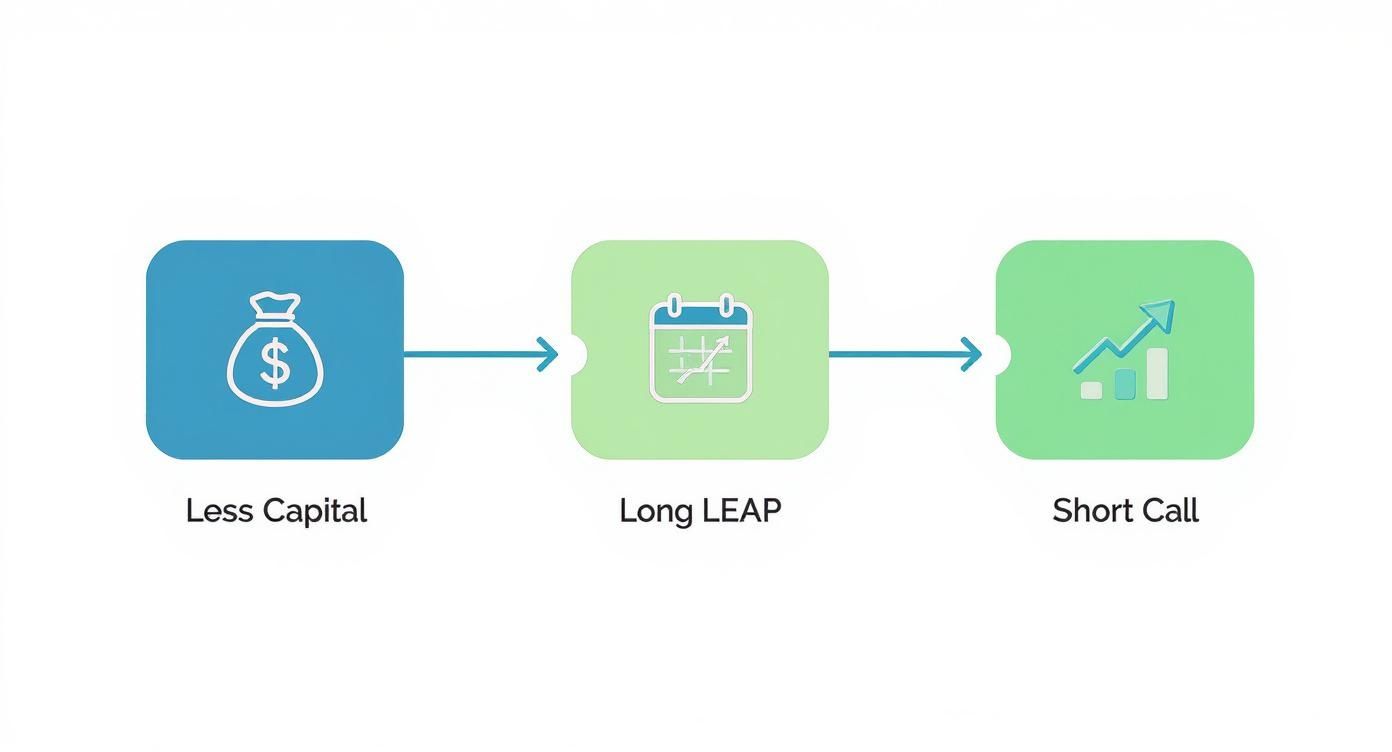
As you can see, a smaller amount of capital buys the long-term LEAP, which then acts as the collateral you need to sell a short-term call and collect income.
Step 3: Sell the Short Call
With your LEAP locked in, it's time to collect your first "paycheck." This means selling a shorter-term, out-of-the-money call option. The premium you get from this sale is your immediate income, and it instantly lowers the net cost of setting up the trade.
Here’s what to look for when picking your short call:
Expiration Date: Look for an expiration that is 30 to 45 days out. This is widely considered the sweet spot where Theta decay really accelerates, meaning the option loses its time value the fastest—which is exactly what you want as a seller.
Strike Price (and Delta): The strike you choose is a constant balancing act between income and risk. A common starting point is to sell a call with a Delta around 0.30. This usually means there's about a 70% probability that the option will expire worthless, letting you pocket the entire premium.
This is where a tool like Strike Price really helps. Instead of just guessing, you can see the real-time probability of assignment for every strike. This lets you make a data-driven choice that actually fits your risk tolerance. Selling a call with a 30% chance of being assigned might offer more premium than one with a 15% chance—and you can decide exactly which trade-off you’re comfortable with.
A Real-World PMCC Trade Example
Theory is great, but seeing a poor man's covered call in action is where it all clicks. Let's walk through a real-world example using the SPDR S&P 500 ETF (SPY) to see how the numbers play out.
Let's say SPY is currently trading at $450 per share. You're moderately bullish on the market for the next year and want to generate some monthly income, but you don't want to shell out $45,000 to buy 100 shares for a traditional covered call. This is the perfect scenario for a PMCC.
Setting Up the Trade
First, you need your stock substitute—the long-term LEAP call. The goal here is to find an option that acts almost exactly like the stock, which means looking for a distant expiration date and a high Delta.
Buy the LEAP Call: You pull up the options chain and look for a call expiring in about a year. You land on the $380 strike call. It’s deep in-the-money, has a high Delta of 0.85, and costs $80.00 per share ($8,000 for the contract).
Sell the Short Call: Now it’s time to generate that income. You look at the options expiring in 35 days and sell the $460 strike call, which is out-of-the-money. This call has a Delta of 0.30, and you pocket a $400 premium ($4.00 per share).
So, what's your total out-of-pocket cost? It's simply the cost of the LEAP minus the premium you just collected.
- Cost of LEAP: $8,000
- Premium from Short Call: -$400
- Net Debit (Total Cost): $7,600
Just like that, you've opened a PMCC on SPY for $7,600. That’s a massive capital savings compared to the $45,000 needed for a regular covered call.
Calculating Your Profit and Breakeven
With the trade in place, you can map out your potential profit and your breakeven point. The best-case scenario is for SPY to close right at your short strike price ($460) when the short call expires.
Your maximum profit is the difference between your two strike prices, minus the net debit you paid to enter the trade.
- Difference in Strikes: ($460 - $380) * 100 = $8,000
- Net Debit: $7,600
- Maximum Profit: $8,000 - $7,600 = $400
Your breakeven point is the strike price of your long LEAP plus the net cost per share you paid.
- Breakeven Price: $380 + ($7600 / 100) = $456
As long as SPY finishes above $456 at the short call's expiration, you’re in the money.
The Power of Greeks in Action
The real engine behind the PMCC is the interplay between the option "Greeks." Your long LEAP has a high Delta (0.85) but very slow time decay (Theta). On the other hand, the short call you sold has a negative Delta (-0.30) but high positive Theta decay working in your favor.
The magic of the PMCC lies in this imbalance: the Theta decay of the short call you sold actively works to pay down the cost of your long-term LEAP. You are essentially collecting "rent" (premium) that benefits from time passing, while your primary asset (the LEAP) is less affected by it.
This dynamic is what lets the strategy deliver impressive returns, sometimes even when the underlying stock barely moves. A great case study on stockspinoffinvesting.com showed a PMCC on Warner Brothers Discovery (WBD). While WBD's stock only climbed 3% over eight months, the PMCC strategy returned 31.5% by repeatedly selling calls against the LEAP.
This example shows how a PMCC can outperform a simple buy-and-hold approach by turning an asset into an active income generator. It's a powerful tool for traders looking to make their capital work harder.
Understanding and Navigating the Risks

While the poor man’s covered call offers incredible capital efficiency, it's definitely not a risk-free strategy. Like any trade, knowing what can go wrong is the first step to protecting your capital and managing the position like a pro.
Because the strategy uses a long-term option (LEAP) instead of actual stock, it comes with its own unique set of challenges. The key is to have a game plan before you enter a trade, so you're not making emotional decisions if the market moves against you.
Downside Price Movement: The Primary Risk
The biggest threat to a PMCC is a sharp, unexpected drop in the underlying stock's price. Your LEAP has a high Delta, which is great when the stock goes up, but it means the option will lose value fast when the stock falls.
The premium you collect from selling the short-term call acts as a small buffer, but a steep dive in the stock can easily wipe out that cushion and then some. If the drop is severe enough, your LEAP can lose so much value that the entire trade turns into a loss. This is where the leverage of a PMCC can cut both ways.
For example, a study comparing a PMCC on the Financial Select Sector SPDR Fund (XLF) to a traditional covered call during a downturn showed the PMCC lost $99 on an $824 investment—a 12.0% loss. The traditional covered call lost $128, but on a much larger $5,347 capital base, which was only a 2.4% loss. The smaller capital requirement of the PMCC amplifies your percentage losses when things go south.
The Challenge of Early Assignment
Another risk to keep on your radar is early assignment on your short call option. It’s less common for out-of-the-money options, but it becomes a real possibility if the stock price blows past your short strike, especially around an ex-dividend date.
If the buyer of your call exercises their right to buy the shares, your broker needs to deliver them. Since you don't actually own the stock, this creates a short stock position of 100 shares in your account. To fix this, your broker will likely exercise your long LEAP to get the shares.
While assignment sounds scary, a well-structured PMCC is built to be profitable even if this happens. Because your long LEAP's strike price is much lower than your short call's strike, exercising it to deliver the shares should still result in a net gain on the entire position.
Getting comfortable with the mechanics of a short call option is the best way to demystify the assignment process and handle it without panicking. The goal is to make sure the spread between your strikes is wide enough to more than cover your initial cost.
Whipsaw Price Action
A "whipsaw" market—where the stock price swings aggressively up and down—can also cause headaches. A sudden rally can send the stock flying past your short call strike, putting it deep in-the-money and cranking up the assignment risk.
This forces you to make a choice:
- Roll the option: Close the threatened short call and open a new one at a higher strike price for a later date, ideally for a net credit.
- Close the position: Bail out of the entire trade to lock in a small profit or cut your losses before they grow.
- Do nothing: Wait it out and hope the stock pulls back, but this means accepting the risk of being assigned.
These scenarios require you to actively monitor your positions. Sudden price moves can change the game in an instant, requiring quick adjustments to protect your LEAP and keep the income train rolling.
To bring it all together, here’s a look at the main risks and how you can prepare for them.
Risk Comparison and Mitigation
| Risk Scenario | Description | Potential Mitigation Strategy |
|---|---|---|
| Downside Movement | A significant drop in the stock price causes the long LEAP option to lose value faster than the premium collected from the short call. | Choose stocks you are bullish on long-term. Set a stop-loss on the position or close the trade if the stock breaks a key support level. |
| Early Assignment | The short call is exercised by the buyer, forcing you to deliver 100 shares you don't own, usually by exercising your LEAP. | Ensure the spread between your long and short strikes is wide enough for the trade to be profitable upon assignment. Avoid writing short calls near ex-dividend dates. |
| Whipsaw Market | Rapid up-and-down price swings make managing the short call difficult, increasing assignment risk on rallies and losses on dips. | Be prepared to roll the short call up and out during rallies to avoid assignment. Consider closing the trade if the volatility becomes too difficult to manage. |
| Time Decay (Theta) | While you benefit from theta decay on your short call, your long LEAP also loses value over time, though at a much slower rate. | Ensure the theta decay on your short call is significantly higher than the theta decay on your long LEAP, creating a positive net theta for the position. |
Understanding these risks isn't about avoiding the PMCC strategy; it's about trading it smarter. By knowing what to watch for and having a plan, you can become a much more confident and successful PMCC trader.
How to Manage Your PMCC Position

Putting on a poor man’s covered call is just the first step. The real money—the consistent income—comes from how you manage the trade after it's live. Think of yourself as a pilot who just took off; now you have to navigate, react to the weather, and stick the landing.
A PMCC is definitely not a "set it and forget it" strategy. The market is always moving, and your position needs to be able to adapt. Having a clear playbook for what to do in different situations is what separates winning traders from the rest. This is your playbook.
Scenario 1: The Stock Price Stays Flat or Rises Slowly
This is exactly what you want to see. When the stock cooperates, your main job is to simply collect the premium from your short call as time decay (Theta) does its work. Your management becomes a simple, repeatable process.
A great rule of thumb is to take profits early. Instead of waiting for that short call to expire worthless, many traders close it out once they've captured 50% of its max profit.
- Example: If you sold a call and collected a $200 premium, you'd put in an order to buy it back for $100.
Closing the trade early gets you out of the riskiest part of the contract's life—the last few weeks—for a small remaining gain. Once you've closed that winning short call, you can immediately sell a new one for the next 30-45 day cycle and start the income machine all over again.
By consistently taking profits at 50%, you reduce risk, lock in gains, and increase the frequency of your income. This mechanical approach removes emotion and turns your PMCC into a steady, cash-flowing asset.
Scenario 2: The Stock Price Rallies Sharply
A big jump in the stock price might sound great, but for a PMCC, it can spell trouble. If the stock blows past your short call's strike, you're at risk of being assigned and having your LEAP called away. This is a critical moment that calls for a defensive move known as "rolling."
To defend your position, you'll want to roll up and out. This is a single transaction where you:
- Buy to close your current short call, which is now being threatened.
- Sell to open a new short call with a higher strike price and a later expiration date.
The goal here is to do this for a net credit, meaning the premium you collect from the new call is more than what it costs to close the old one. This adjustment not only brings in more cash but also gives the stock more room to run before your new short call is at risk.
Scenario 3: The Stock Price Falls
When the underlying stock drops, your long LEAP is going to lose value. The premium from your short call provides a small cushion, but your focus should shift to damage control and reducing your overall cost basis.
If the stock has dropped significantly, your short call is likely far out-of-the-money and worth very little. Now is the time to consider rolling down. You’ll buy back your cheap short call for a nice profit and sell a new one at a lower strike price, bringing it closer to the stock's current price.
This move accomplishes two things:
- You collect a much larger premium because the new strike is closer to the money.
- That bigger premium further reduces the net cost of your LEAP, lowering your breakeven point on the entire trade.
A word of caution: don't get too aggressive. You never want to roll your short call's strike price below your LEAP's breakeven point. Doing so would lock in a loss if the stock suddenly rebounded and your shares got assigned.
Knowing When to Exit the Entire Position
Every trade has to end at some point. For a PMCC, the exit plan depends on your original goal and what the market is doing. Here are the most common reasons to close the whole thing down—selling your LEAP and buying back any open short call.
You've Hit Your Profit Target: You decided upfront you were aiming for a 25% return on your invested capital, and you hit it. Take the win, close the position, and move on to the next opportunity.
Your Bullish Thesis Is Broken: The story has changed. Maybe the company's fundamentals have soured, or the stock broke through a key long-term support level. Don't let hope become your strategy. Cut the trade, preserve your capital, and live to trade another day.
Your LEAP Is Nearing Expiration: Once your LEAP gets inside 90 days to expiration, its time decay (Theta) starts to accelerate dramatically. At this point, it stops acting like a stock substitute and starts acting like a regular, fast-decaying option. It's time to either close the entire PMCC or roll the LEAP itself out to a new one with a much later expiration date.
What Happens with Taxes and Assignment?
Beyond just placing the trade, you need to know what happens on the back end—specifically with taxes and assignment. These are the two areas that trip people up the most, but getting them right is what separates a smooth, profitable trade from a stressful mess.
A big question I always hear is, "How does the IRS look at this strategy?" It's a great question, because the answer isn't a single thing. It’s two different things, one for each leg of the trade.
Breaking Down the Tax Implications
The premium you collect from selling your short calls is almost always taxed as a short-term capital gain. Think of it as quick income. It gets taxed at your regular income tax rate for that year, so it's something to keep in mind when you're planning.
Your long LEAP call, on the other hand, is where the real tax advantage can kick in. If you hold that LEAP for more than a year before you sell it, any profit you make from it can qualify as a long-term capital gain. That's a big deal, because those are usually taxed at a much lower rate.
Important Takeaway: The PMCC creates two separate tax events. The premium from your short calls is taxed as short-term income. The profit from your LEAP can get favorable long-term capital gains treatment if you hold it for over a year.
Getting this distinction is crucial for managing your taxes well. If you want to go deeper, our guide on the taxes on covered calls breaks it all down in more detail.
Understanding the Assignment Process
The word "assignment" sounds scary, but with a properly set up PMCC, it’s usually just how a winning trade closes out. Assignment simply means the person who bought your short call wants to exercise their right to buy 100 shares of the stock at the strike price.
So what happens? You don’t actually own the shares, right? Here’s how it unfolds:
- You Go Short: First, your account will show a short position of 100 shares of the stock.
- Your LEAP Gets Exercised: To fix this, your broker will likely exercise your long LEAP call for you, buying 100 shares at its much lower strike price.
- The Shares Are Delivered: Those new shares immediately cover the short position, and everything is settled.
Because your LEAP's strike price is so much lower than your short call's strike, this whole process should lock in a tidy profit. Your gain is the difference between the two strike prices, minus whatever you paid to set up the trade in the first place. Instead of being a moment of panic, assignment is just the final, profitable step.
Common Questions About the Poor Man's Covered Call
Getting started with a new strategy always brings up a few questions. Let's tackle some of the most common ones that pop up when traders first explore the poor man's covered call.
What Is the Best Delta for a PMCC?
Choosing the right Deltas is everything. For your long LEAP call—the one that replaces the stock—you want a high Delta, something around .80 or higher. This makes it behave almost exactly like owning the actual shares, which is the whole point.
For the short call you're selling against it, a lower Delta around .30 is a good target. This gives you a sweet spot: you collect a respectable premium, but the odds of the option finishing in-the-money and causing headaches are much lower.
Can You Lose More Than You Invested?
No, and that's one of the best things about the PMCC. Your risk is clearly defined from the start. The absolute most you can lose is the net debit you paid to open the position.
The worst-case scenario is the stock price cratering, causing both your long and short options to expire worthless. But unlike some scary, undefined-risk strategies out there, you can never lose more than your initial investment.
It's always a good idea to get familiar with the tax rules in your area. To better understand the implications of your trades, check out this guide on Capital Gains Tax for UK investors, as regulations can be different depending on where you live.
Is This a Bullish Strategy?
Yes, the PMCC is a moderately bullish strategy. It shines when the underlying stock grinds slowly and steadily higher, or even just trades sideways.
You make money from that upward drift, but you're also earning income from the time decay on the short call you sold. A massive, explosive rally isn't necessary for the trade to work out. Just don't use it if you think the stock is heading down.
Stop guessing and start making data-driven decisions. Strike Price gives you real-time assignment probabilities and strike-level analytics to help you master the poor man's covered call. Turn uncertainty into a strategic advantage and build your income stream with confidence. Start your free trial at strikeprice.app