
A Trader's Guide to the Put Ratio Spread
If a stock moves past your strike, the option can be assigned — meaning you'll have to sell (in a call) or buy (in a put). Knowing the assignment probability ahead of time is key to managing risk.
Posted by
 John Clarke
Related reading
A Step-by-Step Covered Calls Example for Consistent Income
Unlock consistent income with our step-by-step covered calls example. This guide breaks down the strategy, risks, and outcomes to help you trade confidently.
Long Call and Short Put The Ultimate Synthetic Stock Guide
Unlock the power of the long call and short put strategy. This guide explains how synthetic long stock works, its benefits, risks, and how to execute it.
What is a Call Spread? A Clear Guide to Bull and Bear Spreads
What is a call spread? Discover how bull and bear spreads limit risk and sharpen your options trading strategy.
A put ratio spread is a slick options strategy for traders who think a stock is going to either hold steady or drift down a bit. It’s built by buying one put option and selling two puts at a lower strike price, which often lets you open the position for a net credit or at a very low cost.
Understanding the Put Ratio Spread
Think of the put ratio spread as setting a strategic ‘profit trap’ for a stock. It’s a versatile play for traders with a moderately bearish to neutral outlook. Instead of making a simple bet that a stock will fall, this approach lets you profit if the stock stays flat, moves down to a specific target, or even if implied volatility ticks up.
This strategy really shines under the right market conditions. For instance, it’s a great fit when a stock is nearing a strong support level you believe will hold, since you hit max profit if the stock price lands exactly on your short strike at expiration. It’s also a go-to in high implied volatility environments, where the fat premiums from selling two options can easily offset—or even cover—the cost of the single put you buy. For a refresher on how spreads work, our guide on what is option spread covers the fundamentals.
When to Use This Strategy
The put ratio spread isn’t an everyday tool; its success hinges on the right setup. You’ll want to pull this one out of your playbook when:
- You're moderately bearish: You expect a stock to drop, but not crash. The ideal outcome is a slow grind down to your short strike price.
- You anticipate range-bound movement: If you think a stock will trade sideways or slightly down within a defined channel, the strategy can profit from time decay.
- Implied volatility is high: Juicy premiums boost the credit you get from the short puts, sweetening your risk-reward profile and making it possible to enter the trade for a net credit.
The core idea is to build a position that benefits from a specific, limited downward move or from the simple passage of time, all while defining a clear zone of maximum profitability.
To broaden your understanding of various spread trading concepts, it's always helpful to explore different market perspectives. First, here’s a quick summary to help you see if this strategy lines up with your goals.
Put Ratio Spread At a Glance
The table below breaks down the key characteristics of a put ratio spread, giving you a quick snapshot of the strategy's profile.
| Characteristic | Description |
|---|---|
| Market Outlook | Neutral to Moderately Bearish |
| Ideal Volatility | High (to maximize premium collected) |
| Profit Potential | Limited (max profit at the short strike) |
| Risk Potential | Unlimited (if the stock price drops sharply) |
| Key Advantage | Can be established for a net credit or low cost |
In short, it’s a strategy that offers a low-cost or no-cost entry with a well-defined profit zone, but it requires careful management due to its unlimited downside risk.
How to Build the Put Ratio Spread Step by Step
Alright, let's move from the "what" to the "how." Building a put ratio spread is actually pretty simple once you get the hang of it. The basic recipe is this: you buy one put option and, at the same time, sell two put options at a lower strike price. A critical detail here is that all three options must have the same expiration date.
The real genius of this strategy is right there in the name—the ratio. Selling more options than you buy (usually 1:2) creates a unique risk/reward profile that you just don't get with a simple long put. It sets you up to profit not only if the stock drifts down but also if it just sits still.
One of the first things you'll notice when building a put ratio spread is the initial cost. Depending on the strikes you pick and the current implied volatility, you can open this trade for a small net debit (costing you a little upfront) or even a net credit (putting money straight into your account). Higher volatility generally means richer premiums on the options you sell, making a net credit much more likely.
The Basic Components
Putting your spread together comes down to two key choices you'll make when looking at an options chain. If you need a quick refresher on that, our guide on how to read option chains is a great place to start.
Here’s the play-by-play:
- Buy One Put Option: This is your long leg. Most traders will pick an at-the-money (ATM) or slightly out-of-the-money (OTM) put. This option gives you the right to sell the stock at a set price and forms the foundation of your moderately bearish view.
- Sell Two Put Options: These are your short legs. You’ll sell two puts at a strike price that’s further OTM than your long put. The cash you collect from selling these two options is what helps pay for the one you bought, creating that distinct payoff shape.
The distance between your long and short strikes is a huge variable. A wider gap can create a larger potential profit zone, but it also dials up your maximum risk if the stock makes a big move against you. It's a classic risk/reward trade-off.
Visualizing the Trade's Behavior
This diagram maps out the ideal market conditions for a put ratio spread, showing how it performs in stable, slightly lower, or even volatile markets.
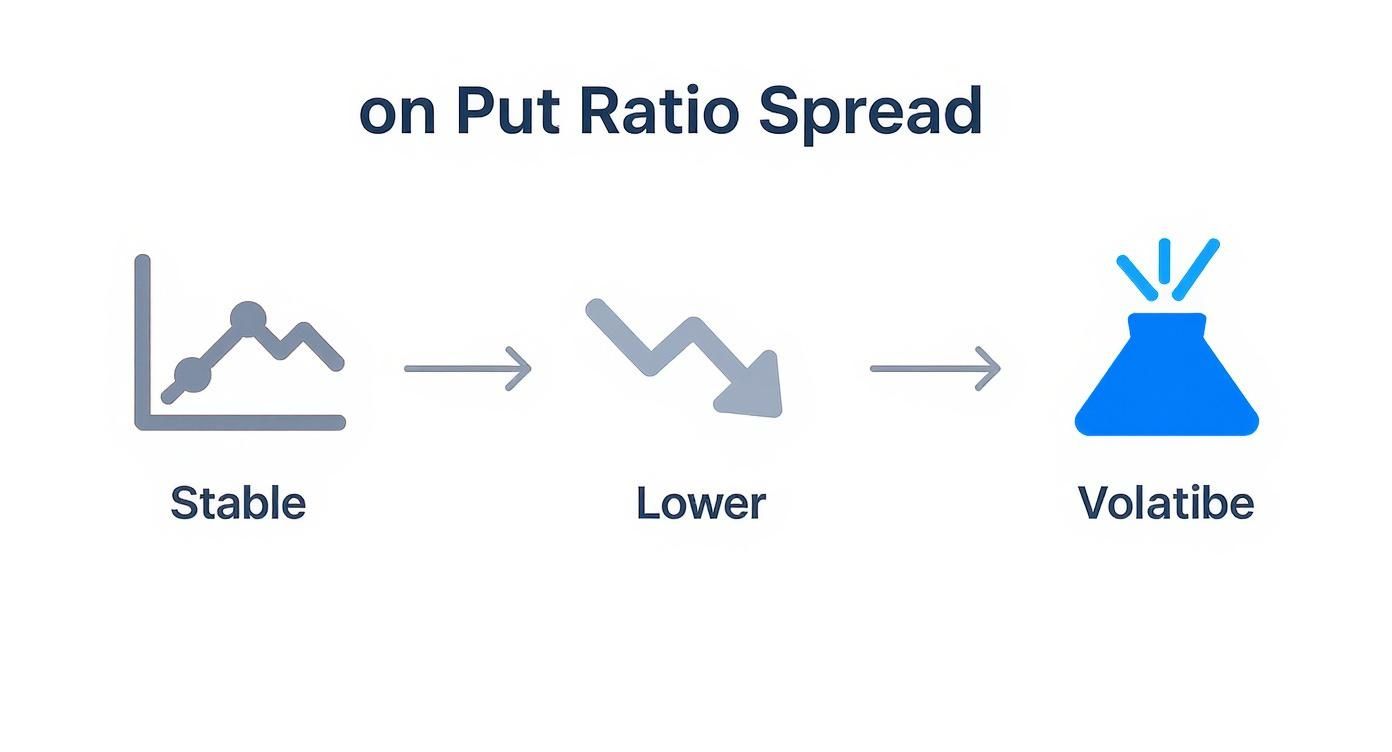
As you can see, this isn't a strategy for every situation. It’s built for specific market outlooks, not for roaring bull markets or catastrophic crashes.
The whole point of this structure is to build a "profit tent" on your payoff diagram. You hit your max profit if the stock price lands exactly on your short strike price at expiration. In that perfect scenario, both short puts expire worthless, and your long put still holds all its intrinsic value.
Once the stock price drops below your short strike, that's when things get tricky. Your profit starts to shrink because the two short puts begin losing money faster than your single long put gains value. This is where the "unlimited risk" part of the put ratio spread comes from, and it's exactly why you need to manage this trade carefully.
Calculating Your Profit, Loss, and Breakeven Points
Knowing the theory behind a put ratio spread is a great start, but the real test is mastering the numbers that define your trade. Before you put any capital on the line, you need a rock-solid understanding of your potential profit, your absolute risk, and the exact price points where you start making money.
Let's break down these critical calculations so they're second nature.
The magic of this strategy is its specific profit target. Unlike just buying a put where "lower is always better," the put ratio spread has a "sweet spot." Your ideal scenario is for the stock to land precisely on your short strike price right at expiration.

Calculating Maximum Profit
Your peak profit happens if the stock closes exactly at the short put's strike price on expiration day. In this perfect outcome, the two puts you sold expire worthless. This leaves you with the full intrinsic value of the single put you bought, plus any credit you collected upfront.
The formula is pretty straightforward:
Max Profit = (Strike Price of Long Put - Strike Price of Short Put) + Net Premium Received (or - Net Premium Paid)
If you opened the trade for a net credit, that credit gets added right on top of your potential gain. If you paid a debit, it eats into your max profit. This number tells you the absolute best you can do on the trade.
Calculating Maximum Loss
This is the most important calculation of all because, with a put ratio spread, your downside risk is theoretically unlimited. As the stock price tanks further and further below your breakeven point, your losses just keep piling up.
Why? Because you're short two puts but only long one, creating a naked short put position once the stock drops low enough.
On the flip side, your risk to the upside is capped. If the stock rallies and closes above your long put strike, all three options expire worthless.
- Upside Max Loss: If you paid to open the trade, your loss is limited to the net debit.
- Upside Max Profit: If you opened for a credit, your "profit" on the upside is simply the credit you collected.
The real danger here is a sudden, unexpected market crash. That’s why position sizing and picking the right strikes are absolutely non-negotiable.
Pinpointing Your Breakeven Points
Every put ratio spread has breakeven points that act like a fence, boxing in your profitable zone. You'll have one on the downside, and sometimes one on the upside (if you paid a debit to get into the trade).
1. Upside Breakeven Point (for debit spreads only):
If you paid to enter the position, you need the stock to move a bit just to cover that initial cost.
- Formula: Strike Price of Long Put - Net Debit Paid
2. Downside Breakeven Point:
This is the floor of your profit zone. Any price below this at expiration, and you're in the red.
- Formula: Strike Price of Short Put - Max Profit Per Share
Let's run through a quick example to see how this works in the real world.
A Worked Example Calculation
To make this concrete, let's walk through a hypothetical scenario. This table breaks down a 1:2 put ratio spread where you buy one put and sell two puts at a lower strike.
Hypothetical Put Ratio Spread Scenario
| Metric | Formula / Value |
|---|---|
| Stock Price | $100 |
| Action 1 (Buy) | Buy 1 XYZ $100 Put @ $4.00 (Total Cost: $400) |
| Action 2 (Sell) | Sell 2 XYZ $95 Puts @ $2.25 each (Total Credit: $450) |
| Net Premium | $450 Credit - $400 Debit = $50 Net Credit |
| Maximum Profit | ($100 - $95) + $0.50/share credit = $5.50/share or $550 |
| Max Profit Achieved | If XYZ closes exactly at $95 at expiration |
| Maximum Loss | Unlimited to the downside; $50 profit to the upside |
| Downside Breakeven | $95 Short Strike - $5.50 Max Profit = $89.50 |
| Upside Breakeven | None (because the trade was opened for a credit) |
As you can see, your profitable range at expiration is anywhere between $89.50 and $100, plus any price above $100. Your entire risk zone is any price below $89.50, where losses can become significant.
Navigating Your Trade with the Option Greeks
Once you put on a put ratio spread, the trade takes on a life of its own. Its value will ebb and flow not just with the stock price, but with the invisible currents of time and volatility. If you really want to manage your position like a pro, you need to understand the option Greeks.
Think of the Greeks as the dashboard for your trade. They tell you exactly how sensitive your position is to different market shifts. Mastering them turns you from a passenger into a pilot, letting you see how your P&L will change long before expiration day arrives. For a complete refresher, our guide on understanding the options trading Greeks is a great place to start.
How Delta and Gamma Shape Your Position
Delta tells you how much your position's value should change for every $1 move in the stock. For a put ratio spread, your initial Delta is almost always negative, meaning you make money as the stock price drops. But since you sold two puts and only bought one, it's not a simple, straight-line relationship.
That’s where Gamma comes in. Gamma is the accelerator pedal for your directional risk, measuring how quickly your Delta changes.
- Near the Long Strike: As the stock drifts down toward your long put, your negative Delta gets bigger. Your position becomes more bearish, faster.
- Near the Short Strikes: If the stock keeps falling toward your short strikes—your sweet spot for max profit—Gamma flips negative. This is a huge deal. It means your negative Delta starts shrinking and can even turn positive if the stock crashes, flipping your P&L from bearish to bullish.
This "Gamma flip" is a defining feature of the put ratio spread. It's also the source of its unlimited downside risk. Once the stock plummets past your breakeven point, your position starts bleeding money at an ever-increasing rate.
Making Friends with Theta and Vega
While Delta and Gamma are all about price moves, Theta and Vega handle the other two critical forces: time and volatility. In fact, they're often the real profit drivers for this strategy.
Theta, or time decay, is usually the hero of a put ratio spread. Because you sold two options but only bought one, you are "net short" premium.
This means that, all else being equal, your position gains a little bit of value every single day as time ticks by. The two options you sold decay faster than the one you bought, creating positive cash flow from time alone.
This is why the strategy can work even if the stock doesn't move an inch, especially if you opened the trade for a net credit.
Vega measures your position's sensitivity to changes in implied volatility (IV). How Vega impacts a put ratio spread is a bit more nuanced and really depends on where the stock is trading relative to your strikes.
- Stock Above Long Strike: When the stock price is high, your position is typically negative Vega. A drop in IV is your friend here, as it makes all the puts in your spread cheaper.
- Stock Below Short Strikes: If the stock takes a nosedive, your position can become positive Vega. In this scenario, a spike in IV would actually help you by increasing the value of your net long put position, potentially offsetting some of your losses.
Understanding these dynamics is critical. A sudden jump in volatility can completely change your P&L, and knowing your Vega exposure tells you whether that change is going to be a tailwind or a headwind for your trade.
Key Risks and How to Manage Them Effectively
While the put ratio spread offers a compelling way to enter a trade for a low cost, it's not without its sharp edges. Every options strategy demands respect for its risks, and this one is no exception. Ignoring them can turn a promising trade into a significant loss in a hurry.
The most critical danger is the unlimited downside risk. This isn’t just some textbook theory; it’s a real threat if the underlying stock price takes a nosedive far below your short strikes. Because you sold two puts but only bought one, a market crash leaves you with a net short position that loses money faster and faster the further it drops.

Mitigating the Unlimited Downside Threat
Good trading isn't about avoiding risk entirely—it's about controlling it. When you're using a strategy like this, you have to know how to manage the trade, especially when markets get choppy. For a wider view on these principles, check out this guide on risk management in an unpredictable world.
Here are a few practical ways to keep that primary risk in check:
Be Smart with Your Strikes: Don't just pick your short strikes randomly. Try placing them at or just below a strong technical support level—a price floor where the stock has historically found buyers. This stacks the odds in your favor that support will hold and your trade will stay safe.
Avoid High-Flyers and Cliff-Divers: This strategy is a terrible fit for biotech stocks waiting on FDA news or tech companies about to drop a game-changing product. A massive, unexpected price gap downwards can blow right through your breakeven point before you even have a chance to react. Stick to more stable, predictable stocks.
Size Your Position Correctly: This one's huge. Never, ever allocate too much of your portfolio to a single put ratio spread. Because the risk is undefined, a small position size ensures that even a worst-case scenario won't wipe out your account.
Understanding Assignment Risk
Another key risk to keep on your radar is early assignment. This happens when the owner of a put you sold decides to exercise their right to sell you shares at the strike price before the expiration date. It usually only becomes a real threat if your short put is deep in-the-money.
If you get assigned, you’ll suddenly own 100 shares of the stock for each contract. Your options trade just turned into a stock position, and you need to be ready to manage that new risk immediately.
Watching assignment risk is crucial, especially as you get closer to expiration. Platforms like Strike Price can send you alerts when the probability of assignment on your short options starts to climb, giving you a heads-up to take action.
Proactive Trade Adjustments
The market doesn't always play nice. If a trade starts moving against you, sitting around and hoping is not a strategy. Smart traders always have a plan for when things go wrong.
Here are a couple of adjustment tactics to consider:
Roll the Position: If the stock is starting to test your short strikes, you can "roll" the trade out to a later expiration date. This means closing your current position and opening a similar one further out in time. You can often do this for a credit, which buys you more time for your original thesis to play out.
Convert to a Risk-Defined Spread: If the stock drops hard and you want to put a hard cap on your potential losses, you can buy back one of your short puts. This instantly converts your 1x2 ratio spread into a standard 1x1 vertical put spread, which clearly defines your maximum risk.
Using Modern Trading Tools to Nail Your Strategy
Understanding the theory behind a put ratio spread is the easy part. The real challenge? Executing it with precision when real money is on the line. This is where modern trading tools come in, turning abstract concepts into a clear, data-driven process. Forget gut feelings—these platforms let you analyze, model, and manage your trades with a level of insight that used to be reserved for the pros on Wall Street.
The first step in building a solid put ratio spread is picking your strikes. Instead of just guessing, advanced platforms give you a probability analysis for every single strike on the options chain. You can see the statistical odds of a stock finishing above or below a certain price by expiration, which helps you place your short strikes with a whole lot more confidence.
Model Your Trade Before You Risk a Dime
Once you have a few strikes in mind, you can model the entire trade from start to finish. Visual tools like payoff diagrams instantly show you exactly where you'll make money and where you'll lose it across a whole range of prices. You can see your max profit, your breakeven points, and that dreaded zone of unlimited loss—all before putting a single dollar on the table.
This pre-trade analysis also covers the Greeks. A good platform will calculate the initial Delta, Gamma, Theta, and Vega for your potential spread. This gives you a complete snapshot of how your position will behave the second you enter the trade.
Think of modeling as a stress test for your trade. What if volatility goes through the roof? What if the stock tanks faster than you expected? Answering these questions beforehand is the key to managing risk proactively instead of just reacting to the market.
Stay Ahead with Proactive Monitoring and Alerts
After you've placed the trade, the real work begins. Modern tools help you shift from being a reactive trader—the kind who gets caught off guard—to a proactive manager. You can set up custom alerts to ping you if the stock price breaks a critical level, like your breakeven point or a key support zone you're watching.
This is especially crucial for tracking assignment risk on your short puts. Platforms like Strike Price monitor the probability of early assignment in real-time. If those odds start creeping up, you get an alert. That gives you precious time to decide whether to roll the position or just close it out. It’s a data-backed way to stay one step ahead.
This kind of analysis isn't just theory; it's backed by historical performance. For example, extensive backtesting has shown that put ratio spreads kill it during periods of high market fear. Research revealed that these spreads on SPY delivered much higher profits when the Implied Volatility Rank (IV Rank) was above 50%. Why? Because the inflated premiums gave traders bigger upfront credits and much wider profitable ranges.
You can dig into the data and learn how IV influences put ratio backtests for a deeper dive. By using tools to spot these high-IV environments, you can time your strategy to align with conditions that have historically paid off.
Common Questions About Put Ratio Spreads
Even after you get the mechanics down, a few practical questions always pop up. Let's tackle the most common ones traders ask before putting on a put ratio spread.
Is This a Good Strategy for Beginners?
Honestly, this one is a bit tricky for newcomers. While the setup seems simple enough, the put ratio spread comes with unlimited downside risk, and that’s a big deal.
It’s a strategy that demands active management and a real understanding of assignment risk and how to make adjustments on the fly. If you're just starting out, you're much better off sticking with risk-defined strategies, like vertical spreads, until you get your sea legs.
What's the Ideal Market for a Put Ratio Spread?
This strategy doesn't work everywhere; it really shines in specific conditions. It’s perfect when you think a stock will stay flat, drift down just a little bit to a known support level, or when implied volatility is high.
That high volatility is key. It boosts the premium you collect from the two puts you sell, which can often let you open the trade for a net credit and gives you much wider breakeven points.
This isn't just theory—the strategy has proven itself in the real world. During the wild market swings of 2020-2023, put ratio spreads performed exceptionally well because the elevated volatility created the perfect environment for this setup. You can discover more insights on ratio trade performance during that period.
How Is This Different from a Put Backspread?
Good question—they sound similar but are complete opposites in terms of risk and what you're betting on. It all comes down to the ratio of options you buy versus sell.
- Put Ratio Spread (or Front Spread): You buy one put and sell two (or more) puts at a lower strike. This gives you limited profit potential but exposes you to unlimited downside risk.
- Put Backspread: Here, you flip the ratio. You sell one put and buy two (or more) at a lower strike. This completely reverses the risk, giving you unlimited profit potential with limited, defined risk.
Think of it this way: the front spread is a bet on low volatility and a specific price target. The backspread is a lottery ticket—you're betting on a massive, explosive move down.
Ready to stop guessing and start trading with data-driven confidence? Strike Price provides the real-time probability metrics and smart alerts you need to master strategies like the put ratio spread. Analyze your risk, find high-probability trades, and manage your positions like a pro. Start your trial today.