
Synthetic Covered Calls Explained A Guide to Smarter Income
If a stock moves past your strike, the option can be assigned — meaning you'll have to sell (in a call) or buy (in a put). Knowing the assignment probability ahead of time is key to managing risk.
Posted by
 John Clarke
Related reading
A Step-by-Step Covered Calls Example for Consistent Income
Unlock consistent income with our step-by-step covered calls example. This guide breaks down the strategy, risks, and outcomes to help you trade confidently.
Long Call and Short Put The Ultimate Synthetic Stock Guide
Unlock the power of the long call and short put strategy. This guide explains how synthetic long stock works, its benefits, risks, and how to execute it.
What is a Call Spread? A Clear Guide to Bull and Bear Spreads
What is a call spread? Discover how bull and bear spreads limit risk and sharpen your options trading strategy.
Feel like you're priced out of earning income on expensive stocks? It happens. You see a great company you're bullish on, but buying the 100 shares needed for a traditional covered call would tie up a massive chunk of your capital. This is where a synthetic covered call comes in.
It’s a clever options strategy that gives you the same income potential as a regular covered call, but for a tiny fraction of the upfront cost. Think of it as a way to get in the game on pricey stocks you thought were out of your league.
A Smarter Way to Generate Options Income
Look at a stock like NVIDIA or Amazon. Selling covered calls on them is a fantastic way to generate income, but the cost to buy 100 shares can be eye-watering. For many traders, locking up tens of thousands of dollars in a single position just isn't practical.
It’s a common frustration. You’re forced to sit on the sidelines, unable to collect that steady "rent" on a stock you believe in, simply because the cost of entry is too high.
The Capital-Efficient Alternative
This is the exact problem a synthetic covered call solves. Instead of buying 100 shares of stock, you use a long-term, deep-in-the-money call option as a stock replacement. That one simple switch changes everything, drastically cutting your capital outlay while keeping the risk and reward profile nearly identical.
This approach gives you a few powerful advantages right away:
- Massive Capital Reduction: You free up your cash for other trades or to diversify your portfolio.
- Higher Potential ROI: Because your initial investment is so much smaller, the premium you collect represents a much larger return on your capital.
- Access to Any Stock: Suddenly, you can run an income strategy on high-priced stocks that were previously out of reach.
A synthetic covered call lets you control a stock-like position and collect income on it, but without the huge upfront cost. It’s a game-changer for traders who want to make their capital work smarter, not harder.
At the end of the day, this strategy opens up the same income-generating opportunities as a traditional covered call, but with far more flexibility. It completely changes how you can think about earning premiums from the market.
How a Synthetic Covered Call Actually Works
To really get what makes a synthetic covered call so powerful, let's first touch on the classic version. A traditional covered call is pretty simple: you own at least 100 shares of a stock and sell one call option against them. That gives you an immediate premium, but it also puts a ceiling on your profits if the stock takes off past your call's strike price.
It's a straightforward setup because your shares are the "cover" for the call you sold. If the option buyer decides to exercise their right to buy the stock, you just hand over the shares you already own.
Now, let's build the synthetic version. The most common flavor of this strategy is the Poor Man's Covered Call (PMCC). Instead of buying 100 shares outright, you buy a single, long-term call option that's deep in-the-money. These are often LEAPS contracts (Long-term Equity Anticipation Securities).
This LEAPS contract effectively becomes your stock substitute. It moves almost identically to owning 100 shares but costs a whole lot less.
Building the Position Step by Step
Think of it like leasing a high-end car for a year instead of buying it. Your upfront cost is way lower, but you still get to drive it and have full control. With that control, you can then "sublet" it for short weekend trips to generate income—that’s the exact same idea as selling short-term calls against your lease.
Here’s how the two pieces fit together:
- The Stock Replacement (Your Lease): You buy a LEAPS call option with a far-off expiration date, ideally 9-12 months away, and a deep in-the-money strike price. This ensures your option has a high delta (usually 0.80 or more), meaning its value will track the actual stock very closely.
- The Income Generator (Subletting): Against that long LEAPS call, you sell a short-term call option (maybe 30-45 days out) with a strike price that is out-of-the-money. This is the part that brings in regular cash, just like in a standard covered call.
The strategy's capital efficiency has caused a massive surge in its adoption by retail traders. Data from the Options Clearing Corporation (OCC) shows that retail volume in single-leg LEAPS shot up by over 40% between 2018 and 2023. Unlike a traditional covered call that might require $10,800 to buy 100 shares at $108, a synthetic setup for the same stock could cut that capital need by more than 50%, dropping it to just $4,800.
The diagram below breaks this process down into three simple stages.
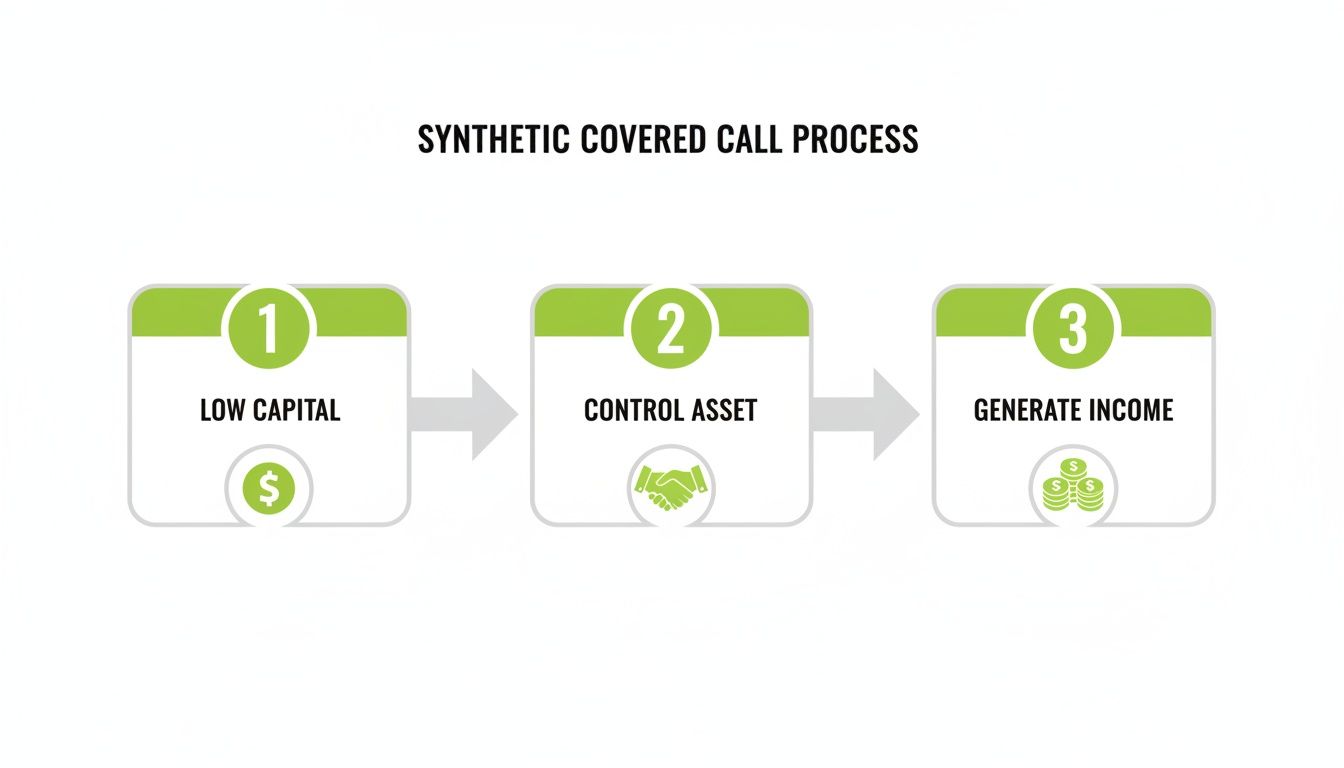
This flow really drives home the main benefit: you get income generation and control over an asset for a fraction of the typical upfront cost.
Traditional vs Synthetic Covered Call Construction
To see the differences at a glance, here’s a quick comparison of how each strategy is built.
| Attribute | Traditional Covered Call | Synthetic Covered Call (PMCC) |
|---|---|---|
| Components | Long 100 Shares + Short Call | Long LEAPS Call + Short Call |
| Capital Required | High (cost of 100 shares) | Low (cost of LEAPS minus premium) |
| Primary Use Case | Generate income on existing stock holdings | Generate income with high capital efficiency |
While both aim for income, the PMCC is all about getting the same job done with significantly less capital tied up, opening the door to trading more expensive stocks.
Understanding the Payoff Profile
The profit and loss (P&L) graph for a synthetic covered call looks almost identical to a traditional one. Your maximum profit is capped at the strike price of your short call, and your max loss is the net debit you paid to open the trade (the cost of your LEAPS minus the premium received from your short call).
Your profit comes from two places: the premium you collect from selling the short-term call, and any increase in the value of your long LEAPS call. The goal is for the income from those short calls to chip away at, and eventually surpass, the initial cost of your LEAPS.
Because you're juggling two options instead of a stock and an option, the option trading Greeks play a bigger role. The time decay (theta) on your long-term LEAPS is very slow, while the theta on your short-term call is fast—this difference is exactly what you're exploiting. A good handle on how delta, theta, and vega interact is key to managing these trades well.
Ultimately, the synthetic covered call turns a capital-heavy strategy into a highly efficient income engine. It gives you the freedom to run a classic income play on stocks that might otherwise be out of reach, unlocking a whole new set of trading opportunities.
Synthetic vs. Traditional: Which Is Right for You?
Deciding between a synthetic and a traditional covered call isn't just about saving a bit of cash; it's about picking the right tool for the job. Both strategies are designed for a bullish-to-neutral outlook, but the way they're built creates a world of difference in how they perform and the risks you take on.
A traditional covered call is as straightforward as it gets. You own the stock, you collect any dividends, and you’re managing a pretty simple position. It’s a classic for a reason, especially for long-term investors who already have the shares and just want to squeeze a little extra income out of their portfolio.
The synthetic covered call, on the other hand, is all about leverage and capital efficiency. If your main goal is to get the highest possible Return on Investment (ROI) from every dollar you put to work, the synthetic version is almost always the answer.
The Power of Leverage and ROI
The single biggest reason traders flock to synthetic covered calls is the massive boost it gives to your ROI. Instead of buying 100 shares of stock, you’re using a LEAPS option as a stand-in, which means your initial cash outlay is a fraction of the cost.
Let's make this real. Say a stock is trading at $200.
To run a traditional covered call, you’d need $20,000 to buy the 100 shares. A synthetic version using a deep in-the-money LEAPS might only set you back $4,000. If both trades bring in $200 in premium from selling a short-term call, the math is crystal clear:
- Traditional ROI: ($200 / $20,000) = 1% return on capital.
- Synthetic ROI: ($200 / $4,000) = 5% return on capital.
That 5x difference on the exact same trade shows you the power of leverage. For traders obsessed with making their capital work as hard as possible, the synthetic route is tough to beat. You can dive deeper into this capital-efficient setup in our guide on the Poor Man's Covered Call.
Understanding the Unique Risks
Of course, that extra efficiency doesn't come for free. Synthetic covered calls bring a few options-specific risks to the table that you just don't have to worry about with the traditional setup. Getting a handle on these is non-negotiable.
The two big Greek risks you need to watch are vega (sensitivity to implied volatility) and theta (time decay).
- Vega Risk: Implied volatility (IV) is a big deal for your long LEAPS call. A sudden drop in IV—what traders call a "vega crush"—can tank the value of your LEAPS even if the stock price hasn't budged. With a traditional covered call, volatility doesn't directly mess with the value of your shares.
- Theta Risk: You’re making money from the quick theta decay on the short call you sold. But don't forget, your long LEAPS call is also bleeding value to time decay, just much more slowly. A good trade makes sure the short call's decay more than covers the long call's, but it's a constant headwind you don't have with straight stock ownership.
The core trade-off is simple: the synthetic version gives you incredible leverage and ROI, but you must actively manage the risks associated with options, like changes in volatility and the constant pressure of time decay on both sides of your position.
Making the Right Choice for Your Portfolio
So, how do you choose? It really boils down to your account size, trading style, and how much risk you're comfortable with.
| Factor | Choose Traditional Covered Call If... | Choose Synthetic Covered Call If... |
|---|---|---|
| Capital | You have plenty of capital and might already own the 100 shares. | You want to put up as little capital as possible and maximize ROI. |
| Risk Tolerance | You prefer a simple position without having to manage complex options risks. | You're comfortable managing the Greeks, especially vega and theta. |
| Dividends | Capturing dividend payments is an important piece of your strategy. | You're focused purely on premium income and potential capital gains. |
| Trading Style | You're a long-term, buy-and-hold investor looking for extra yield. | You're an active options trader hunting for leverage and efficiency. |
Research shows that covered call strategies, as a whole, deliver strong risk-adjusted returns. A study by AQR Capital Management looking at strategies from 2006 to 2015 found they produced annualized returns of 6.6% with way less volatility than the underlying indexes. This led to a superior Sharpe ratio of 0.45 versus 0.33, confirming just how efficient the strategy can be. You can check out more from this comprehensive analysis of global covered call performance.
Ultimately, if you're a long-term investor already holding the shares, the traditional covered call is a no-brainer. But if you’re an active trader trying to generate income with maximum capital efficiency, the synthetic covered call is a powerful tool that can open up a whole new world of opportunities.
How to Manage Your Trade When the Market Moves

Putting on a synthetic covered call is just the first step. The real skill—and where the money is made or lost—comes from managing the position as the market does its thing.
This isn't a "set it and forget it" strategy like a traditional covered call can sometimes be. It's a more active approach that demands you pay attention to protect your capital and lock in your gains. Staying proactive is the name of the game.
Navigating the Risk of Early Assignment
One of the first things traders worry about is early assignment on the short call. It sounds scary—the option buyer exercises their right to buy 100 shares from you before expiration, leaving you short the stock. But in reality, it's usually a manageable problem.
This risk gets highest when your short call is deep in-the-money, especially with an ex-dividend date coming up. Why? The buyer wants to own the shares to collect that dividend payment, and exercising their call is the way to do it.
The best way to handle early assignment is to see it coming. If you're watching your position as it gets deeper in-the-money or a dividend date nears, you can usually act before it becomes a real threat.
If you do get assigned, you’re not stuck. You have a couple of options:
- Exercise Your LEAPS: Use your long LEAPS call to buy 100 shares at its strike price, which immediately covers the 100 shares you now owe.
- Buy Shares on the Market: Simply go into the open market and buy 100 shares to close out your new short stock position.
Of course, most traders would rather just sidestep the whole assignment headache by adjusting the trade beforehand.
When and How to Adjust Your Position
Smart adjustments are what separate the pros from the rookies. Your go-to move for managing a synthetic covered call is rolling the short option. This just means you close the current short call and open a new one, usually with a different strike price or a later expiration date.
A well-timed roll can do a few different things for you:
- Collect More Premium: If the stock isn't doing much, you can roll your call to the next expiration cycle and pocket some more cash.
- Avoid Assignment: Is the stock price climbing and testing your short strike? You can roll the call up and out—to a higher strike and a later date—giving the stock more room to run before you're at risk.
- Defend the Position: If the stock price takes a dive, you can roll your short call down and out. This lets you collect a bigger premium, which helps chip away at the initial cost of your long LEAPS call.
Knowing exactly when and how to make these adjustments is a skill in itself. Our guide on rolling over options breaks down the mechanics and gives you clear scenarios for making the right move.
Knowing When to Close the Trade
Look, not every trade is going to work out. Knowing when to fold 'em is just as important as knowing when to hold 'em. With a synthetic covered call, a big drop in the stock price can hammer the value of your LEAPS call, and those losses can easily wipe out all the premium you've collected.
Before you even enter a trade, have an exit plan. Maybe it's a certain percentage loss on your LEAPS, or maybe it's a key price level on the chart that tells you your bullish bet was wrong. Don't let a small, manageable loss turn into a big one by hoping for a comeback. Your number one job is always to protect your capital.
Putting Your Strategy into Action with Data
Theory is great, but executing a synthetic covered call with real money requires more than just a textbook understanding. You need a clear, data-driven workflow that turns a complex strategy into a repeatable process. Guesswork just won't cut it.
Instead of getting lost in an endless option chain, modern tools can help you zero in on the perfect strike price for your short call. The goal is always the same: find that sweet spot that gives you a nice premium without an unmanageable risk of assignment.
Using Probability to Guide Your Decisions
Your most powerful ally here is probability. Platforms like Strike Price crunch market data in real-time to give you the odds for every single strike. That means you can see, right on the screen, the statistical chance of a stock finishing above or below a certain price by expiration.
This completely changes the game from hoping to knowing. You can set your own risk threshold—say, you only want to sell calls with a 15% probability of finishing in-the-money—and instantly see which options fit the bill. This data-first approach pulls emotion out of the equation and helps you build a more consistent income stream.
Here’s a look at the Strike Price dashboard. Notice how the probability metrics are laid out clearly for each strike, making it easy to decide quickly.
When you can see the assignment probability, potential premium, and your safety margin all side-by-side, you're making an objective trade-off between risk and reward.
Reverse-Engineering Your Income Goals
What if you have a specific income target? Instead of hunting for trades, you can reverse-engineer them. Advanced tools, like Strike Price’s Target Mode, let you plug in your desired weekly or monthly income and your preferred safety level (e.g., an 80% chance of success).
The platform then scans the market for you, presenting tailored strategies that meet your exact criteria. This is a huge advantage for anyone building a reliable income portfolio, as every trade is designed from the start to hit a specific financial goal.
By using probability and target-based tools, you shift from being a reactive trader to a proactive strategist. You're not just finding trades anymore; you're building a data-backed income engine designed for your goals.
This method really shines in certain market conditions. Synthetic covered calls thrive when volatility is high and on stocks where the premium is juicy. For example, some traders focused on Tesla have used this strategy to create an annualized income yield of 27.5%, all by strategically picking strikes on the volatile stock. This works best when implied volatility is up, making short-dated options more valuable thanks to rapid time decay. You can learn more about how traders generate synthetic income on volatile stocks.
A Dashboard for Smarter Management
Finally, you can’t manage what you can’t see. A smart dashboard is essential for keeping track of all your positions in one place. It should monitor your open contracts, watch your assignment risk, and send you alerts when things change—whether it's a threat or a new opportunity.
If a stock moves against you and assignment risk starts to spike, a timely alert gives you the heads-up you need to roll the position before it becomes a problem. This turns a complex, multi-leg strategy into a workflow you can actually manage, letting you trade your synthetic covered calls with confidence backed by real data.
A Step-By-Step Synthetic Covered Call Example

Alright, let's move from theory to practice and see how this actually works. We'll walk through building a synthetic covered call—often called a Poor Man's Covered Call (PMCC)—using a stock that’s perfect for this strategy: NVIDIA (NVDA). It's a popular name, but its high share price makes it a prime candidate.
Let's assume NVDA is trading at $130 a share. Our game plan is to set up a position that generates some income, all while keeping a cautiously bullish outlook.
Setting Up the Trade
First things first, we need our stock replacement—the long LEAPS call. The key here is to buy an option that's deep in-the-money and has a ton of time left before it expires. This gives us a high delta and minimizes the hit from time decay.
- Buy to Open: 1 NVDA LEAPS Call
- Expiration: January 2026 (about 18 months away)
- Strike Price: $90 (deep in-the-money to mimic stock movement)
- Cost (Premium): $48.00 per share, for a total of $4,800.
With our long-term position in place, it's time to generate some cash. We'll sell a short-term, out-of-the-money call against our LEAPS.
- Sell to Open: 1 NVDA Call
- Expiration: 45 days from now
- Strike Price: $140 (comfortably out-of-the-money)
- Credit (Premium): $4.00 per share, bringing in $400.
This is the magic of the strategy. Your net debit, or the total cash out of your pocket, is just $4,400 ($4,800 for the LEAPS minus the $400 you collected). Compare that to the $13,000 you'd need to buy 100 shares outright. Big difference.
Calculating Key Metrics
Now that we're in the trade, let's map out our potential profit, loss, and breakeven points.
Maximum Profit: The most we can make is the difference between our two strike prices, minus what we paid to get in. So, ($140 - $90) - $48 (LEAPS cost) + $4 (short call credit) = $6.00 per share, or $600. This best-case scenario happens if NVDA closes exactly at $140 when our short call expires.
Maximum Loss: The worst that can happen is losing our initial investment. Our max loss is capped at the $4,400 net debit we paid. This would happen if NVDA completely tanks and both options expire worthless.
Breakeven Price: To figure out our breakeven point at the short call's expiration, we just add our net debit to the long call's strike price: $90 + $44 = $134.
Exploring Potential Scenarios
So, how does this trade play out in the real world? Let's look at a few possibilities.
Stock Soars Past $140: If NVDA takes off and hits $145, our short call is now in-the-money. We could simply close the entire position and walk away with a profit close to our max gain. Or, if we're still bullish, we could roll the short call up to a higher strike (like $150) and out to a later date. This banks more premium and gives the stock more room to climb.
Stock Trades Sideways: If NVDA just chops around and ends up near $135, our short $140 call expires worthless. Perfect. We keep the full $400 premium, and our cost basis on the LEAPS drops to $4,400. Now we can turn around and sell another short call for the next month, repeating the income cycle.
Stock Price Drops: What if NVDA pulls back to $120? Our short call will expire worthless (which is good), but our LEAPS call will have taken a hit. To manage this, we could roll our short call down to a lower strike, say $130. This would bring in a bigger premium, helping to offset the paper loss on our LEAPS and lower our overall cost basis even further.
Got Questions About Synthetic Covered Calls?
As you get your head around the synthetic covered call, it's totally normal for the practical "what-if" questions to start popping up. This strategy has some unique moving parts, and really understanding the nuts and bolts is what separates confident trading from guesswork.
Let's dig into some of the most common questions traders have.
What’s the Real Advantage of a Synthetic Covered Call?
It all comes down to one thing: capital efficiency. That's the whole reason this strategy exists. You get to control a position that acts just like owning stock and generate income from it, but for a tiny fraction of the cost of buying 100 shares outright.
This efficiency opens up two huge opportunities. First, it keeps your cash free for other trades or investments instead of being tied up in one big stock position. Second, it can seriously juice your Return on Investment (ROI) because the initial cash you put up is so much smaller compared to the premium you collect.
Are Synthetic Covered Calls a Good Strategy for Beginners?
They can be, but they definitely require more homework than a standard covered call. While the risk profile looks pretty similar on paper, you're managing a position with two options legs instead of just one option and a pile of stock. That means more variables to keep an eye on.
For anyone new to this, success usually boils down to two things:
- Getting comfortable with the Greeks: You need a solid feel for how time decay (theta) and shifts in implied volatility (vega) will impact your long and short options differently.
- Using the right tools: A platform that gives you clear, simple probability metrics and risk alerts can make a world of difference. It dramatically shortens the learning curve and helps you sidestep the common rookie mistakes.
What Happens If My Short Call Gets Assigned Early?
Okay, this one sounds scarier than it is. If your short call gets assigned early, it just means you'll see a short stock position in your account. You're now on the hook to deliver 100 shares you don't actually own. It's a manageable situation.
The most straightforward fix is to simply exercise your long LEAPS call. This lets you buy 100 shares at your LEAPS strike price, which you immediately use to close out that short stock position. In reality, though, most active traders never let it get this far—they just roll their short call before assignment becomes a real risk.
How Is This Strategy Taxed?
Taxation on options can get tricky, and it really depends on where you live and how long you hold each piece of the trade. As a general rule, any gains from your short-term options (held for less than a year) are taxed as short-term capital gains, which usually means a higher tax rate.
Your long LEAPS call, on the other hand, might qualify for the more favorable long-term capital gains tax rates if you hold it for over a year. Because all the adjusting, rolling, and potential assignments can create unique tax events, it’s always a smart move to chat with a qualified tax professional to understand exactly what your obligations are.
Ready to stop guessing and start making data-driven decisions? With Strike Price, you can instantly see the probability of success for any strike price, set income targets, and receive smart alerts to manage your synthetic covered calls with confidence. Transform your options trading from a gamble into a strategic income engine. Start your free trial at Strike Price today!