
A Trader's Guide to Vertical Call Spreads
If a stock moves past your strike, the option can be assigned — meaning you'll have to sell (in a call) or buy (in a put). Knowing the assignment probability ahead of time is key to managing risk.
Posted by
 John Clarke
Related reading
A Step-by-Step Covered Calls Example for Consistent Income
Unlock consistent income with our step-by-step covered calls example. This guide breaks down the strategy, risks, and outcomes to help you trade confidently.
Long Call and Short Put The Ultimate Synthetic Stock Guide
Unlock the power of the long call and short put strategy. This guide explains how synthetic long stock works, its benefits, risks, and how to execute it.
What is a Call Spread? A Clear Guide to Bull and Bear Spreads
What is a call spread? Discover how bull and bear spreads limit risk and sharpen your options trading strategy.
A vertical call spread is an options strategy where you buy one call option and sell another call option at the same time. Both options have the same expiration date but different strike prices.
Think of it as making a precise, calculated bet on a stock's direction. Instead of just hoping for an unlimited rally, you're defining a specific price range where you expect the stock to land.
Defining Your Risk with Vertical Call Spreads
Let's say you're confident a stock will rise, but you don't think it's going to the moon. Buying a regular call option might be too expensive, or it could carry more risk than necessary if the stock only moves up a little.
This is where a vertical call spread shines. It's a powerful, capital-efficient alternative. By selling a higher-strike call against the one you buy, you immediately lower the cost of your bullish bet.
This setup creates a trade with a clearly defined risk and reward from the very beginning. You know your maximum possible profit and your maximum possible loss before you even click "buy." This built-in risk management is what makes vertical spreads a cornerstone strategy for traders of all levels. They turn a speculative guess into a strategic position with known boundaries.
For a broader look at how spreads function, our guide on what are option spreads offers a great foundation.
The Two Sides of the Coin
Vertical call spreads aren't a one-size-fits-all tool. They come in two distinct flavors, each designed for a different market outlook. Understanding both is key to using them effectively.
The two primary types are:
- Bull Call Spread: This is your go-to when you're moderately bullish on a stock. You buy a call with a lower strike price and sell a call with a higher strike price. This creates a "net debit," meaning you pay a small premium to open the trade. The goal is for the stock to rise and finish above the higher strike price by expiration.
- Bear Call Spread: You use this when you're neutral to moderately bearish. You believe the stock will stay below a certain price. To build it, you sell a call with a lower strike and buy one with a higher strike. This results in a "net credit," so you receive money upfront. Your goal is for the stock to stay below the lower strike, letting both options expire worthless so you can keep that initial premium.
To put vertical call spreads in perspective, it helps to explore the broader landscape of different trading strategies that traders use to navigate the markets.
A vertical call spread cleverly limits both your potential profit and, more importantly, your potential loss. This defined-risk nature is its greatest strength, removing the fear of unlimited downside and allowing for more calculated decision-making.
Why Choose a Vertical Spread
The main appeal here is efficiency and control. By selling an option, you directly reduce the cost of the option you're buying. This is a huge advantage, especially when volatility is high and single-leg options get pricey. It makes the strategy accessible, even for traders with smaller accounts.
To make things even clearer, let's break down the two types side-by-side.
Bull Call Spread vs Bear Call Spread At a Glance
The table below offers a quick comparison, highlighting the core differences between a bullish and bearish vertical call spread.
| Attribute | Bull Call Spread (Debit) | Bear Call Spread (Credit) |
|---|---|---|
| Market Outlook | Moderately Bullish | Neutral to Moderately Bearish |
| Trade Setup | Buy a lower-strike call, sell a higher-strike call | Sell a lower-strike call, buy a higher-strike call |
| Initial Cost | Net Debit (You pay to enter) | Net Credit (You receive money to enter) |
| Max Profit | Difference in strikes minus the net debit paid | The net credit received |
| Max Loss | The net debit paid | Difference in strikes minus the net credit received |
| Primary Goal | Profit from the stock price increasing | Profit from the stock price staying below a key level |
Ultimately, whether you're paying a debit for a bull call spread or collecting a credit for a bear call spread, you're using the same core mechanic: defining a price range to trade within. This control is what makes vertical spreads such a valuable part of any trader's toolkit.
How a Vertical Call Spread Trade Works
To really get a feel for vertical call spreads, you have to look under the hood. This strategy isn't just one trade—it's two moves you make at the same time, working together to create a position where you know your exact risk upfront. Once you understand the parts, you’ll build an intuition for how it all works.
At its core, every vertical call spread involves two call options on the same stock with the exact same expiration date. The only thing that's different is their strike prices. This "vertical" gap between the strikes on the option chain is exactly where the strategy gets its name.
When you buy one call and sell another one simultaneously, you create a structure where your potential profit and loss are locked in from the get-go.
The Anatomy of a Spread
Think of it like building with LEGOs. Each piece has a job, and the way you connect them determines what you end up with. Whether you're bullish or bearish, you’re always working with the same fundamental pieces.
Here’s what you're managing:
- The Long Call: This is the call option you buy. It gives you the right to purchase the stock at its strike price. If you’re setting up a Bull Call Spread, this is your engine for profiting from the stock moving up.
- The Short Call: This is the call option you sell. It creates an obligation to sell the stock at its strike price if assigned. The cash (premium) you get from selling it helps pay for the long call, lowering your overall cost and capping your maximum profit.
- Strike Prices: The distance between the strike of your long call and your short call is the "width" of the spread. This width is the key to calculating your max profit and loss.
- Expiration Date: Both calls must expire on the same day. This is what keeps them working together as a single, cohesive strategy.
This quick visual shows how these pieces come together to form either a bullish or bearish spread.
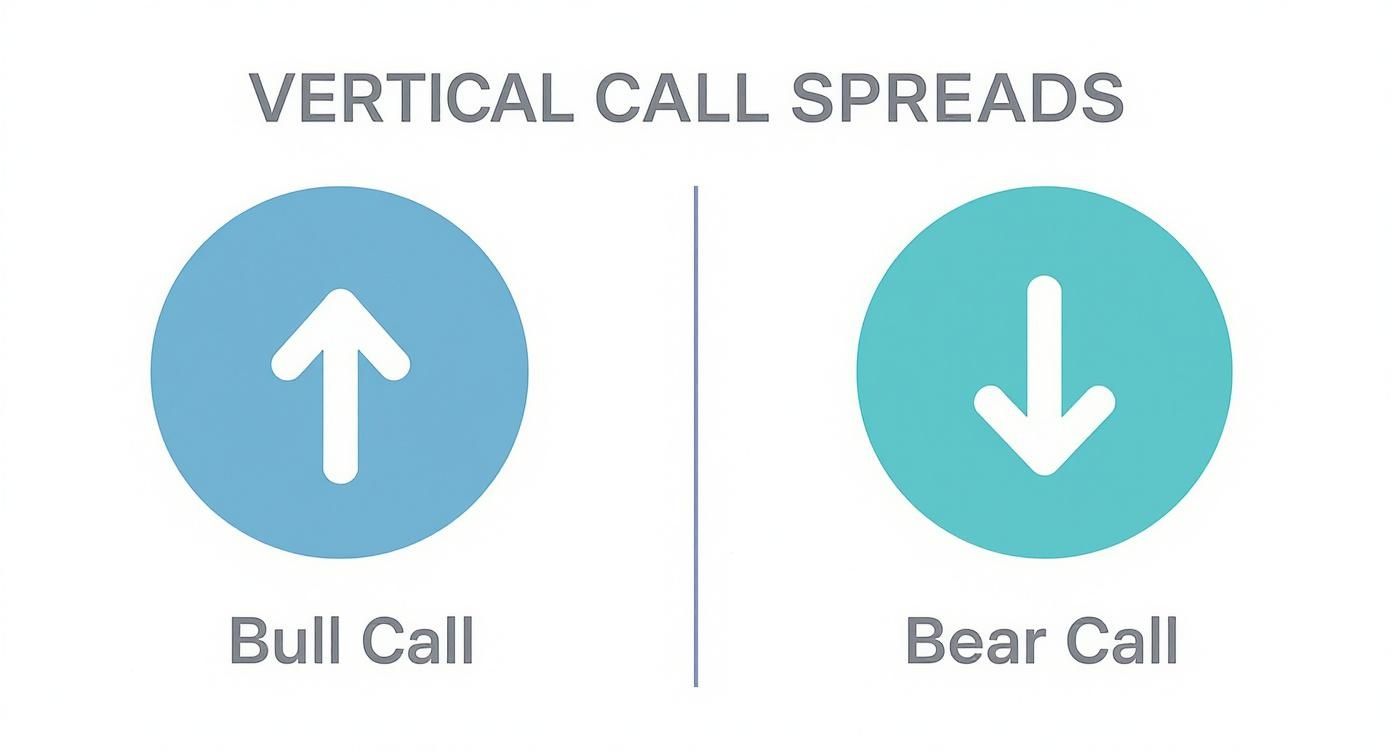
As you can see, the only real difference is which strike you buy versus which one you sell. That simple choice determines whether you pay a debit to bet on the stock going up or collect a credit to bet on it going down.
Calculating Your Risk and Reward
The best part about vertical spreads is that the math is dead simple. Let’s walk through a common example: a bull call spread.
Imagine you buy a $45 strike call for $6.50 and, at the same time, sell a $51 strike call for $2.00. Your net cost, or "debit," is $4.50 per share ($6.50 paid - $2.00 collected).
- Max Loss: Your maximum loss is capped at the $4.50 debit you paid. Since options contracts control 100 shares, your total risk on this trade is $450.
- Breakeven Point: To figure out where you start making money, just add the net debit to the lower strike price: $45.00 + $4.50 = $49.50. The stock needs to be above $49.50 at expiration for the trade to be profitable.
- Max Gain: This is the width of the spread ($51 - $45 = $6.00) minus the net debit you paid ($4.50). Your max profit is $1.50 per share, or $150 per contract.
Your maximum loss on a Bull Call Spread is always limited to the initial net debit you paid to enter the trade. No matter how far the stock falls, you cannot lose more than your initial investment.
To get comfortable with these numbers, you’ll want to know how to read option chains fluently. That’s where you’ll find all the strike prices and premiums you need to build these spreads.
Visualizing the Payoff
A payoff diagram is the clearest way to see how your spread will perform as the stock price moves. It’s a simple graph showing your potential profit or loss at expiration for any given stock price.
Here's a typical payoff diagram for the Bull Call Spread we just discussed.
The diagram makes it obvious. There’s a "floor" where your loss is capped and a "ceiling" where your profit is capped. The flat line on the left shows your loss can’t get any worse, and the flat line on the right shows your profit potential is fixed. Once the stock price crosses your breakeven point, you start making money, all the way up to your max profit level.
When a Bull Call Spread Is Your Best Move
https://www.youtube.com/embed/if0P_RU5zWc
Knowing what a bull call spread is and knowing when to use one are two very different skills. This strategy isn’t a blunt instrument for every bullish scenario; it’s a precision tool designed for a specific outlook: moderate optimism. You should reach for this spread when you think a stock is going up, but you aren’t banking on a massive, explosive rally.
Think of it as the difference between expecting a steady jog uphill versus a rocket launch. If you believe a stock will climb from $50 to $55, buying an expensive call option outright might be overkill. A bull call spread lets you target that specific move in a much more capital-efficient way.
This approach becomes especially powerful in a few key situations where it offers a clear advantage over simply buying a naked call.
The Sweet Spot for Bull Call Spreads
The ideal setup for a bull call spread is a mix of directional confidence and a need for cost control. It’s all about expressing a bullish view without paying the full premium that high uncertainty often demands.
Here are the prime scenarios to consider:
- Anticipating a Positive Catalyst: An upcoming earnings report or a big product launch might have you feeling bullish. The problem? This anticipation cranks up implied volatility (IV), making single-leg calls incredibly expensive. A bull call spread lets you offset that high cost by selling a higher-strike call, making your bet far more affordable.
- Targeting a Specific Price Level: If your chart analysis points to a stock rallying to a known resistance level and likely stalling, a bull call spread is perfect. You can set your short strike right at or near that resistance, perfectly aligning your profit zone with your technical outlook.
- Capital Efficiency is Key: For traders with smaller accounts, buying calls on high-priced stocks can be a non-starter. Bull call spreads dramatically lower the cash you need to put down, freeing up capital for other trades and better risk management.
The real power of a bull call spread is its ability to turn a general bullish feeling into a calculated, defined-risk trade. It forces you to define not just if a stock will rise, but also how far you think it will go.
Leveraging Seasonal and Statistical Tendencies
Another powerful way to use vertical call spreads is by trading on historical patterns or seasonality. Certain stocks show predictable behavior during specific times of the year, which can create high-probability opportunities for defined-risk strategies like this one.
For instance, seasonality can play a big part in the performance of giants like Microsoft. A look back over the last 12 years shows that from early to late December, Microsoft stock has closed higher about 75% of the time. While the average return was a modest +0.7%, traders could have used bullish vertical call spreads during this window to consistently leverage that small, probable gain. You can dig deeper into these historical patterns and how they create trading opportunities.
In short, the bull call spread is your go-to move when you want to be smart about being bullish. It's for the trader who has a clear thesis, a price target in mind, and a healthy respect for managing risk and capital.
When to Deploy a Bear Call Spread Strategy
So, you’re not convinced a stock is going to the moon anymore. In fact, you think it’s run out of steam. This is where the bear call spread comes into play.
This isn’t a strategy for calling a market top or predicting a crash. Instead, it’s your go-to move when you’re moderately bearish—or even just neutral—on a stock. You’re simply betting that the price will stay below a certain level for a little while.
Think about a stock that just shot up after a great earnings report. The excitement is high, but you suspect it's overdone. You don't necessarily think it's going to tank, but you’re pretty confident it’s not going to keep rallying. That's a perfect setup for a bear call spread. You're basically selling a bet that the stock has hit a temporary ceiling.
Capitalizing on Stagnation and Time
The real beauty of the bear call spread is that you can make money from two things: a stock price that’s going nowhere (or down) and the simple passing of time.
Because this is a credit spread, you get paid a premium the moment you open the position. If the stock cooperates and stays below your short strike, that premium is yours to keep as pure profit.
You win if both call options expire worthless. This happens if the stock closes below the strike price you sold. Every day that passes, time decay—what traders call theta—works in your favor, slowly chipping away at the value of the options you sold and pushing the trade closer to a win.
Here are a few ideal scenarios to look for:
- A Stock Hitting a Wall: Your charts show a stock is approaching a strong resistance level—a price it has failed to break through in the past. Selling a bear call spread with your short strike right at or above that resistance is a high-probability way to trade that ceiling.
- The Post-Earnings Fade: Implied volatility (IV) often skyrockets around earnings. A bear call spread lets you sell that expensive premium, betting that once the hype dies down, the stock will settle down and won't continue its upward tear.
- Income in a Sideways Market: If a stock is stuck in a trading range, you can use bear call spreads to generate regular income. Just keep selling them against the top of that range, collecting premium while you wait.
A bear call spread is a smarter, defined-risk alternative to shorting stock or buying puts. It lets you profit from a neutral-to-bearish view and gives you a way to win even if the stock doesn’t move an inch.
Why It's a Smarter Bearish Bet
Let's be honest, shorting a stock can be terrifying. If you're wrong and the price skyrockets, your potential losses are unlimited. Buying puts isn't much better; they can be expensive, and time decay is constantly working against you, bleeding value from your position every single day.
The bear call spread neatly sidesteps both of these problems.
Your risk is capped from the start. It’s simply the difference between the two strike prices, minus the credit you collected upfront. You know your absolute maximum loss before you even click "buy," which takes the fear of a catastrophic blow-up off the table.
Even better, since you’re a net seller of options, time decay is your best friend. This structure allows you to confidently act on those high-probability setups where a stock looks like it's taking a breather.
How to Select the Right Strike Prices

This is where your market outlook gets real. Picking the right strike prices is how you turn a general feeling about a stock into a concrete trade with defined risk and reward. It’s the engine of your vertical spread.
Get this part right, and you've built a trade that lines up perfectly with what you're trying to accomplish. Get it wrong, and you might find yourself fighting an uphill battle right from the start.
The whole decision boils down to one critical trade-off: risk versus reward. You're not just picking numbers off an option chain; you're deciding how aggressive or conservative you want this trade to be. The distance between your two strikes—what traders call the "width" of the spread—is the main lever you'll pull to find that balance.
The Trade-Off Between Wide and Narrow Spreads
Think of it like building a bridge. A short, narrow bridge is cheap and quick to build, but it only gets you a little way across the gap. A long, wide bridge costs a lot more and takes more effort, but it can carry you much further. Strike selection works the same way.
Narrow Spreads: Choosing strikes that are close together (like $50 and $52.50) makes for a cheaper bull call spread. That lower cost means your max loss is smaller, and your odds of making some profit are higher. The catch? Your maximum potential gain is also much smaller.
Wide Spreads: On the other hand, picking strikes that are further apart (like $50 and $55) will cost you more upfront. This increases your maximum potential loss, but it also blows the roof off your maximum potential profit. It's a more aggressive play, giving you a better reward-to-risk ratio if the stock really moves.
A narrow spread is a high-probability, low-reward bet. A wide spread is a lower-probability, high-reward bet. Your choice should come down to how confident you are in the stock's potential move.
Using Delta as Your Probability Compass
So how do you actually do this? One of the most practical tools you have is an option "Greek" called Delta. While it has a technical definition, most traders use it as a quick and dirty proxy for probability.
For calls, Delta is a number between 0 and 1.0. You can think of it as a rough estimate of the chances that an option will expire in-the-money (ITM). A call with a 0.30 Delta, for example, has roughly a 30% chance of expiring with the stock price above its strike.
This gives you an incredibly powerful framework for building your spread:
For a Bull Call Spread: You might buy a call with a Delta around 0.60 to 0.70 (an ITM option with a good chance of staying profitable) and sell a call with a Delta around 0.30 to 0.40 (an OTM option you expect to be challenged).
For a Bear Call Spread: You could sell a call with a 0.20 to 0.30 Delta (a strike you believe the stock has a low probability of hitting) and buy a higher-strike call with an even lower Delta, like 0.10, just for protection.
Using Delta anchors your strike selection in data, not just guesswork. It's the first real step in moving from just understanding vertical spreads to intelligently building your own trades that fit your personal risk tolerance.
Platforms like Strike Price are built to make this simple. They display these probability metrics right on the option chain, so you can see the statistical likelihood of success for every potential strike without doing any math. This clarity helps you build spreads that aren't just solid in theory but are also statistically aligned with your trading plan.
Using Probabilities to Sharpen Your Edge

Reading a chart is one thing. Understanding the odds is what separates consistently profitable traders from everyone else. The next real step in trading vertical call spreads is to start thinking like a casino, not a gambler.
Successful traders don't just guess or "feel" bullish. They lean on probabilities and hard data to find better setups.
This mindset shift turns trading from a game of chance into a strategic business. Instead of just hoping a trade works out, you start asking sharper questions: "What are the actual odds of this trade succeeding?" and "Is this spread a good value based on the data?"
When you can quantify your risk and potential for success, you build a trading system that's repeatable and, more importantly, reliable.
Finding Your Theoretical Edge
At the core of this approach is the idea of theoretical edge. This isn't some fuzzy concept; it's a measurable advantage that tells you if a spread's current price is a good deal based on statistics, historical data, and volatility.
Think of it like being a professional poker player. You don't expect to win every single hand. But you consistently place your bets only when the odds are stacked in your favor over the long run.
In options trading, finding a theoretical edge means you’re only putting capital to work on trades where the potential reward justifies the statistical risk. You're looking past the premium and asking if the market is accurately pricing the real probability of your spread paying off.
A trade with a positive theoretical edge is one where, if you made the same type of trade a hundred times under similar conditions, you'd statistically expect to come out ahead. It's about playing the long game with data on your side.
Filtering for Higher-Quality Trades
So, how do you actually find this edge in the wild? The secret is filtering. By digging into historical data under specific market conditions, you can dramatically improve the quality of your decisions.
One powerful technique is to analyze a spread's win rate based on factors like implied volatility. For instance, some analysts will filter historical data to only look at periods where implied volatility (IV30) was within 25% of its current level. This creates a much more accurate simulation of today's market environment.
This approach helps you determine if a vertical call spread has a real edge relative to its current market price. If the calculated theoretical value is less than the credit you receive for selling the spread, you've found a position with a positive expected edge. This is how smart screeners identify potential spread opportunities.
This kind of filtering helps you answer crucial questions before you put any money on the line:
- How has this type of spread performed historically on this stock?
- What's the average profit or loss for this exact setup?
- Does the current implied volatility make this trade more or less attractive?
Making Data-Driven Decisions
This is where modern tools become a trader's best friend. Instead of spending hours crunching numbers in a spreadsheet, platforms can serve up these probabilities in real-time.
For example, an option probability calculator can instantly tell you the statistical likelihood of a stock closing above or below any strike price by expiration. This is an absolutely essential tool for building vertical spreads on a solid statistical foundation.
Imagine you're building a bear call spread. Instead of picking a strike that just "looks" far enough away, you can sell a call with a calculated 85% probability of expiring worthless. That single data point transforms your trade from a subjective bet into a calculated, high-probability position.
This is the core philosophy behind Strike Price. Our entire platform is designed to put these metrics at your fingertips, giving you real-time probability data and alerts for every single strike. By baking this information directly into your process, you can consistently find and execute trades that have a quantifiable, statistical edge—moving you closer to your income goals with a whole lot more confidence.
Common Questions About Vertical Call Spreads
Even after you get the hang of the mechanics, a few practical questions always pop up when you start trading vertical spreads. Let's tackle the most common ones to clear up any confusion about managing these trades in the wild.
What Happens If My Short Call Gets Assigned Early?
This is a big fear for new spread traders, and it's a valid one. Early assignment can happen, especially if your short call is deep in-the-money and there's a dividend payment coming up. If you're assigned, you'll suddenly find yourself short 100 shares of the stock for every contract you sold.
But don't panic. Your long call is your built-in safety net. You can simply exercise it to buy 100 shares, which immediately cancels out your short stock position. Most brokers are pretty slick about handling this, but you absolutely need to keep an eye on ex-dividend dates to see this risk coming.
How Do I Manage a Spread That Moves Against Me?
First rule: have an escape plan before you even place the trade. If your bull call spread starts losing money because the stock is tanking, you can almost always close the position early. This lets you salvage some of the premium you paid and lock in a loss that's smaller than your absolute maximum.
On the flip side, if a bear call spread gets tested by a stock that just won't stop rising, you've got choices. You can cut your losses and close it out. Or, if you're a more experienced trader, you might "roll" the position. Rolling means closing your current spread and opening a new one with higher strike prices and a later expiration date, essentially giving your trade more time and breathing room to work out.
Knowing when and how to cut a loser is just as important as knowing when to cash in a winner. Your max loss is the worst-case scenario, but smart, active management can often save you from it.
Can I Trade Vertical Call Spreads on Any Stock?
Technically, yes. But you really, really shouldn't. Spreads are at their best when traded on stocks and ETFs with highly liquid options. That means lots of trading volume and a tight gap between the bid and ask prices.
Why does this matter so much? Liquid options ensure you can get in and out of your trades at fair prices without getting chewed up by slippage. When you're just starting, stick to the big, popular names everyone is trading. It makes life a whole lot easier.
Ready to trade spreads with a real statistical edge? Strike Price gives you real-time probability data for every single strike, helping you build smarter trades from the ground up. Ditch the guesswork and start trading with confidence at https://strikeprice.app.