
Master Covered Call Strategy For Income With Actionable Steps
If a stock moves past your strike, the option can be assigned — meaning you'll have to sell (in a call) or buy (in a put). Knowing the assignment probability ahead of time is key to managing risk.
Posted by
 John Clarke
Related reading
Out of Money Call Options A Guide to Consistent Income
Learn how to use out of money call options to generate consistent income. This guide covers key strategies, risk management, and real-world examples.
How Options Are Priced A Practical Guide for Investors
Understand how options are priced with this clear guide. Learn about intrinsic value, implied volatility, and pricing models to improve your investing strategy.
Greek Options Explained for Income Traders
Unlock your options trading potential. This guide on greek options explained shows you how to use Delta, Gamma, and Theta to generate consistent income.
Covered calls let you keep your shares while selling call options to collect regular premiums. You trade away some upside, but in exchange you build a buffer against market dips and a steady stream of income. It’s a go-to strategy for anyone who wants weekly or monthly cash flow without becoming a full-time trader.
When To Use Covered Call Strategy

This approach really shines in sideways or gently drifting-down markets. When stocks chop around in a narrow range, selling at-the-money calls can boost your yield by 3–5% annualized on top of dividends.
- In flat markets, you harvest time decay and earn reliable premiums.
- Modest pullbacks feel softer thanks to the option income you collected.
- Elevated implied volatility fattens your premiums—just watch assignment odds.
Covered Call Performance In Different Market Conditions
Here’s a quick look at how a covered-call sleeve stacks up against plain index returns across different market environments:
| Market Condition | Covered Call Return | Index Return | Relative Performance |
|---|---|---|---|
| Bull | 20.5% | 28.7% | -8.2% |
| Bear | 8.3% | -5.6% | +13.9% |
| Flat | 12.4% | 10.2% | +2.2% |
As you can see, covered calls tend to lag when the market is on a tear but really shine when things stall or slide.
Covered calls can reduce volatility by up to 40% while delivering reliable income.
Historically, capturing premiums cushions your portfolio during downturns. For instance, in 2021 the S&P 500 jumped 28.7%, whereas a buy-write (covered-call) portfolio returned 20.5%, trailing by 8.2%. If you’d like to dive deeper into these stats, check out HighviewFin’s analysis on flat-market performance.
You can also get a primer on the basics over at the definition of covered call.
A few quick tips for setting up:
- Stick to stocks with tight bid-ask spreads and reliable dividends.
- Hold at least 100 shares per contract to balance liquidity and margin.
Key Benefits
- Premiums Lower Your Cost Basis: That extra cash cushions small pullbacks.
- Predictable Income: You know roughly what you’ll collect each period.
- Strike Selection Flexibility: You can tilt toward growth or safety.
Just remember, you give up some upside if the stock pops. Use delta or historical win-rate metrics to gauge your assignment risk before pulling the trigger. Strike Price’s dashboard alerts you when a position creeps into danger, so you can focus on income while it handles the monitoring.
Next Steps
• Pick dividend-paying stocks with tight spreads
• Select strikes 30–40% out of the money for a growth tilt
• Watch assignment probabilities daily via alerts
• Roll or close positions when the math justifies it
By weaving covered calls into your income plan, you smooth out cash flow and manage drawdowns more effectively. And since assignments can spark tax events, track every premium and share movement with care.
Enjoy the income—stay disciplined, and let the premiums do the heavy lifting.
Choosing Stocks And Option Parameters
Pick liquid stocks to build a reliable covered-call income stream. I start with equities showing tight bid-ask spreads and over 100 contracts in open interest. That combo lets me slip in and out without bleeding premium to slippage.
Next, I zero in on companies paying at least 2% in dividends. From there, an implied volatility percentile above 50 signals richer premiums waiting to be captured.
In one recent scan, I landed on 35 tickers that ticked all the boxes: liquid options, solid dividends, and attractive IV. With that list in hand, you’re ready to screen deeper.
Establish Screening Workflow
Keeping your watchlist fresh is half the battle. I slice my candidate list each week, then set alerts around earnings and ex-dividend dates.
- Ticker Selection: Lean on low spread and high volume options.
- Alerts: Ping 5 days before earnings and 3 days before ex-dividend.
- IV Percentile: Filter for readings above 50.
This simple routine ensures you spot the next best trades before everyone else.
Pick Strikes With Confidence
Strike choice should hinge on clear metrics, not guesswork. A delta near 0.2 typically offers about a 20% probability of assignment while still paying a juicy premium.
Strike Price’s dashboard brings all the stats together in real time. Its Target Mode even aligns yield goals with your account size. For instance, you might aim for 5% monthly return per position while capping assignment odds at 30%.
A disciplined screening process can boost covered-call income by up to 25% annually.
| Delta Range | Approx. OTM% | Assignment Chance |
|---|---|---|
| 0.2 | 20% | 20% |
| 0.3 | 30% | 30% |
| 0.4 | 40% | 40% |
This table shows how delta correlates directly with assignment probability. Balance your premium goals against the risk you’re willing to take.
Set Up Alerts And Calendars
Never let an earnings surprise or ex-dividend sneak up on you. I plug alerts into my calendar at least a week ahead.
- Earnings Alerts: Exit or roll positions smoothly.
- Dividend Schedules: Capture extra yield, knowing assignment risk spikes.
- Weekly Scans: Catch IV percentile swings before they vanish.
Automating these tasks saves hours every week and keeps your income engine humming.
For a deeper dive on reading option chains and understanding bid levels, check out our guide. Learn more about how to read option chains in our article.
Template For Weekly Screening
A quick spreadsheet can turn chaos into clarity. Here are the core columns I use:
- Ticker: Symbol for easy lookup.
- Yield: Filter above 2%.
- IV Percentile: Mark readings over 50.
- Delta: Track near 0.2 for OTM strikes.
- DTE: Target 30–45 days for a sweet spot between premium and time decay.
I revisit this template on a fixed schedule. It surfaces fresh opportunities without the headache.
Screening weekly builds confidence and uncovers new covered-call opportunities before others do.
A solid weekly review doesn’t end with your spreadsheet. I also glance at historical option chain data to spot seasonality and volatility quirks.
If a stock tends to swing wildly, I bump the delta target for extra cushion. When spreads tighten, that tells me risk is simmering down—even though premiums may shrink.
As dividend and earnings dates shuffle, I retire outdated names and bring fresh tickers onto the list. This rotating filter keeps the pipeline stocked with top-tier covered-call candidates.
Follow these steps to build a robust income stream that adapts to market shifts.
- Use probability metrics daily to catch IV spikes.
- Favor stocks with 3%+ yields when volatility dips.
- Rotate into fresh tickers after assignments or ex-dividend events.
With this foundation, your strategy is primed for efficient income. Next, we’ll tackle strike pricing and expiration management.
Setting Strike Prices And Expirations
Dialing in your strikes and expirations transforms a covered-call approach from theory into profit. It’s the crossroads where premium yield meets upside potential.
Choosing a near-the-money strike delivers bigger checks today but caps your gains. Moving further out gives the stock room to run, yet your premium shrinks. Finding the sweet spot matters.
Choosing Near And OTM Strikes
- ATM or slightly ITM strikes can generate 4%-6% monthly yield, albeit with roughly 30% assignment odds.
- Picking strikes 10%-15% OTM leaves room for stock appreciation plus 1%-2% in premium.
- Layering different deltas balances income streams, smoothing out returns in choppy markets.
Put simply, watch the implied volatility rank. Selling calls right after an IV spike often fetches richer premiums than during quiet stretches.
Each month, time decay beyond day 30 accounts for over 60% of total option premium, so expirations drive income power.
Timing Entries And Batching Expirations
Mixing weekly and monthly expirations steadies cash flow and tames rollover costs. Grouping similar DTEs also prevents lumps of assignment risk in any single week.
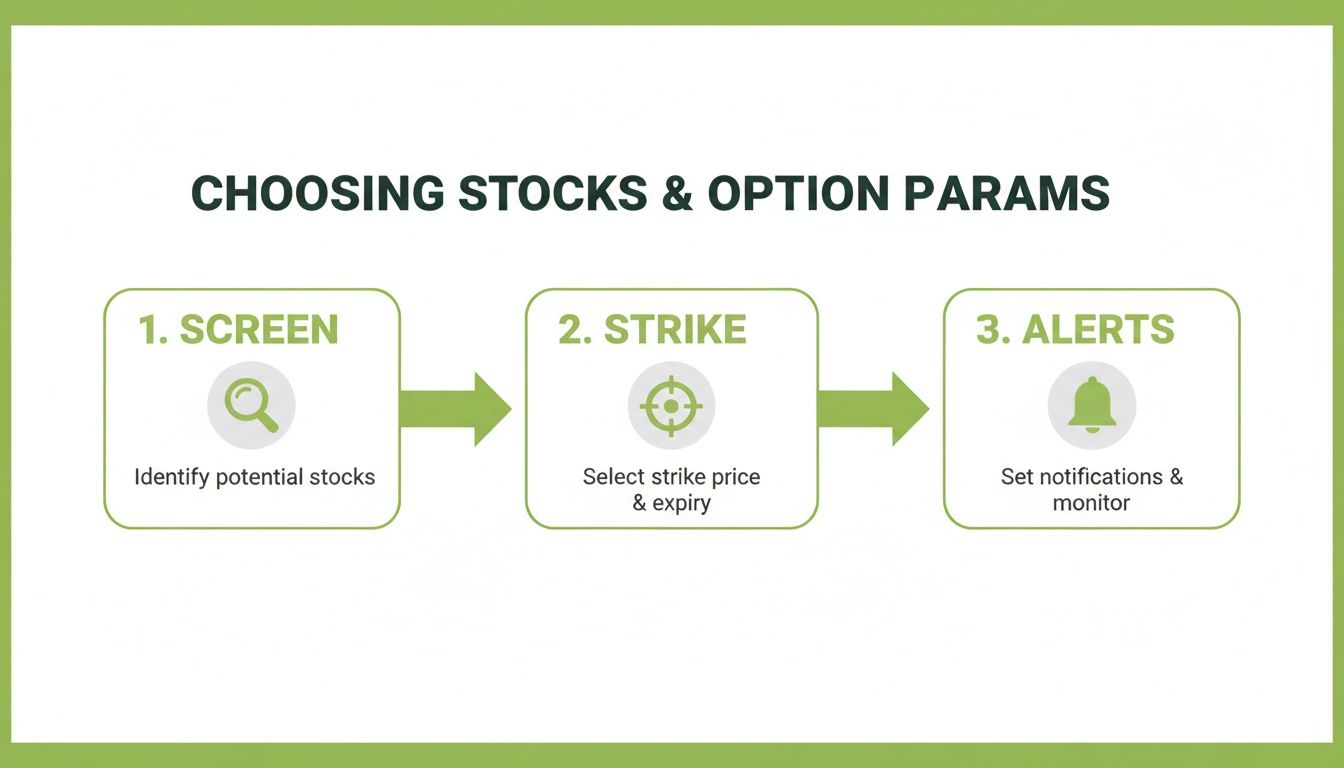
This infographic lays out a clear path: screen for candidates, select strikes, then set up alerts. Each step feeds into the next for a seamless covered-call workflow.
Traditional monthly covered calls often fall short on downside defense. From 2015 through 2025, the CBOE S&P 500 BuyWrite Index captured just 60% of gains in up quarters and 61% in down periods. Read the full research on AlphaArchitect.
Sample Ladder Model
A laddered structure scatters expirations to harness different time decay profiles. This approach spreads out fee impacts and evens out your premium intake.
| Expiration | Yield Range | Upside Potential | Risk Level |
|---|---|---|---|
| Weekly | 1%-2% | Moderate | Low |
| Bi-Weekly | 2%-4% | Balanced | Medium |
| Monthly | 4%-6% | Capped | Higher |
How To Layer Expirations
- Sell weekly calls about 20% OTM on a high-IV stock to capture steep short-dated theta.
- Add a monthly tranche at 5% OTM for heftier premium and extra upside buffer.
- Track assignment probabilities and roll weekly positions two days before expiry if delta climbs above 0.3.
Avoid stacking too many contracts on one expiration date. Stagger DTEs so you’re collecting premium every week without overloading any single period.
Case Study On High Volatility Stock
Imagine a tech name swinging ±10% in two weeks with IV rank near 70%. A mixed ladder entry sold:
- Weekly calls at 15% OTM for $120 per contract
- Monthly calls at 5% OTM for $300 per contract
Combining multiple expirations can boost total premium by up to 30% compared with single-date sales.
Over 30 days, this structure delivered 4.2% in premium income while the stock still rallied 7%—proof you can earn today’s income without giving up tomorrow’s upside.
By adjusting strike distances and layering expirations, you tailor risk to your market outlook. Next, we’ll dive into position sizing and assignment management.
Key takeaways on strikes and expirations:
- Set a target monthly yield and tie strikes to dashboard alerts.
- Batch expirations in a ladder to smooth your income curve and streamline roll timing.
- Avoid concentrated gamma risk by spacing out near-term dates.
With your strikes dialed in, you’ll be locking in premium while keeping room to win on the stock side.
Position Sizing And Risk Management
In my years trading covered calls, I’ve learned that smart position sizing is your best ally. One oversized assignment can knock an entire portfolio off course.
A handy guideline? Never risk more than 3% of your total capital on a single covered call trade.
- Keep each position within your loss tolerance.
- Build cushions with extra cash or margin to soften large swings.
- Dial back size when implied volatility jumps above its historical norm.
These adjustments protect your capital and keep your Greeks in a comfortable range.
Monitoring Delta Exposure
Think of delta as your directional compass. If it leans too heavily one way, a 1% market move can swing your P&L more than you’d like.
- Use your trading platform’s delta monitor or the Strike Price dashboard.
- Two days before expiration, trim contracts with delta above 0.3.
- Review your aggregate delta weekly—close or roll calls to rebalance.
Pairing calls with protective puts can cap downside while you collect premiums. And always match your margin use to your personal risk tolerance and regulatory limits.
Risk Dashboard Template
I start every month with a simple dashboard showing ticker, contracts, delta, days to expiry, and margin impact.
| Metric | Threshold |
|---|---|
| Max Position | 3% capital |
| Delta Exposure | ±15% |
| IV Spike Alert | >60% |
| Margin Use | <20% of cap |
Set stop levels around earnings or ex-dividend dates to avoid sudden swings.
Even low-cost covered-call ETFs have fees—0.29% at best—which still exceeds VOO’s expense ratio by 26 basis points. Read the full analysis on RationalMF.
Tracking Vega and Theta alongside delta completes your risk picture. Strike Price’s real-time alerts flag rising assignment probabilities and margin stress.
Key Takeaway
Small tweaks to position size and active Greeks monitoring build a sturdy income engine.
Managing Ex Dividend Risk
Ex-dividend dates often spark unexpected assignments as buyers chase the payout. I tighten my rules two days before the ex-date.
- Cap margin at 20% of buying power leading into ex-div.
- Watch price action hourly for sudden shifts.
- Roll or close calls once delta hits 0.1 near the ex-date.
A calendar alert gives you breathing room to adjust contracts or hedge.
Tracking Risk Metrics
Delta is only part of the story. Vega, Theta, and Gamma belong in your dashboard, too.
- Theta: Confirm time decay lines up with your premium goals.
- Vega: Prepare for volatility crushes, especially after earnings.
- Gamma: Steer clear of high-gamma trades when markets get choppy.
Review these Greeks weekly and flag any readings above your preset limits. Strike Price’s real-time Greeks tracker ensures you never miss a critical alert.
Scaling Tip
Adjust position size based on realized volatility to maintain a stable risk budget.
By blending disciplined sizing, dynamic Greeks monitoring, and timely stop rules, you’ll build a resilient covered-call strategy focused on steady income. Add small protective puts for tail-risk cover and use margin responsibly—never exceeding 50% collateral coverage. With this blueprint, you’ll be ready for whatever the markets throw your way.
Rolling And Tax Considerations
Rolling a covered call isn’t just a tweak—it’s a chance to reshape your income stream. Instead of letting contracts expire or face assignment, you can push your expiration date out and collect fresh premium. And if the stock has already jumped, moving your strike higher lets you ride more upside.
I stick to a simple personal rule: only roll up after a 5% rally and when implied volatility sits above its 30-day average. It keeps me honest and prevents chasing thin premiums.
Use these signals to guide your rolls:
- Roll Forward when theta is eating your premium faster than assignment risk looms—around 15–20 days to expiration.
- Roll Up after at least a 5% pop in the underlying and IV percentile north of 60%.
- Automate Alerts so you get pinged three days before expiry or when P/L reaches 70% of the original premium.
Mixing these triggers smooths your income without piling on hidden dangers. Strike Price’s custom roll alerts help you lock in the perfect moment.
Best Practices For Rolling
Never skip a quick liquidity check. Open interest and bid-ask spreads can make or break your roll execution.
I always verify those metrics on Strike Price’s dashboard. If spreads are wide or open interest is low, I might let the position ride rather than overpay for a roll.
Rolling out can defang assignment risk, while rolling up preserves stock upside.
| Roll Type | Benefit | Drawback |
|---|---|---|
| Roll Forward | Fresh premium and extra time | Caps potential stock gains |
| Roll Up | Locks in more upside | May sacrifice some premium |
Lining up these pros and cons helps me choose between steady yield or chasing further growth. After big news or earnings, I usually lean toward rolling forward to reset my timeline.
Tax Rules On Premiums
Since most covered calls expire within a year, premiums are treated as short-term capital gains and taxed at your ordinary income rate.
Keep your tax prep headache-free with these steps:
- Log every premium in a dedicated spreadsheet or trading journal.
- Record assignments separately to track cost basis and holding periods.
- Watch for wash sale rules if you repurchase similar options within 30 days.
Assignments that trigger stock sales or put exercises can create wash sale concerns. I maintain distinct records for premiums versus share transactions to dodge surprises.
For a complete walkthrough of tax nuances on premium income and assignments, check out our guide on taxes for covered calls.
Year End Reporting Tools
Good software turns a weeks-long slog into a quick review session. Platforms like TurboTax or ExampleTaxApp import option trades directly.
Strike Price exports your entire premium and assignment history in one clean CSV. Here’s my year-end checklist:
- Gather all option premium records and mark them as short-term gains.
- Compile every assignment and related stock transaction.
- Apply wash sale adjustments where necessary.
- Cross-reference your CSV with the 1099-B from your broker.
- Run it by your tax pro if anything feels off.
Tracking premiums and assignments throughout the year is the single best way to avoid surprises when filing.
Automate Roll And Tax Alerts
Strike Price’s Target Mode makes setting up both roll and tax notifications a breeze. You can trigger alerts for wash sale risks, roll deadlines, or P/L milestones—whatever fits your strategy.
That way, you’ll never miss a window or get caught off guard by a taxable event.
Real World Trade Walkthrough And Tips
I want to share a recent trade I ran on a major tech stock, turning my existing shares into an income engine with covered calls. Moments after pulling up my watchlist, the Strike Price dashboard lit up—implied volatility was higher than usual, hinting at fatter option premiums.

In that screenshot you see the stock’s current price, its IV rank, and the potential premium baked into my chosen strike.
Tracking Alerts On The Dashboard
- When IV rank hit 68%, I knew premiums were juicy.
- Target Mode flagged a 4.5% monthly income goal based on the $150 share price.
- Assignment probability sat at 22%, striking a solid balance between yield and early-exercise risk.
Strike Price then lines up each strike by target yield, so I can zero in on the highest-premium opportunities.
Here you see yields, days to expiration (DTE), and deltas side by side. For instance, the $160 strike showed a 3.8% monthly premium with 30 days left.
Executing The Covered Call Order
I locked in the $160 strike by selling one contract against my 100 shares at a $3.80 premium. A limit order at the midpoint guaranteed that 3.8% return—no nasty slippage in a fast-ticking tape.
- Confirm you hold 100 shares in your margin account.
- Aim for a delta around 0.25 to balance premium against assignment odds.
- Place your limit order at the bid-ask midpoint to capture the quoted price.
Selling a 0.25 delta call with clear entry rules helped me net $380 instantly.
Managing When To Roll Or Close
As the stock drifted near my strike, I set two clear thresholds: a 5% rally to roll up or a 2% drop to close out. Two days before expiration, assignment probability spiked past 35%, so I rolled forward to buy extra time.
| Trigger | Action |
|---|---|
| Price > 5% Gain | Roll Up Strike |
| Price – 2% Drop | Close Position |
| Assignment > 35% | Roll Forward DTE |
That move added another $200 in premium while keeping me positioned for further upside.
Quick Replication Checklist
- Enable alerts for IV rank and assignment probability.
- Use Target Mode to rank strikes by monthly yield.
- Always use limit orders at the midpoint to avoid slippage.
- Watch assignment odds two days before expiry.
Keep this checklist handy—drop it into your trading platform and trust the process.
Personal Tips For Smooth Execution
I favor mid-week entries to dodge Monday and Friday gamma swings. Also, the first third of your DTE window often delivers the richest theta. If IV dips below its 20-day average, I pause new trades until it rebounds.
- Avoid stacking expirations in the same week.
- Cross-check earnings dates to prevent surprise assignments.
- Lean on protective puts only if you see volatility about to surge.
These simple habits help you sidestep early assignment and squeezed premiums. Small wins here compound into steady income over time.
Key Takeaways From The Walkthrough
- Real-time alerts pinpoint ideal entry points and strike ranking.
- Limit orders lock in your target premiums with minimal slippage.
- Well-timed rolls capture extra income and manage assignment risk.
- Spreading expirations smooths out cash flow and reduces concentration.
- A concise checklist turns this into a repeatable income strategy.
This example on a high-volume tech name shows how disciplined steps can generate 4% or more each month. You now have a narrative guide and practical blueprint—go ahead and place your first covered call today.
Remember to review your dashboard after each trade and refine your approach.
FAQ
Before you roll out your first covered call, nail down some risk controls. A good starting point is capping each trade at about 3% of your portfolio. From there, spread your positions across sectors and vary your strike distances to keep any single risk from dominating.
Here are a few solid guardrails to consider:
- 5–8% hard stops on stock swings to limit losses
- No single ticker representing more than 10% of your holdings
- A cash buffer set aside for surprise assignments
- Backtesting stop levels against past market downturns
Keep a trading journal and review every single trade. When volatility regimes shift, tweak those caps so they stay in line with current conditions.
Weekly Vs Monthly Expirations
Time decay really picks up in the final days before expiry. You might see 1–2% from weeklies each week, but your commissions will add up. On the flip side, monthlies often deliver 3–5% premiums and give theta a chance to work more smoothly.
| Option Term | Typical Yield | Trade Frequency |
|---|---|---|
| Weekly | 1–2% | High |
| Monthly | 3–5% | Moderate |
Balance the burst of weekly income against the friction of fees, or stick with monthlies if you prefer a steadier pace.
Early Assignment Scenarios
When early assignment hits, your broker sells your shares at the strike price—sometimes well before expiration. You can either redeploy the cash into a fresh covered call or rotate into a dividend-paying stock. Just watch your tax lots; short-term gains can be a nasty surprise.
Early assignment often spikes around ex-dividend dates and on deep in-the-money calls.
Checking assignment calendars every week will help you stay one step ahead.
Portfolio Income Integration
Covered-call premiums work beautifully alongside bonds and dividend stocks, smoothing out the bumps in your cash flow. A rough allocation might look like this:
- 30–50% in option premiums
- 30–40% in fixed income
- Remainder in dividend payers
Then, every quarter, rebalance to lock in gains and reset risk targets. A few pointers:
- Mix income sources to keep cash flowing steadily
- Roll strikes after big moves to stay in control
- Keep an eye on your total yield versus a 6–8% annual goal
Ready to maximize your covered-call premium income? Try Strike Price for real-time probability insights and alerts.