
A Practical Guide to Learn How to Trade in Options
If a stock moves past your strike, the option can be assigned — meaning you'll have to sell (in a call) or buy (in a put). Knowing the assignment probability ahead of time is key to managing risk.
Posted by
 John Clarke
Related reading
Out of Money Call Options A Guide to Consistent Income
Learn how to use out of money call options to generate consistent income. This guide covers key strategies, risk management, and real-world examples.
How Options Are Priced A Practical Guide for Investors
Understand how options are priced with this clear guide. Learn about intrinsic value, implied volatility, and pricing models to improve your investing strategy.
Greek Options Explained for Income Traders
Unlock your options trading potential. This guide on greek options explained shows you how to use Delta, Gamma, and Theta to generate consistent income.
So, you want to learn how to trade options. It all starts with two basic building blocks: Calls (a bet that a stock will go up) and Puts (a bet that it will go down).
Once you get those down, you can move on to simple, income-focused strategies like selling Covered Calls on stocks you already own or using Cash-Secured Puts to buy shares you want at a discount. The real key is to nail these fundamentals before you even think about trying more complex trades.
Building Your Foundation in Options Trading
Jumping into options without getting the basics right is like trying to build a house with no blueprint. It’s not going to end well. Before you place a single trade, you absolutely have to understand what an option contract is and get comfortable with the lingo.
At its core, an option is just a contract. It gives the buyer the right, but not the obligation, to buy or sell a stock at a set price, on or before a specific date. That distinction is everything—it gives you a flexibility that just buying or selling shares can't offer.
The Two Pillars: Call and Put Options
Everything in the options world is built on two types of contracts. Understanding what they do is the first real step on your trading journey.
Call Options: You use these when you’re bullish on a stock, meaning you expect its price to go up. Buying a call gives you the right to buy 100 shares of a stock at a specific price, hoping to get it for less than its future market value.
Put Options: These are for when you’re bearish and think a stock’s price is going to drop. Buying a put gives you the right to sell 100 shares at a set price, which can protect you from a downturn or let you profit from it.
If you want to go deeper into how these contracts actually work, check out our guide on how options trading works and its core concepts.
To make things even clearer, here's a quick side-by-side comparison.
Call Options vs Put Options at a Glance
This table breaks down the core differences between call and put options, helping you see exactly when and why you'd use each one.
| Feature | Call Option | Put Option |
|---|---|---|
| Market Outlook | Bullish (You expect the price to rise) | Bearish (You expect the price to fall) |
| Right Granted | The right to buy 100 shares | The right to sell 100 shares |
| When It's Profitable | When the stock price rises above the strike price | When the stock price falls below the strike price |
| Primary Use Case | To profit from an anticipated price increase | To profit from or hedge against a price decrease |
Think of this table as your cheat sheet. When you're bullish, you lean towards calls. When you're bearish, puts are your go-to.
Understanding Key Contract Terms
Every single option has three main parts that define its value and how it behaves. Getting these terms down will make analyzing potential trades a whole lot easier.
Strike Price: This is the locked-in price where you have the right to buy (for calls) or sell (for puts) the stock. It’s the number that determines if your option is profitable when it expires.
Expiration Date: Options don't last forever. This is the last day the contract is valid. If it hasn't been exercised by this date, the option becomes worthless.
Premium: Think of this as the price tag on the contract itself. It’s what the buyer pays the seller for the rights the option provides.
Options trading has exploded in popularity, with everyone from new retail traders to big institutions getting in on the action. In a record-breaking month, Cboe Global Markets reported an average daily volume of 20.5 million options contracts in September 2025. Index options like the S&P 500 alone saw a 27.1% jump in volume compared to the previous year.
Generating Income with Beginner-Friendly Strategies

Alright, let's move from the theory to the practical stuff: making money. Instead of chasing those lottery-ticket trades, we're going to focus on two of the most reliable strategies for building a consistent income stream: the Covered Call and the Cash-Secured Put.
Think of this as a repeatable process. The goal isn't to predict wild price swings but to consistently collect small payments, known as premium. This is how you learn how to trade in options without taking on scary, undefined risk.
The Covered Call: Your First Income Strategy
A covered call is probably the simplest way to generate income from stocks you already own. You're essentially selling someone the right to buy your shares at a higher price in the future.
Here's the basic idea:
- You need to own at least 100 shares of a stock for every call contract you want to sell. This is what makes the call "covered"—you already have the shares.
- You get paid a premium immediately just for selling the option. That cash is yours to keep, no matter what happens.
- Ideally, the stock price stays below your chosen strike price until the option expires. If it does, the option becomes worthless, and you get to keep both your shares and the premium.
This strategy is perfect if you're neutral or just slightly bullish on a stock you're holding for the long term. You're basically getting paid to wait, and you're okay with selling your shares for a profit if the price takes off.
Real-World Trade Example: Covered Call on XYZ Corp
Let's say you own 100 shares of XYZ Corp, which you bought for $45 a share. It’s now trading at $50. You decide to sell one call option with a $55 strike price that expires in 30 days. For making this deal, you collect a premium of $1.50 per share, pocketing $150 upfront ($1.50 x 100 shares).
Breaking Down the Covered Call Outcomes
Once you've sold that call, one of two things will happen by the expiration date.
Scenario 1: Stock Stays Below the Strike Price
If XYZ closes at or below $55 on expiration day, the option expires worthless. The buyer isn't going to buy your shares for $55 when they're cheaper on the open market.
- Result: You keep the $150 premium, and you keep your 100 shares of XYZ. Now you can turn around and sell another covered call for the next month.
Scenario 2: Stock Moves Above the Strike Price
If XYZ rallies and closes above $55 (let's say it hits $58), your option is likely "assigned." This is just the formal term for being required to sell your 100 shares at the $55 strike price you agreed to.
- Result: You sell your shares for $5,500 ($55 x 100). Your total profit is the $1,000 capital gain from the stock ($55 sale price - $45 cost basis) plus the $150 premium you collected, for a total of $1,150. The trade-off? You miss out on any gains the stock made above $55.
The Cash-Secured Put: Getting Paid to Buy Stocks
The cash-secured put is another fantastic income strategy. It lets you either buy a stock you want at a discount or just walk away with free premium. When you sell a put, you're agreeing to buy 100 shares of a stock at a certain price (the strike price) if the stock drops below that level.
To make it "cash-secured," you have to have enough cash in your account to actually buy the shares. This is key—it keeps you from getting into a risky, leveraged position. And just for making this promise, you get paid a premium right away.
It's strategies like these that have brought millions of new traders into the market. The Options Clearing Corporation saw retail investors trade a record 12 million options contracts in 2024. That momentum continued into 2025, with over 6 million retail contracts traded by midyear, thanks to commission-free apps and better learning resources. If you're interested, you can explore more about how retail traders are driving record options volumes and reshaping the market.
Cash-Secured Put Trade in Action
Let's walk through a quick example.
Real-World Trade Example: Cash-Secured Put on ABC Inc.
You want to buy 100 shares of ABC Inc., but you feel its current price of $92 is a little steep. You'd be thrilled to get it for $85. So, you sell one put option with an $85 strike price that expires in 45 days. You immediately collect a $2.00 per share premium, totaling $200. To make this trade "secured," you must set aside $8,500 ($85 x 100 shares) to cover the potential purchase.
Just like with the covered call, there are two main outcomes. If ABC stays above $85, the put expires worthless. You keep the $200, and the $8,500 you set aside is freed up.
If ABC drops below $85, you'll be assigned and must buy the 100 shares for $8,500. But here's the cool part: your actual cost basis is only $83 per share ($85 strike price - $2 premium). You got exactly what you wanted—to buy the stock at a discount to where it was trading.
Using Probability to Select Better Strike Prices
Picking a strike price can feel like a shot in the dark, especially when you’re starting out. It's easy to get drawn in by the highest premium or just choose a number that "feels right." But that’s a guessing game, and guessing is not a sustainable trading strategy.
A much smarter approach is to use simple probability to stack the odds in your favor. Instead of throwing darts, you can make data-driven decisions that match your actual income goals and risk tolerance. This is one of the most important steps if you want to learn how to trade in options with any kind of consistency.
Meet Delta: Your Go-To Probability Gauge
The best tool for the job is a metric called Delta. While its technical definition involves how much an option’s price changes, for an options seller, it's a fantastic real-time probability estimate.
In short, an option's Delta gives you a rough idea of the chances it will expire in-the-money (ITM). For sellers, this translates directly to the probability of being assigned.
A call option with a .20 Delta, for example, has roughly a 20% chance of finishing in-the-money. This also means it has an 80% chance of expiring worthless—which is exactly what you want when you're collecting premium.
Putting Delta to Work in Your Trades
Finding Delta is easy. Every decent trading platform displays the "Greeks" (Delta, Gamma, Theta, Vega) right in the options chain. You just have to make sure those columns are visible.
Once you can see it, you can use Delta to filter for trades that fit your style.
- For Conservative Trades: Look for options with a low Delta, typically .20 or less. Selling a put with a .20 Delta gives you an implied 80% probability of the trade expiring profitably.
- For a Bit More Aggression: You could choose a higher Delta, like .30 or .40. The premium will be higher, but so is the chance of assignment (30% or 40%, respectively).
By picking a Delta that aligns with your target win rate, you’re building a rules-based system. You stop reacting to market noise and start executing a plan with a statistical edge on your side.
Trader's Tip: For out-of-the-money options, a quick way to calculate the probability of profit (POP) is 100 - Delta. A call option with a .25 Delta has about a 75% chance of expiring worthless, making it a solid high-probability trade.
A Real-World Example with Delta
Let’s see how this works in practice. Imagine stock XYZ is trading at $100 a share, and you're looking to sell a covered call that expires in 30 days.
You pull up the options chain and see a couple of choices:
- The $105 strike call has a Delta of .35 and pays a $2.00 premium.
- The $110 strike call has a Delta of .20 and pays a $1.10 premium.
A beginner might jump at the higher $2.00 premium from the $105 strike. But its .35 Delta signals a 35% chance of having your shares called away. That's a pretty significant risk.
A trader using probabilities, however, sees the $110 strike as a much better fit for an income strategy. The .20 Delta means there's an 80% chance you keep both your shares and the premium. The smaller premium is simply the cost of buying yourself a higher degree of safety.
This trade-off is the heart and soul of successful options selling. To dig deeper into the numbers, check out guides on using an option probability calculator to really fine-tune your trade selection.
More Than Just One Number
Of course, Delta isn't the only thing that matters. It’s a snapshot in time and will shift as the stock price moves and volatility changes.
But using it as your main filter for choosing strike prices is a huge leap forward from just guessing. It transforms your trading from a gamble into a strategic process grounded in probability. Over the long run, consistently making high-probability trades is what builds your account and your confidence as a trader.
Mastering Risk Management from Day One
Your long-term success in options trading won't be defined by your winners. It’ll be defined by how you handle your losers.
It’s a hard lesson, but a crucial one. A huge win means nothing if you give it all back—and then some—on the next trade. This is exactly where most new traders get wiped out, making risk management the single most important skill you can learn.
Your number one job is to protect your capital. Everything else, including making money, is a distant second. The real goal is to stay in the game long enough for your strategies to actually work.
The Golden Rule of Position Sizing
The fastest way to blow up an account? Bad position sizing. So many traders get a "sure thing" feeling and go all-in, risking a massive chunk of their capital on one idea.
Let me be clear: there are no sure things in the market.
A disciplined trader never risks more than 1% to 2% of their total portfolio on a single trade. It’s that simple.
- Got a $10,000 account? Your max loss on any trade should be between $100 and $200.
- Working with $25,000? Your risk limit is $250 to $500.
This rule isn't just about the numbers; it forces discipline. It makes it impossible for one bad trade to cripple your account and, just as importantly, it keeps emotions from hijacking your decisions. To really nail this down, check out these essential best practices for risk management and build that solid foundation.
Know Your Exit Before You Enter
You should know exactly when you're getting out of a trade before you even click the "buy" or "sell" button. That means setting both a profit target and a stop-loss. An exit plan isn't a sign of weakness; it's what professionals do.
For options sellers, a great rule of thumb is to take profits after capturing 50% of the maximum premium. Say you sell an option for a $1.50 premium ($150 total). You can immediately place an order to buy it back once its value drops to $0.75. This locks in your profit early, frees up your capital, and you don't have to sweat it out until expiration.
On the flip side, your stop-loss is your emergency eject button. A common practice is to close the trade if the premium doubles against you. Using that same $1.50 premium, your stop-loss would trigger if the option's price climbs to $3.00. You take a manageable $150 loss and move on.
Navigating Assignment and Rolling Trades
When you sell options, the risk of assignment is always there. It’s not the end of the world—it’s just the contract being fulfilled. If you sell a cash-secured put, you buy the shares. Sell a covered call, you sell your shares.
The key is to only enter trades where you are genuinely okay with that outcome at the strike price you chose.
But what if a trade moves against you before expiration? You have two choices: take the loss or "roll" the trade. Rolling means closing your current position and opening a new one further out in time (and maybe at a different strike), usually for a net credit.
The decision to roll has to be strategic. Ask yourself one simple question: "Has my original reason for this trade changed?" If the stock's outlook has soured, it's often better to just accept the small loss. Don't roll a bad trade just to avoid admitting you were wrong.
Because options can involve significant leverage, it's also critical to understand what a margin call is and how it works.
This disciplined approach is what separates traders who last from those who burn out. The global options market is always shifting. For example, in April 2025, while global options volume fell to 6.66 billion contracts, North America's volume actually jumped 26.4% to 1.43 billion contracts. Watching these kinds of trends in volume and open interest gives you valuable clues about market sentiment and liquidity—both key pieces of risk assessment. You can discover more insights about global derivatives volumes on FIA.org.
As you begin your trading journey, understanding the landscape of potential risks is paramount. The table below outlines some of the most common challenges new options traders face and offers practical ways to manage them.
Common Options Trading Risks and Mitigation Strategies
| Risk Type | Description | Mitigation Strategy |
|---|---|---|
| Position Sizing Risk | Risking too much capital on a single trade, leading to catastrophic losses. | Never risk more than 1-2% of your total portfolio value on one position. |
| Market Risk | The underlying stock moves unexpectedly against your position due to broad market events. | Use stop-losses to define your maximum loss before entering a trade. Stay diversified. |
| Assignment Risk | The obligation to buy or sell the underlying stock when selling an option. | Only sell options on stocks you are willing to own (puts) or sell (calls) at the strike price. |
| Volatility Risk | Changes in implied volatility (IV) can negatively impact the price of your option. | Be aware of IV levels before entering a trade. Avoid selling options right before major news like earnings. |
| Liquidity Risk | Inability to easily exit a position due to low trading volume for a specific option contract. | Trade options on highly liquid underlying stocks with tight bid-ask spreads and high open interest. |
Think of this table not as a list of things to fear, but as a roadmap for building a resilient trading plan. By anticipating these risks and having a clear strategy for each, you put yourself in a position to trade with confidence and discipline.
Walking Through a Trade from Start to Finish
Theory is great, but let's be honest—it doesn't really click until you see a trade play out in the real world. So, let’s walk through two classic examples from start to finish: a covered call on a popular tech stock and a cash-secured put on a stable, dividend-paying company. Think of these as blueprints you can follow.
Example 1: The Covered Call on a Tech Stock
Let's say you own 100 shares of a well-known tech company, Innovate Corp (ticker: INOV), which is currently trading at $150 per share. You're bullish long-term, but you don't see it rocketing up in the next month. This is the perfect spot to generate a little extra income.
Your goal here is simple: collect a premium without a high risk of having to sell your shares. Using a probability-based approach, you pull up the options chain for INOV and look for a call expiring in about 30 days. You want a strike with a Delta around .20, which gives you a roughly 80% probability that the option will expire worthless.
You spot the $160 strike call. It has a Delta of .22 and is paying a premium of $2.50 per share. Perfect. You decide to sell one contract.
- Action: Sell to Open 1 INOV $160 Call Contract
- Premium Collected: $250 ($2.50 x 100 shares)
- Your Obligation: You're now on the hook to sell your 100 INOV shares for $160 each if the stock is trading above $160 when the option expires.
Now, you just monitor the trade. Ideally, INOV’s stock price just drifts around between $150 and $160. If the option's value drops to $1.25 (a 50% profit), you could buy it back to close the trade early, locking in $125 and freeing up your shares to sell another call. But if the stock rallies hard past $160, you have to be ready for assignment.
Example 2: The Cash-Secured Put for Income or Acquisition
Next up, let's look at a stable company that pays a nice dividend, Solid Goods Inc. (ticker: SGI). It’s currently trading at $48 a share. You like the company and would be happy to own it, but you think $45 is a much better entry point. This is exactly what cash-secured puts were made for.
You check the options chain expiring in 45 days and find a strike below the current price. The $45 strike put has a Delta of .30 and offers a premium of $1.10 per share. That .30 Delta means you have a slightly higher chance of assignment (around 30%), but you're fine with that—you actually want to buy the stock at that price.
To make this trade, you need to have $4,500 in cash set aside in your account ($45 strike x 100 shares) to secure the put.
- Action: Sell to Open 1 SGI $45 Put Contract
- Premium Collected: $110 ($1.10 x 100 shares)
- Your Obligation: You are obligated to buy 100 SGI shares for $45 each if the stock price is below $45 at expiration.
So what happens? If SGI stays above $45, the option expires worthless. You just pocket the $110 as pure profit—a nice 2.4% return on your secured cash in just 45 days. If the stock drops to $44, you get assigned. You buy the 100 shares for $4,500, but because you collected that premium, your effective cost basis is only $43.90 per share ($45 strike - $1.10 premium). You got the stock you wanted at a discount.
This is a simple flow for how to approach risk with any trade.
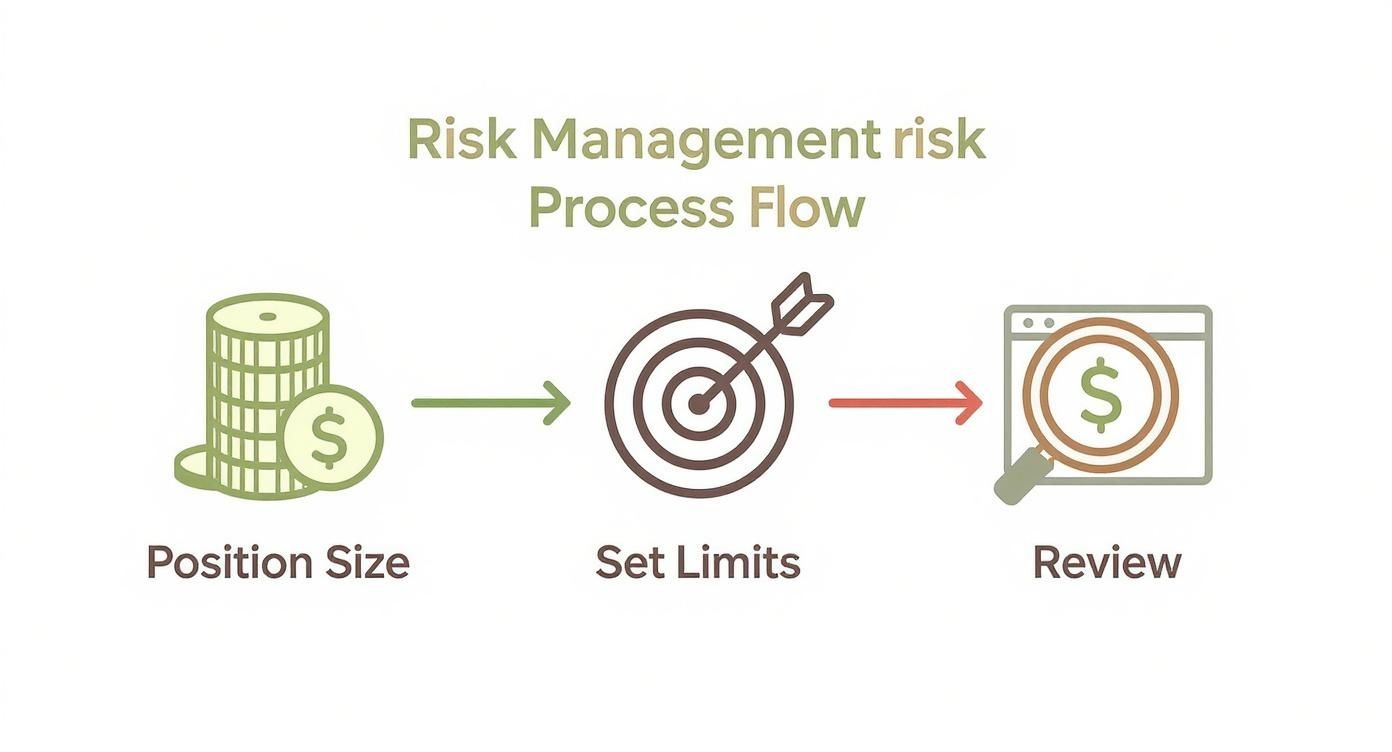
It’s a good reminder that every single trade should start with deciding your position size, setting clear profit and loss limits, and always reviewing your open positions.
Key Takeaway: Neither the covered call nor the cash-secured put is about perfectly predicting where the market is headed. They're about setting up a win-win situation where you either collect income or you achieve a goal you already had: selling your stock high or buying a stock low.
Your Questions Answered
When you're starting out with options, a million questions pop into your head. That's totally normal. Getting clear answers is how you build the confidence to actually place a trade. Let's tackle some of the most common ones I hear from new traders.
How Much Money Do I Need to Start Trading Options?
There’s no magic number here, but the real answer is: enough to do more than just one trade. How much you need really boils down to the strategies you want to run.
If you're selling cash-secured puts, you absolutely must have the cash on hand to buy 100 shares at the strike price. So, if you sell a put with a $40 strike, that means you need $4,000 sitting in your account, ready to go. For covered calls, you need to own at least 100 shares of the stock first.
A good starting point for many is somewhere in the $2,000 to $5,000 range. This gives you enough room to diversify a bit and, more importantly, absorb a few losses while you're on the learning curve—and trust me, there is a learning curve. The golden rule? Start small and only trade with money you can genuinely afford to lose.
What Is the Biggest Mistake Beginners Make?
Easy. The most common—and most expensive—mistake is jumping into flashy, high-risk strategies without even knowing the basics. New traders get lured in by the promise of massive returns from buying cheap, far out-of-the-money options. They treat them like lottery tickets and, almost always, lose their entire investment.
Another huge blunder is terrible risk management. They'll use a position size that's way too big for their account. All it takes is one bad trade to wipe out weeks of hard-earned gains.
The smarter path is to start with simple, income-focused strategies like covered calls and cash-secured puts. Get your process down, manage your risk on every single trade, and you'll build a sustainable foundation for long-term success.
What Happens If My Option Gets Assigned?
First off, don't panic. Assignment isn't some trading disaster you need to fear; it's just a normal part of the process. It simply means the contract is being fulfilled exactly as you agreed it would be.
- If you sell a covered call and get assigned, you'll sell your 100 shares at the strike price. You get to keep the premium you collected upfront.
- If you sell a cash-secured put and get assigned, you'll buy 100 shares of the stock at the strike price, using the cash you already set aside.
In both situations, the key is being prepared from the start. You should only be selling options on stocks you're actually okay with owning (for puts) or selling (for calls) at the price you chose.
Can I Lose More Money Than I Invested in Options?
This is a big one, and the answer completely depends on your strategy.
When you buy a call or a put, your risk is capped. The absolute most you can lose is the premium you paid for that option. That’s it. Your risk is defined the second you enter the trade.
It's when you sell options that the risk profile can get a lot scarier.
Now, with a cash-secured put or a covered call, your risk is still defined and limited. The real danger lies in selling "naked" or "uncovered" calls. In that scenario, your potential loss is theoretically infinite because there’s no limit to how high a stock’s price can climb. This is exactly why beginners should stick to covered and secured positions and avoid undefined risk strategies at all costs.
Ready to stop guessing and start making data-driven decisions? Strike Price provides real-time probability metrics for every strike price, helping you balance safety and premium. Get smart alerts and track your portfolio with a tool designed for income-focused options traders. Learn more and start your journey at Strike Price.