
Sell to Open A Trader's Guide to Options
If a stock moves past your strike, the option can be assigned — meaning you'll have to sell (in a call) or buy (in a put). Knowing the assignment probability ahead of time is key to managing risk.
Posted by
 John Clarke
Related reading
Out of Money Call Options A Guide to Consistent Income
Learn how to use out of money call options to generate consistent income. This guide covers key strategies, risk management, and real-world examples.
How Options Are Priced A Practical Guide for Investors
Understand how options are priced with this clear guide. Learn about intrinsic value, implied volatility, and pricing models to improve your investing strategy.
Greek Options Explained for Income Traders
Unlock your options trading potential. This guide on greek options explained shows you how to use Delta, Gamma, and Theta to generate consistent income.
When you sell to open an options contract, you're essentially creating a new position from scratch by selling an option you don't already own. This makes you the seller or writer of the contract.
Think of it like writing an insurance policy. You collect an immediate payment (the premium) from the buyer. In return, you take on an obligation—like promising to sell your shares or buy their shares at a set price if certain conditions are met. Your goal is for that "policy" to expire worthless, letting you pocket the entire premium as profit.
Understanding the Four Core Option Trades
To really get a feel for sell to open, it helps to see how it fits in with the other three basic orders. Every move you make in the options market is either opening a brand new position or closing one you already have. This simple idea creates a powerful four-part framework that defines every trade.
Opening vs. Closing Positions
At its heart, "opening" a position just means you're starting a new trade. You’re either buying a contract you don't own or selling one you don't hold. "Closing," on the other hand, means you're getting out of a trade you're already in.
This distinction is crucial because your goals are completely different. When you open a position, you're acting on a belief about where a stock might go. When you close, you're looking to cash in on a profit or cut your losses based on how things actually played out. This is a foundational concept in understanding how options trading works and brings clarity to every order you place.
The Four Essential Order Types
Each of the four main order types has a unique job, and together they form the building blocks for every options strategy out there. Sell to open is just one piece of that puzzle.
The table below breaks down how each order works, what you're trying to achieve, and a simple analogy to make it all click. Think of this as your go-to reference as we dig deeper into the mechanics of selling options.
The Four Core Option Order Types Explained
| Order Type | Action | Objective | Analogy |
|---|---|---|---|
| Buy to Open | Starting a new trade by buying an option. | To profit from the contract's value increasing. | Buying a concert ticket, hoping its value rises as the show date nears. |
| Sell to Close | Exiting a trade by selling an option you own. | To lock in profits or cut losses on a long position. | Selling your concert ticket for a profit before the show begins. |
| Sell to Open | Starting a new trade by selling an option. | To profit from the contract's value decreasing. | Writing an insurance policy and collecting a premium, hoping no claim is made. |
| Buy to Close | Exiting a trade by buying back an option you sold. | To lock in profits or cut losses on a short position. | Buying back the insurance policy you wrote, ideally for less than you were paid. |
This framework makes it clear: when you’re selling to open, you're kicking off a short options position with the hope that the contract’s value goes to zero. If it does, you won’t have to do a thing to close it—you just keep the cash.
How a Sell To Open Order Really Works

Placing a sell to open order is a lot more intuitive than its technical name suggests. At its core, you're creating and selling a brand new options contract right from your brokerage account. This is the first step you’ll take for popular income strategies like covered calls and cash-secured puts.
It all starts with picking a stock you know and are comfortable owning (or selling). From there, you decide whether to sell a call or a put option, a choice that hinges entirely on your outlook for that stock.
The Anatomy of the Trade
Once you’ve got your stock and option type, it’s time to define the terms of the contract. This comes down to two key variables: the strike price and the expiration date.
- Strike Price: This is the price you agree to sell your shares at (for a call) or buy shares at (for a put). It’s the line in the sand.
- Expiration Date: This is when the contract ends. If the option isn't exercised by this date, your obligation simply vanishes.
After you punch in these details, your broker shows you the premium—the cash you get for selling the contract. As soon as your order fills, that premium hits your account almost instantly. For instance, selling one contract for a $1.50 premium puts $150 (100 shares x $1.50) directly into your buying power.
This instant credit is the main draw for option sellers. But it's not free money. It's your compensation for taking on the contract’s obligation, and it represents your maximum possible profit on the trade.
The Mindset Shift: Obligation Over Ownership
This is where you need to think differently. When you buy a stock, you're hoping its value goes up. But when you sell to open, you're accepting a specific responsibility. You've made a promise to whoever bought the contract from you.
That promise—your obligation—will be one of two things:
- For a Call Option: You are obligated to sell 100 shares of the stock at the strike price if the buyer decides to exercise their right.
- For a Put Option: You are obligated to buy 100 shares of the stock at the strike price if the buyer exercises their right.
This is the fundamental difference that separates option sellers from buyers. You’re collecting cash upfront in exchange for a potential future commitment. Success means managing that commitment wisely, hoping the contract you sold expires worthless. If it does, you simply keep the entire premium, and the trade is over.
Popular Income Strategies Using Sell To Open
Alright, you get the mechanics of a sell to open order. Now for the fun part: putting that knowledge to work.
Let’s dive into two of the most popular income strategies in the options world: the Covered Call and the Cash-Secured Put.
These are go-to strategies for a reason. They shift your mindset from chasing speculative gains to generating consistent, predictable cash flow. Instead of just buying a stock and crossing your fingers, these techniques let you get paid while you wait.
We'll use a simple, real-world example to break down exactly how each strategy works, turning the theory into something you can actually use.
The Covered Call: Generating Income From Stocks You Own
The covered call is a classic for investors who already own at least 100 shares of a stock. It's a way to earn extra cash by agreeing to sell those shares at a specific price down the road.
Imagine you own 100 shares of XYZ stock, currently trading at $48 per share. You think the stock is more likely to trade sideways or maybe inch up a bit, but you aren't expecting a massive rally. This is the perfect setup to sell to open a covered call.
Here’s how it plays out:
- Your Position: You own 100 shares of XYZ.
- Your Action: You sell to open one XYZ call option contract.
- The Terms: You pick a $50 strike price that expires in 30 days.
- The Premium: For selling the contract, you instantly collect a premium of $1.50 per share. That's $150 in cash ($1.50 x 100 shares) deposited right into your account.
Why "covered"? Because you already own the underlying shares. If the option buyer decides to exercise their right, you aren't scrambling to buy shares on the market; you simply deliver the ones you already have.
A covered call is like renting out a room in a house you already own. You collect rent (the premium) from a tenant (the option buyer) for giving them the right to potentially buy your house (the stock) at a set price.
So, what happens when the expiration date rolls around?
- Outcome 1: Stock Stays Below $50. If XYZ is trading at $49.99 or less when the option expires, it expires worthless. The buyer won't pay $50 for shares they can get cheaper on the open market. You keep the $150 premium and your 100 shares. Win-win.
- Outcome 2: Stock Rises Above $50. If XYZ climbs to $52, the buyer is definitely going to exercise their right to buy your shares for $50. You sell your 100 shares for $5,000 ($50 x 100). Don't forget, you also keep the initial $150 premium, bringing your total take to $5,150. Sure, you missed out on the gains above $50, but you locked in a profitable exit.
The Cash-Secured Put: Getting Paid to Buy Stocks at a Discount
The cash-secured put is the other side of the income coin. Instead of selling a call on a stock you own, you sell to open a put on a stock you want to own—but at a better price.
Let's stick with XYZ stock, still trading at $48 per share. You like the company, but you’d feel a lot better about buying in if you could get a discount.
Here's the cash-secured put setup:
- Your Goal: You want to buy 100 shares of XYZ, but cheaper.
- Your Action: You sell to open one XYZ put option contract.
- The Terms: You choose a $45 strike price that expires in 30 days.
- The Premium: You collect a $1.00 per share premium, which puts $100 ($1.00 x 100 shares) in your pocket immediately.
The "cash-secured" part is critical: you need to have enough cash set aside to buy the shares if you're assigned. In this case, that’s $4,500 ($45 strike x 100 shares).
Now for the outcomes:
- Outcome 1: Stock Stays Above $45. If XYZ is trading at $45.01 or higher at expiration, the option expires worthless. The buyer has no incentive to sell you shares for $45 when the market price is higher. You just keep the $100 premium and can run the play again.
- Outcome 2: Stock Drops Below $45. If XYZ falls to $43, the buyer will exercise the option, and you're obligated to buy their 100 shares at the $45 strike price. But here's the beauty of it: your effective purchase price is actually $44 per share ($45 strike price - $1.00 premium). You just bought the stock you wanted, but at a solid discount from where it was trading when you started.
Understanding the Real Risks of Selling Options
While pocketing instant cash from selling an option feels like a win, the sell to open order comes with some serious responsibility. It's not free money. Unlike buying an option where your loss is capped at whatever premium you paid, selling an option opens the door to much, much larger obligations. You have to respect what can happen if the trade turns against you.
The biggest risk for any option seller is assignment. This is the moment of truth when the option buyer decides to exercise their right, forcing you to make good on your end of the bargain. When you're assigned, your broker doesn't wait for your permission; they automatically execute the trade, either by selling your shares or buying them on your behalf.
Defined Risk vs. Unlimited Risk
Not all option selling strategies are built the same. The amount of risk you’re taking on depends entirely on what kind of option you sell and whether you have the position secured.
- Cash-Secured Puts: This strategy comes with a defined risk. Your absolute maximum loss is the strike price minus the premium you collected, and that only happens if the stock goes all the way to zero. The obligation is crystal clear: you have to buy 100 shares at the strike price, a promise you've already backed up with cold, hard cash.
- Covered Calls: This also has a defined risk, though it's more about what you miss out on—an opportunity cost. Your "risk" here is the stock price taking off like a rocket, soaring way past your strike price. You'll have to watch those gains from the sidelines because you’re obligated to sell your shares at the lower strike price.
- Naked Calls: Now this is where things get scary. This strategy carries theoretically unlimited risk. If you sell a call option without actually owning the 100 shares to back it up, you’re trading "naked." Should the stock price shoot to the moon, you’re on the hook to buy shares at the sky-high market price just to sell them at the much lower strike price. This is how accounts get wiped out.
A huge part of managing these risks is being able to look at the market and think through the potential outcomes clearly. The better you can do that, the better you'll be at judging whether a premium is worth the obligation you're taking on. It helps to sharpen your critical thinking skills to make smarter moves. Because the stakes are so high, most brokers have extremely strict rules for selling naked options. To get the full picture, check out our guide on understanding options margin requirements.
A Tale of Two Traders
Selling an option completely flips the script on the classic risk-reward dynamic. Buyers are hunting for big, fast profits. Sellers, on the other hand, are playing a different game—they're aiming for consistent, smaller wins by collecting premiums over time.
This fundamental difference in goals and risk is what sets the two worlds apart. The table below really lays out the contrast.
Risk and Reward Profile: Buying vs. Selling Options
| Attribute | Buying an Option (Buy to Open) | Selling an Option (Sell to Open) |
|---|---|---|
| Max Profit | Theoretically Unlimited | Limited to the Premium Received |
| Max Loss | Limited to the Premium Paid | Substantial or Unlimited |
| Probability | Lower Probability of Profit | Higher Probability of Profit |
| Mindset | Seeking large price moves | Seeking time decay and stability |
This table shows exactly why selling options is so popular. It offers a higher probability of profit, which is incredibly appealing. Statistically, options trading has exploded, and "sell to open" orders are a massive part of what keeps the market liquid.
But there's a dark side to that growth. That same high-probability trade—short option writing—was a major contributor to the $2 billion in retail losses on options premiums reported between 2019 and 2021. This isn't just a number; it's a warning that while selling options can be a great income strategy, you have to manage your risk carefully to avoid becoming just another statistic.
Choosing the Right Strike Price and Expiration
Placing a sell to open order is the easy part. The real skill—what separates consistent income from a risky gamble—is picking the right strike price and expiration date. It all comes down to a calculated trade-off between the premium you collect and the risk you’re willing to take.
Two of the most important numbers you’ll want to watch are delta and the probability of profit. You can think of delta as a quick estimate for the odds that an option will end up in-the-money. A delta of 0.30, for instance, signals roughly a 30% chance of the option finishing in-the-money, and a 70% chance of expiring worthless.
What does this really mean for you? If you sell an option with a 0.30 delta, you have about a 70% probability of keeping the entire premium. That’s the statistical edge that option sellers live by.
The Role of Implied Volatility
Another huge factor is implied volatility (IV). Think of IV as the market’s collective forecast for how much a stock’s price might swing around. When IV is high, it’s like a storm warning for the stock—uncertainty is up, and so are option premiums.
Selling options when IV is high is often more profitable because you collect bigger premiums for taking on the same basic obligation. But that extra premium is compensation for higher perceived risk; the market expects the stock to be more erratic. On the flip side, low IV means smaller premiums but suggests calmer, more predictable waters ahead.
Finding Your Sweet Spot
Picking the right strike price is a balancing act. If you choose a strike price far away from the current stock price (out-of-the-money), your probability of success goes up, but the premium you collect will be smaller. Go with a strike closer to the stock's current price, and you’ll get a juicier premium, but your risk of being assigned goes up, too. This core relationship is what traders are talking about when they refer to moneyness in options trading.
Here’s a simple way to think about it:
- For higher income: Pick a strike price closer to the current stock price. You’ll collect more premium, but you also increase the chance of assignment.
- For higher safety: Select a strike price further from the current stock price. You’ll earn less premium, but you dramatically boost the odds that the option will expire worthless.
At the end of the day, there’s no single "best" strike price. There’s only the one that best fits your risk tolerance and what you’re trying to achieve with that specific trade. When you use probability metrics to guide that choice, you turn a guess into a calculated strategy, giving you a statistical advantage every time you sell.
How to Manage Your Open Option Positions
Hitting that sell to open button is just the first step. The real art of selling options is what happens after the trade is live. A smart option seller never just sets a trade and walks away. They keep a close eye on their positions, ready to pounce to either lock in a win or cut a small loss before it grows.
You absolutely need a game plan. Before you even place the trade, you should know exactly what you’ll do if it goes your way and what you’ll do if it moves against you. You never, ever want to be making decisions based on emotion when the market is moving.
Taking Profits and Cutting Losses
One of the most important tools in your kit is the buy to close order. Sure, the perfect outcome is letting an option expire worthless and keeping 100% of the premium. But in the real world, it’s often much smarter to close the position out early.
Many experienced traders live by a simple rule: buy back your short options once you’ve captured 50% to 75% of the maximum possible profit. This move locks in a solid win, frees up your capital for the next trade, and completely eliminates any lingering risk that the market could suddenly turn against you. On the flip side, if a trade starts to go south, using a buy to close order to exit for a small, manageable loss is infinitely better than crossing your fingers and hoping for a miracle that may never come.
Think of it this way: Holding on for those last few pennies of premium is like trying to squeeze the last drop of juice from a lemon. You end up putting in a lot of extra effort and risk for very little reward.
Adjusting Your Position by Rolling
So, what happens if a trade moves against you, but you still believe in your original idea? Instead of just taking the loss, you have another option: you can "roll" the position. Rolling is a single transaction that does two things at once:
- Buying to close your current short option.
- Selling to open a new option on the same stock, but with a later expiration date and, often, a different strike price.
This move gives your trade more time to become profitable, and you almost always collect another credit (more premium) for doing it. It’s a powerful way to adapt to what the market is doing without having to give up on your position entirely. This visual can help you think through when it’s time to open a new trade or adjust an existing one.
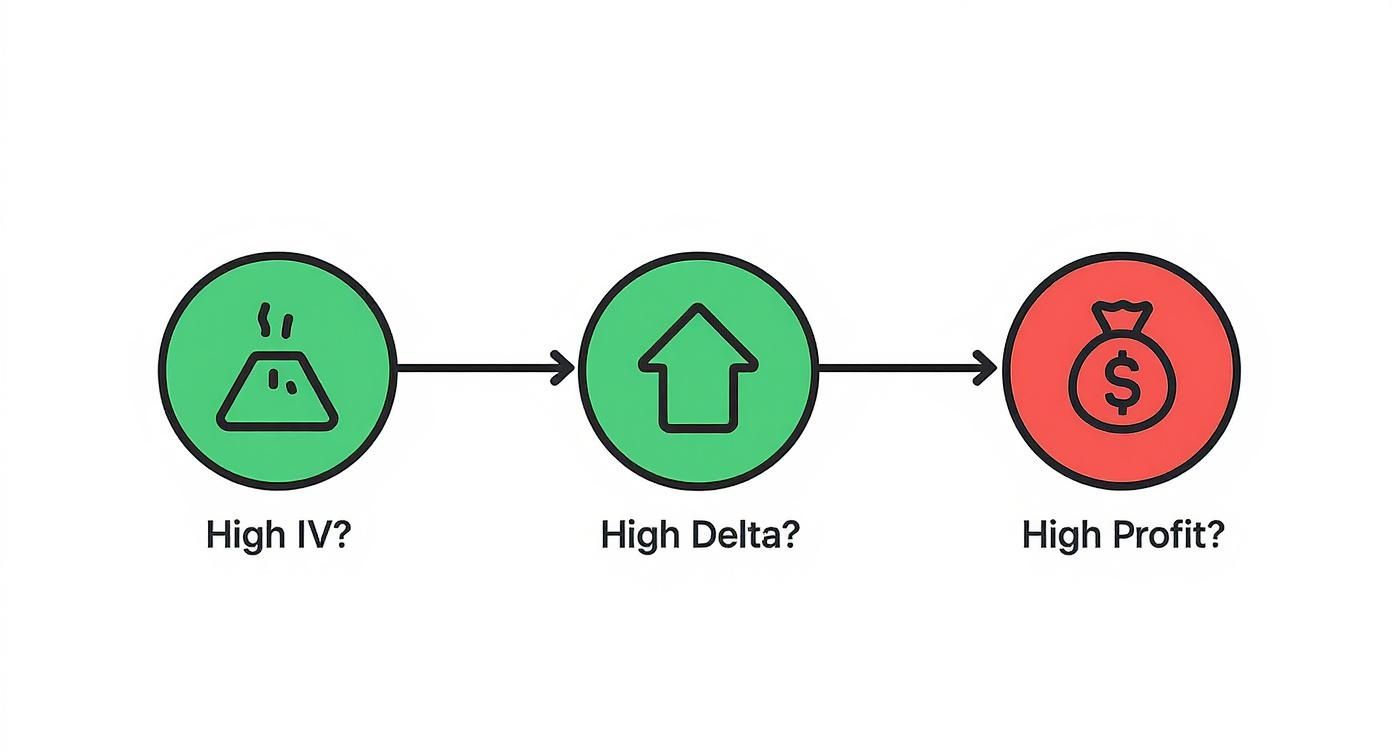
This workflow shows how factors like high implied volatility can create opportunities with more premium, which is often a great time to sell a new position or roll an existing one for a credit.
Managing your open positions is what separates guessing from building a real strategy. Strike Price was built to give you that data-driven edge, with real-time probability metrics and smart alerts that tell you when it’s time to take profits or manage your risk. Turn your options trading into a consistent, repeatable process. Explore Strike Price today and start making more informed decisions.