
Understanding Options Greeks A Guide for Income Investors
If a stock moves past your strike, the option can be assigned — meaning you'll have to sell (in a call) or buy (in a put). Knowing the assignment probability ahead of time is key to managing risk.
Posted by
 John Clarke
Related reading
Out of Money Call Options A Guide to Consistent Income
Learn how to use out of money call options to generate consistent income. This guide covers key strategies, risk management, and real-world examples.
How Options Are Priced A Practical Guide for Investors
Understand how options are priced with this clear guide. Learn about intrinsic value, implied volatility, and pricing models to improve your investing strategy.
Greek Options Explained for Income Traders
Unlock your options trading potential. This guide on greek options explained shows you how to use Delta, Gamma, and Theta to generate consistent income.
Getting into options without understanding the Greeks is like trying to drive a sports car with the dashboard blacked out. Sure, you can hit the gas, but you have no idea how fast you're going, if you're about to run out of fuel, or if a storm is brewing just over the horizon.
The Greeks—Delta, Gamma, Theta, and Vega—are your dashboard. They aren't just confusing Wall Street jargon; they're the gauges that give you real-time feedback on your trade's risk and potential.
Your Guide to the Options Greeks Dashboard
Think of your trading account like that high-performance vehicle. Too many traders jump in blind, hoping for the best. The Greeks change that, turning a guessing game into a strategic drive.
Instead of flying blind, these metrics help you answer the most important questions you should be asking before, during, and after you place a trade:
- How sensitive is my position to the stock price? That’s Delta. It’s your speedometer.
- How fast is that sensitivity changing? That's Gamma. Think of it as your acceleration gauge.
- Is time on my side or against me? That's Theta. It’s your fuel gauge, showing how much value your option loses each day.
- How will market panic or calm affect my trade? That's Vega, your weather sensor for volatility.
Visualizing Your Trading Dashboard
This simple visual breaks down how each Greek acts as a critical gauge on your trading dashboard, making the concepts much more intuitive.
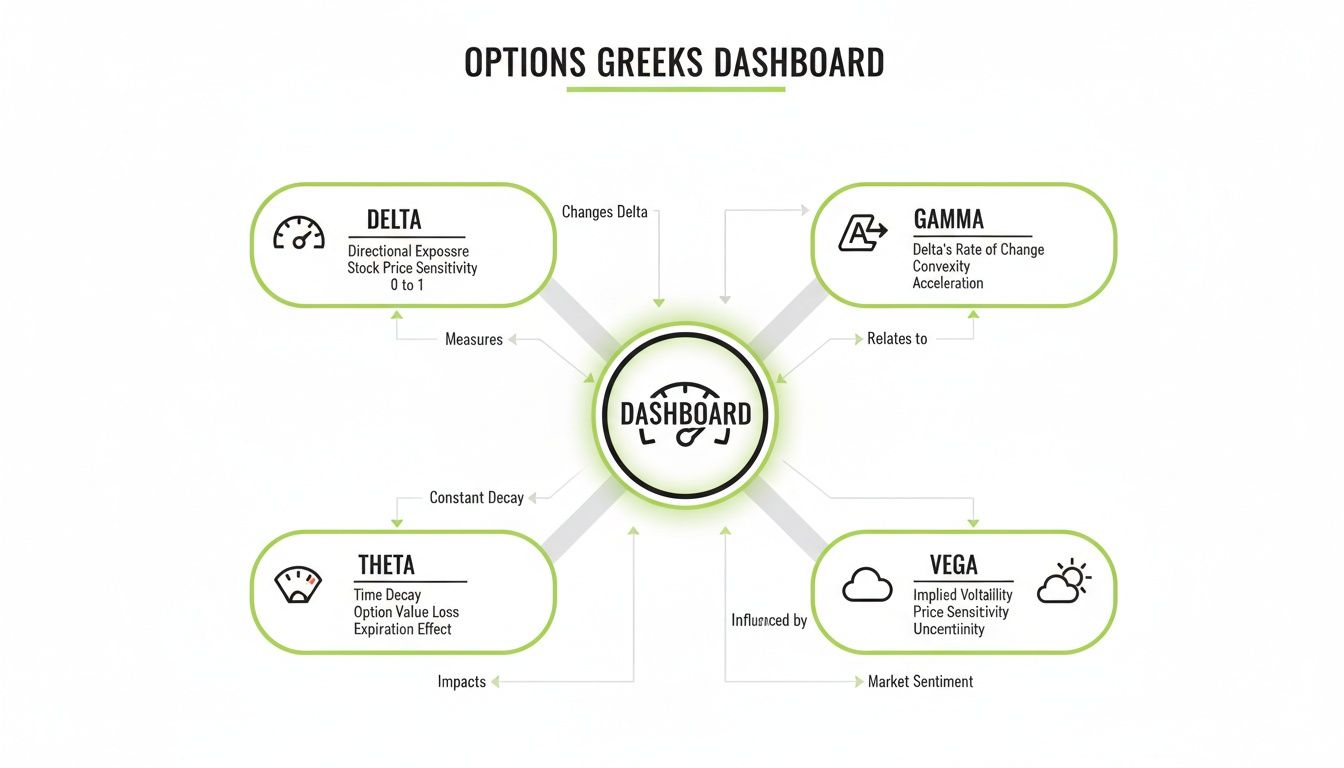
Framing Delta as speed, Gamma as acceleration, Theta as your fuel level, and Vega as the road conditions helps turn abstract numbers into something you can actually feel and act on. This mental model is the first step toward trading with confidence.
The 4 Core Options Greeks at a Glance
To put it all together, here’s a quick summary table that cuts straight to what each of the main Greeks does, along with a simple analogy to help it stick.
| Greek | What It Measures | Simple Analogy | Key Takeaway for Sellers |
|---|---|---|---|
| Delta | Sensitivity to the underlying stock price. | Speedometer | Tells you the approximate chance of your option being assigned. |
| Gamma | The rate of change of Delta. | Acceleration | Shows how quickly your assignment risk can change as the stock moves. |
| Theta | Value lost per day due to time decay. | Fuel Gauge | Your best friend. It's the daily profit you make just from time passing. |
| Vega | Sensitivity to changes in implied volatility. | Weather Sensor | Measures how much "fear" or "calm" in the market can impact your price. |
This table is your quick-reference guide. For income sellers, Theta is your engine, driving daily profits, while Delta and Gamma help you steer clear of trouble.
Why Delta Is Your Most Important Gauge
If you're an income-focused seller running covered calls or secured puts, Delta is your go-to metric. It pulls double duty, not only showing price sensitivity but also acting as a surprisingly accurate proxy for the probability of an option finishing in-the-money.
Historical data from platforms like OptionMetrics confirms this. At-the-money covered calls on major indices, for example, typically have a Delta around 0.50. This means for every $1 the stock moves, the option price changes by about $0.50. More importantly, it signals a roughly 50/50 chance of assignment, giving you a clear, quantifiable way to measure your risk before you even click "sell."
Getting a handle on these numbers is what separates consistent traders from the crowd. Of course, tracking it all can be a pain. If you're looking for a platform to make monitoring these metrics easier, check out our guide to the best options trading software. By learning to read your dashboard, you stop gambling and start managing your positions for steady, repeatable income.
Delta and Gamma: Your Speedometer and Tachometer
Think of yourself behind the wheel of a high-performance car. To drive well, you're constantly glancing at two gauges: the speedometer, which shows your current speed, and the tachometer, which tells you how hard the engine is working to accelerate.
In the world of options, Delta is your speedometer, and Gamma is your tachometer. Mastering these two Greeks is the key to understanding how your option's price will react as the underlying stock moves.
For an income-focused seller, they help you control your speed, manage your acceleration, and ultimately, stay on the road to consistent returns.
Reading Your Speedometer with Delta
Delta is the most straightforward Greek. It tells you exactly how much your option's premium should change for every $1 move in the underlying stock. It's a direct measure of your position's sensitivity to the stock's price.
- Call options have a positive Delta, from 0 to 1.00. A 0.30 Delta means the call's price will likely increase by $0.30 if the stock climbs by $1.
- Put options have a negative Delta, from 0 to -1.00. A -0.25 Delta means the put's price will likely increase by $0.25 if the stock drops by $1.
But for sellers of covered calls and cash-secured puts, Delta has a second, incredibly useful meaning: it's a quick and dirty estimate of the probability that your option will expire in-the-money.
A covered call with a 0.30 Delta has roughly a 30% chance of being assigned at expiration. This simple insight is a game-changer for managing risk, letting you balance the premium you collect against the odds of having to give up your shares.
This is exactly why many income traders look for options with a Delta of 0.30 or less. It’s a sweet spot that often provides a decent premium while keeping the probability of assignment comfortably in your favor.
If you want a deeper dive, our complete guide on delta in option trading breaks it down even further with more examples.
Watching Your Acceleration with Gamma
If Delta is your speed, Gamma is your acceleration. It measures how fast your Delta will change as the stock price moves. Think of it as the sensitivity of your speedometer.
A low Gamma means your Delta is steady and predictable. A high Gamma, on the other hand, means your Delta can shift dramatically with just small moves in the stock, turning a seemingly safe position into a nail-biter overnight.
This risk is most pronounced for at-the-money options that are getting close to their expiration date. As an option gets into its final days, its Gamma can skyrocket. This "Gamma risk" is why a position that felt safe for weeks can suddenly become incredibly volatile in the final week of trading.
How Delta and Gamma Work Together
Let’s see how this plays out in a real scenario. Imagine you sold a covered call with a 0.20 Delta and a Gamma of 0.04.
- Initial Position: Your option has low sensitivity to the stock, with around a 20% chance of assignment. Things feel calm.
- Stock Rises $1: Your new Delta is now roughly 0.24 (the original 0.20 Delta + the 0.04 Gamma). The assignment probability has ticked up to about 24%.
- Stock Rises Another $1: The Delta becomes approximately 0.28 (the 0.24 Delta + the 0.04 Gamma). The risk of assignment is now accelerating.
High Gamma is what causes a sudden stock rally to turn your low-risk covered call into a high-anxiety trade. For income sellers, the goal is to find positions with a solid Delta and a low, manageable Gamma. This keeps your "drive" smooth and predictable, without any sudden, heart-stopping lurches toward assignment.
Theta and Vega: Your Engine and Your Sail
While Delta and Gamma deal with how an option's price reacts to the underlying stock moving, two other forces are always in play. Think of them as the environment your trade is sailing through: Theta, the unstoppable current of time, and Vega, the shifting winds of market fear.
For anyone selling options for income, mastering these two Greeks is non-negotiable. They represent the core trade-off between the steady, predictable income you want and the sudden market squalls you need to avoid.
Learning to harness the reliable decay from Theta while navigating the turbulence of Vega is what separates novice sellers from pros.
Theta: The Melting Ice Cube
Here’s a simple way to think about an option's extrinsic value: picture it as a block of ice. Every single day, a little bit of it melts away, no matter what the stock does.
That melting is Theta, or time decay. And if you're an option seller, it's your absolute best friend.
Theta tells you how much value an option is expected to lose every calendar day. If you see an option with a Theta of -0.05, it’s priced to lose about five cents of its value by tomorrow morning, assuming nothing else changes. For a seller, that five-cent decay is pure profit dripping right into your account.
As an option seller, every tick of the clock is a small win. Theta is the only Greek that offers something close to a guarantee in a world of uncertainty. Time only moves forward, and options always lose value as they get closer to expiration.
This is the entire engine behind income strategies. You’re selling an asset that is designed to depreciate, and you get to collect the premium as it melts. The decay isn't even a straight line—it accelerates like crazy in the last 30-45 days of an option's life. That’s the sweet spot many sellers target. If you want to dive deeper, check out our guide on option time decay.
Vega: Riding the Winds of Volatility
If Theta is the steady current pushing your trade toward profit, Vega is the wind. It can either fill your sails and get you there faster or blow you completely off course.
Vega measures how sensitive an option is to changes in implied volatility (IV). You can think of IV as the market's "fear gauge"—it’s what everyone thinks the stock might do in the future.
When the market gets nervous or a big event is coming up, IV tends to shoot up, making option premiums more expensive. Vega tells you precisely how much your option's price will move for every 1% change in that implied volatility.
Here's how to interpret Vega as an income seller:
- Selling High Vega: When IV is high, you get to sell options for much fatter premiums. It’s like setting your sail in a strong gust of wind. You’ll move faster, but you’re also taking on more risk if that wind suddenly dies or changes direction.
- The Vega Crush: The dream scenario for a seller is to sell an option when IV is high, then watch it "crush" or fall back to normal levels. This drop in IV reduces the option's price, adding to your profit. The danger, however, is if IV keeps climbing after you sell, which can make your short option more expensive even if the stock price doesn't budge.
This is a critical piece of the puzzle: higher Vega means more premium in your pocket upfront, but it also means your position is more sensitive to a sudden wave of market panic.
Theta in Action: A Real-World Edge
The power of Theta isn't just theory; it's a measurable force that drives real-world returns.
Just look at the 2022 bear market. Data from SpiderRock revealed that Theta decay for short-dated options accelerated by a whopping 35% during that period. Sellers who understood this dynamic were able to pocket significantly higher premiums as time decay worked its magic. In fact, it's estimated that nearly 70% of premium income for sellers comes from time decay alone. You can find more historical options greeks data on their website.
This is why a solid grasp of Theta isn't just helpful—it's foundational for building a consistent income strategy.
Putting The Greeks Into Practice With Real Examples
Theory is great, but seeing the Greeks in a real-world context is where it all clicks. Let's move from dashboard analogies to the trading screen and walk through two of the most common income strategies: selling a covered call and selling a cash-secured put.
By looking at the actual Greek values on a sample options chain, you'll see exactly how these numbers can guide your trading decisions. This is how you start balancing risk and reward with real confidence.

These practical applications will turn the abstract data of understanding options greeks into a real, actionable edge.
Example 1: Selling A Covered Call On A Tech Stock
Imagine you own 100 shares of a popular tech company, let's call it "TechCorp" (TC). It's currently trading at $150 per share. You think the stock will probably trade sideways or maybe drift up a little over the next month, so you want to generate some extra income from your shares.
You decide to sell one covered call contract with 35 days left until it expires. Looking at the options chain, you spot a strike price of $160 that offers a premium of $2.50 per share. That’s $250 in your pocket for selling the contract.
Here’s what the Greeks look like for that $160 call option:
- Delta: 0.30
- Gamma: 0.05
- Theta: -0.04
- Vega: 0.12
So, what is this dashboard telling you?
A Delta of 0.30 is your North Star here. It’s a rough proxy for probability, signaling there's about a 30% chance TC will close above $160 at expiration. That means you have an approximate 70% chance of keeping both your shares and the full $250 premium—perfectly in line with your income goal.
The other Greeks add crucial context. The low Gamma (0.05) means your risk profile won't change dramatically with small stock price moves. Your Theta of -0.04 is your reward for waiting; your position is set to gain about $4 per day from time decay alone. Finally, the Vega of 0.12 shows a moderate sensitivity to market fear. A spike in volatility would make your short call more expensive, but it's not overly exposed.
Example 2: Selling A Cash-Secured Put On A Market ETF
Now, let's switch gears. Say you have some cash sitting on the sidelines and wouldn't mind buying 100 shares of a broad market ETF, like SPY, if you could get it at a discount. SPY is currently trading at $450.
You decide to sell a cash-secured put with 40 days to expiration at a $430 strike price. This trade pays you a premium of $4.00 per share, or $400 per contract, right now.
Here are the Greeks for that $430 put option:
- Delta: -0.25
- Gamma: 0.03
- Theta: -0.07
- Vega: 0.18
This set of Greeks tells a different but equally compelling story.
The -0.25 Delta is the key. It implies there's only about a 25% chance of SPY falling below $430 by expiration. More likely, you'll just keep the $400 premium. But if you are assigned, your effective purchase price would be $426 ($430 strike minus the $4.00 premium you collected), which is a nice discount from today's price.
The Theta of -0.07 is even more powerful here, earning you around $7 per day as time ticks by. Meanwhile, the higher Vega of 0.18 means this position is more sensitive to changes in market volatility, which is pretty typical for big ETFs. You collected a richer premium partly because of this higher Vega, but you also need to be aware that a spike in fear could increase the put's value—working against you.
Greeks in Action: Covered Call vs. Secured Put
Let’s lay these two strategies side-by-side to see how the Greeks reflect the seller's goals in each scenario. While the numbers are different, the logic is the same: use the data to structure a trade that fits your outlook.
| Greek | Covered Call Example (30 Delta) | Interpretation for Seller | Secured Put Example (-25 Delta) | Interpretation for Seller |
|---|---|---|---|---|
| Delta | 0.30 | Approx. 30% chance of shares being called away. Favors keeping the shares and premium. | -0.25 | Approx. 25% chance of being assigned to buy shares. Favors keeping the premium. |
| Gamma | 0.05 (Low) | Delta won't change aggressively with small price moves. Risk is relatively stable. | 0.03 (Very Low) | Delta is even more stable. Position is less sensitive to minor stock fluctuations. |
| Theta | -0.04 | Position earns $4/day from time decay. Time is on your side as the seller. | -0.07 | Position earns $7/day. A stronger "tailwind" from time passing. |
| Vega | 0.12 (Moderate) | Moderately sensitive to volatility changes. A rise in IV hurts the position, but not excessively. | 0.18 (Higher) | More sensitive to volatility. A spike in fear (IV) will have a larger negative impact. |
As you can see, the Greeks provide a detailed snapshot of each trade's unique risk-and-reward profile. By interpreting these values, you can structure trades that align perfectly with your specific objectives, whether that's keeping your shares for income or acquiring new ones at a price you like.
Actionable Rules for Managing Trades with the Greeks
Knowing what the Greeks mean is one thing. Actually using them when the market is moving and your money is on the line? That's a different game entirely.
This is where experienced income traders lean on heuristics—simple, battle-tested rules of thumb that cut through the noise. They aren't rigid laws, but they provide the discipline needed to manage risk and make consistent decisions.
By building a trading process around these guidelines, you can turn abstract Greek data into a concrete plan that keeps you on track toward your income goals.
Rule 1: Target a Delta Under 0.30
For anyone selling covered calls and secured puts, this is the golden rule. A 0.30 Delta on a covered call isn't just a number; it translates to an approximate 70% probability of keeping your shares and the full premium you collected. It’s the statistical sweet spot that balances generating real income with a high likelihood of the trade working out without any drama.
The same logic applies to puts. A -0.30 Delta on a cash-secured put signals a similar probability that the option will expire worthless. You just pocket the premium, no strings attached. Sticking to this threshold is a simple, powerful way to stop yourself from chasing juicy premiums on risky, close-to-the-money strikes.
Rule 2: Avoid Selling Options Inside 21 Days to Expiration
Yes, Theta decay kicks into high gear in the last few weeks of an option's life, which sounds great for sellers. But there's a predator lurking in the shadows: Gamma. As expiration gets closer, Gamma risk spikes, meaning your Delta can swing wildly with even small moves in the stock.
A position that felt perfectly safe can become a nail-biter overnight.
The sweet spot for many sellers is the 30-45 days to expiration (DTE) window. You get plenty of Theta decay working in your favor, but Gamma is still low and manageable. It makes for a much smoother ride.
By staying out of that final, high-risk period, you sidestep the chaotic price swings that can vaporize your profits in a heartbeat.
Rule 3: Sell Puts When Vega Is High
Vega is your gauge for an option's sensitivity to implied volatility (IV)—think of it as the "fear index" for a specific stock. When the market is panicking, IV shoots up, and option premiums get seriously inflated. For an option seller, this is primetime.
It's the absolute best time to sell puts on quality companies you'd be happy to own anyway.
A high Vega means you're getting paid far more for taking on the exact same amount of risk. You collect a fat premium right out of the gate. Then, if that fear subsides and IV comes back down to earth (a "Vega crush"), the option's price drops even further, padding your profits.
You're essentially selling insurance when everyone thinks the sky is falling. To refine your strategies and develop more precise actionable rules for managing trades, exploring how to start leveraging AI for deeper market insights can provide a significant analytical edge.
Common Questions About Using Options Greeks
As you start putting the Greeks to work, you're going to have questions. It's one thing to understand the theory, but it's another thing entirely to apply it with real money on the line.
Let's walk through some of the most common questions that pop up for income-focused options sellers. Getting these answers straight will give you the confidence to manage your trades like a pro.
How Often Should I Check My Greeks?
You definitely don't need to be glued to your screen all day. A quick daily check-in is a great habit to build. Think of it as a morning coffee routine for your portfolio—a simple way to make sure your trades are still on track and haven't drifted into a risk zone you're not comfortable with.
But here’s a much smarter approach: let technology do the watching for you. Setting up alerts for big swings in your key Greeks, especially Delta, is way more effective. This becomes absolutely critical as you get closer to expiration and Gamma risk starts to ramp up.
For instance, you could set an alert to ping you if the Delta on your covered call ever creeps above 0.40. This way, you only need to step in when it's actually necessary. It frees you from the stress of constant monitoring but ensures you never miss a moment that requires your attention.
Which Greek Is Most Important For Selling Options?
All the Greeks are connected, but for income sellers, it really boils down to two: Delta and Theta. Think of them as the foundation of your entire strategy.
- Delta is your navigator. It tells you about risk and probability, giving you a quick read on your odds of assignment. It's how you structure trades that match your goal of keeping the premium.
- Theta is your engine. This is the predictable, steady decay of an option's value over time—it's the very reason selling options for income works in the first place.
Gamma and Vega are still important for managing the unexpected, but Delta and Theta are what drive the bus for an income strategy. Get a solid handle on these two, and you’re well on your way.
Can The Greeks Predict A Trade's Success?
Let's be really clear about this: the Greeks are risk management tools, not a crystal ball. They give you a sophisticated, numbers-based snapshot of probabilities and sensitivities, but they can't predict the future or make market risk disappear.
Understanding options Greeks isn't about guaranteeing a win on any single trade. It's about putting the odds in your favor over the long run, making smarter decisions, and managing risk with precision.
Think of the Greeks as a weather forecast for your portfolio. The forecast might call for a 70% chance of sunshine (like a 0.30 Delta trade expiring worthless), but it can't promise you it won't rain. By consistently using the Greeks to inform your trades, you stack the odds in your favor and build a much more disciplined, resilient process.
Ready to stop guessing and start using real data to guide your options selling strategy? Strike Price provides real-time probability metrics and smart alerts that turn the complex data of the Greeks into simple, actionable insights. See how thousands of traders are generating consistent income. Learn more and start your trial today at Strike Price.